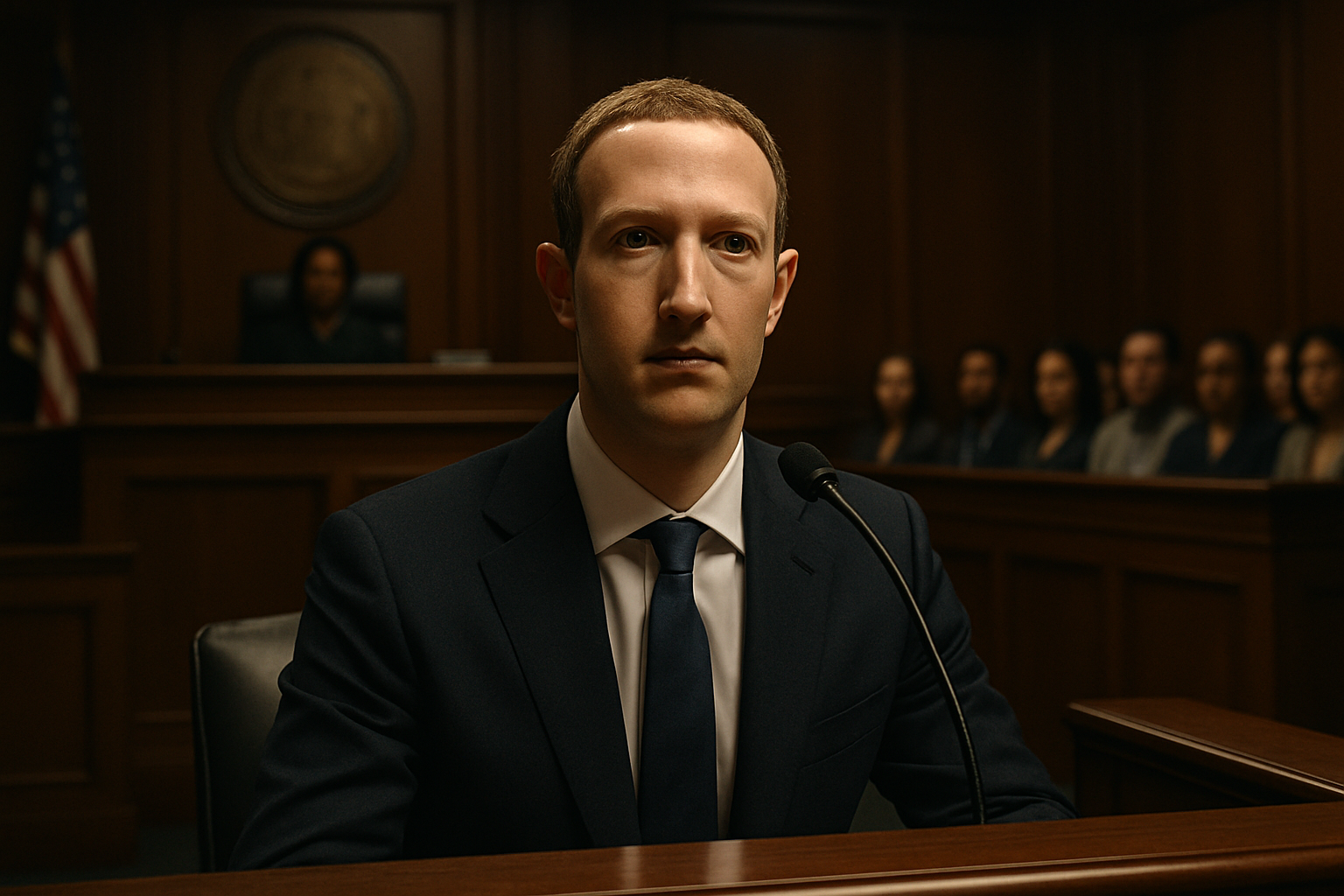
Meta CEO Mark Zuckerberg faced his most challenging legal confrontation yet as he testified Wednesday in a Los Angeles courtroom about Instagram's impact on youth mental health, marking the first time the tech billionaire has appeared in a US court to defend against social media addiction allegations.
The landmark trial centers on a 20-year-old California woman who alleges that early Instagram use created addiction patterns that exacerbated her depression and suicidal thoughts during her teenage years. The case represents a critical test of whether social media companies can be held legally responsible for designing platforms that allegedly harm vulnerable young users.
Confronting Internal Evidence
Plaintiff attorney Mark Lanier confronted Zuckerberg with damaging internal Meta documents from 2014-2015 that explicitly outlined company goals to increase user engagement time by double-digit percentages. The emails appeared to contradict Zuckerberg's 2024 congressional testimony where he stated Meta didn't design platforms to maximize screen time.
"If you are trying to say my testimony was not accurate, I strongly disagree with that."
— Mark Zuckerberg, Meta CEO
Zuckerberg defended his previous statements, claiming the company had since changed its approach to prioritize user wellbeing over engagement metrics. However, the internal documents revealed a corporate strategy focused on increasing "time spent" through features like infinite scroll, autoplay videos, and personalized notifications designed to create habitual usage patterns.
Under-13 User Contradiction
The testimony grew more contentious when Lanier pressed Zuckerberg on his repeated statements to Congress that users under 13 are not allowed on Meta platforms. Internal company documents suggested children under 13 were actually considered a key demographic for growth strategies, despite official age restrictions.
This contradiction became particularly significant given recent research showing 96% of children aged 10-15 use social media, with 70% experiencing harmful content exposure and over 50% encountering cyberbullying. The statistics have fueled a global regulatory wave targeting platform design features.
Global Regulatory Context
Zuckerberg's testimony occurs amid the most significant social media regulation wave in internet history. Australia's under-16 ban has already eliminated 4.7 million teen accounts since December 2025, proving that age restrictions are technically feasible when governments commit to enforcement.
In Europe, Spain is implementing the world's first criminal executive liability framework that could result in imprisonment for tech executives who violate child safety laws. The coordinated approach across Greece, France, Denmark, Austria, and other European nations is designed to prevent platforms from relocating to avoid oversight.
Scientific Evidence Mounts
The trial is supported by mounting scientific evidence about social media's impact on developing minds. Dr. Ran Barzilay of the University of Pennsylvania has demonstrated that early smartphone exposure before age 5 causes sleep disorders, cognitive decline, and weight problems that persist into adulthood.
Recent research from the University of Macau proved that short-form video scrolling negatively impacts children's cognitive development, causing social anxiety and academic disengagement. Large-scale US studies reveal that children spending four or more hours daily on screens face a 61% increased depression risk.
Industry Defense Strategy
Meta and other platforms are mounting a sophisticated defense strategy. Instagram CEO Adam Mosseri previously testified that users cannot be "clinically addicted" to social platforms, distinguishing between medical addiction and what he termed "problematic use."
The companies argue that features like infinite scroll, autoplay, and algorithmic curation represent standard industry practices that enhance user experience rather than create harmful dependencies. They maintain that correlation between social media use and mental health issues doesn't prove causation.
Economic Stakes and Industry Resistance
The trial's outcome could reshape the entire social media industry. Meta and Google's YouTube remain the sole defendants after TikTok and Snap reached settlements. A verdict against the remaining platforms could establish crucial legal precedents for approximately 1,600 other pending cases from families and school districts.
Industry resistance has escalated dramatically. Elon Musk has characterized European regulatory measures as "fascist totalitarian," while Telegram's Pavel Durov has warned of "surveillance state" implications. The "SaaSpocalypse" of February 2026 eliminated hundreds of billions in tech market capitalization amid regulatory uncertainty.
Implementation Challenges
Real age verification presents significant technical and privacy challenges. Effective systems require biometric authentication or identity document validation, raising concerns about creating comprehensive government databases that could enable broader surveillance beyond child protection.
The global semiconductor shortage, with memory chip prices surging sixfold, is constraining the infrastructure needed for age verification systems until new fabrication facilities come online in 2027. Cross-border enforcement requires unprecedented international cooperation that is still in its early stages.
Alternative Approaches
Not all countries are pursuing regulatory enforcement. Malaysia emphasizes parental responsibility through digital safety campaigns, with officials arguing that parents must control device access rather than using technology as "babysitters." Oman has implemented "Smart tech, safe choices" education focusing on conscious digital awareness.
This represents a fundamental philosophical divide in digital governance: European regulatory enforcement versus Asian education and awareness strategies, reflecting different views on government intervention versus individual agency in digital spaces.
Trial Significance
The proceedings are expected to continue for several weeks, with additional Meta executives, researchers, and technical experts scheduled to testify. The trial represents a critical test of whether democratic institutions can effectively regulate multinational technology platforms while balancing child protection, digital rights, and economic competitiveness.
Success could trigger a worldwide wave of similar litigation and strengthen arguments for criminal liability frameworks. A Meta victory could reinforce industry positions against regulation and demonstrate the difficulty of proving platform design directly causes user harm.
Looking Ahead
The February 2026 trial represents a potential inflection point in the relationship between technology companies and democratic governments. The outcome will establish precedents affecting millions of children globally and determine whether the internet's next phase will be shaped by corporate self-regulation or government oversight with meaningful legal consequences.
As Zuckerberg concluded his testimony, the fundamental question remains: Can platforms designed to maximize engagement coexist with the healthy development of young minds? The answer may reshape how an entire generation experiences the digital world.