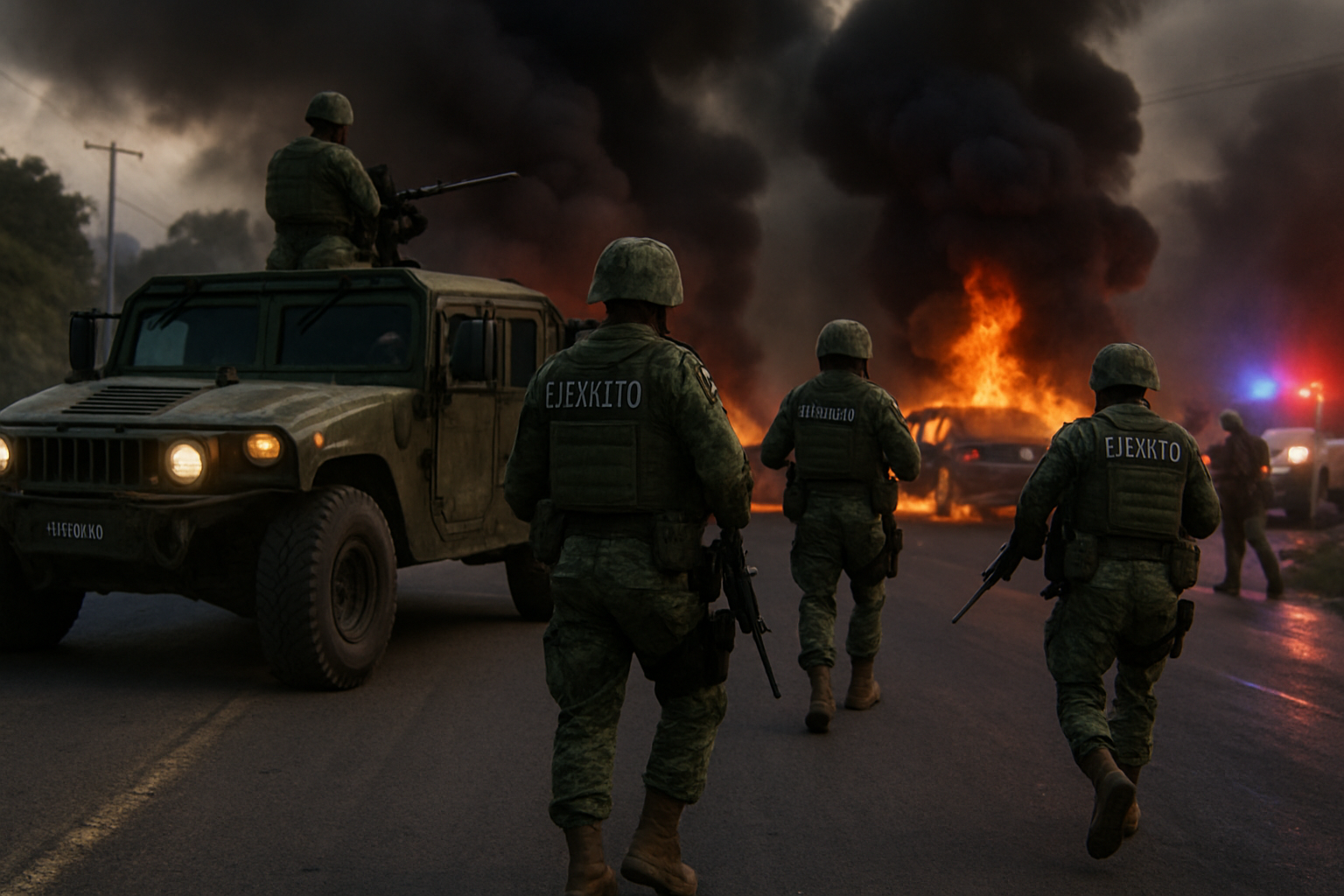
Mexican military forces killed Nemesio Oseguera Cervantes, the world's most wanted drug lord known as "El Mencho," during a high-stakes operation in Jalisco state, sparking an immediate and coordinated wave of cartel violence across the country that has left dozens dead and prompted international travel advisories.
The 59-year-old leader of the Jalisco New Generation Cartel (CJNG) died from gunshot wounds sustained during a fierce firefight with special forces in Tapalpa, Jalisco on Sunday morning. He succumbed to his injuries while being airlifted to Mexico City for medical treatment, according to Mexico's Ministry of Defense.
Unprecedented Cartel Retaliation
Within hours of the announcement, CJNG members launched a sophisticated revenge campaign across 20 Mexican states, demonstrating the organization's reach and operational capacity beyond its western stronghold. The coordinated response included systematic vehicle burning, highway blockades, attacks on government buildings, and targeting of civilian infrastructure.
The death toll from the retaliatory violence has reached at least 24 people, including 17 security personnel and a pregnant civilian woman. In Jalisco alone, cartel members burned 18 Banco del Bienestar branches, set fire to public buses and private vehicles in Guadalajara, and torched a Costco store in Puerto Vallarta.
"This represents the most significant blow to organized crime in Mexico in recent years, but the immediate aftermath shows the sophisticated nature of these criminal organizations."
— Security analyst speaking on condition of anonymity
International Intelligence Cooperation
The operation that led to El Mencho's death was the result of extensive cooperation between Mexican and U.S. intelligence agencies. A newly formed Joint Interagency Task Force-Counter Cartel, led by the U.S. Army and involving multiple American government agencies, provided crucial intelligence and targeting information to Mexican forces.
White House Press Secretary Karoline Leavitt confirmed that U.S. intelligence provided "crucial support" in identifying El Mencho as a priority target due to his central role in fentanyl trafficking. The Drug Enforcement Administration had placed a $15 million bounty on his head, reflecting his status as Mexico's most wanted criminal.
President Donald Trump praised the Mexican military's action, describing it as a victory against "narcoterrorism" and highlighting successful bilateral cooperation under his administration's pressure on Mexico to combat drug trafficking organizations.
Global Impact and Travel Warnings
The violence has had immediate international repercussions, with multiple countries issuing emergency travel advisories for Mexico. The U.S. State Department issued an immediate "shelter in place" advisory for Americans in affected areas, while Canada, Australia, Sweden, and other nations warned their citizens against non-essential travel to Mexico.
The aviation industry has been severely disrupted, with Air Canada, United Airlines, and Aeromexico canceling flights to Puerto Vallarta and Guadalajara. Tourist areas in these normally bustling destinations have become ghost towns as hotels implement lockdown protocols and businesses shutter operations.
The timing is particularly concerning as Mexico prepares to co-host the 2026 FIFA World Cup, with Guadalajara serving as one of the key host cities. Four soccer matches were postponed on Sunday due to the violence, raising questions about security preparations for the international tournament.
Who Was 'El Mencho'
Nemesio Oseguera Cervantes rose from humble beginnings in rural Michoacán to become the leader of Mexico's most powerful and feared criminal organization. Born in 1966 in Aguililla, he entered drug trafficking from an early age and was even imprisoned in the United States for drug dealing before returning to Mexico to build his empire.
Under his leadership since 2011, the CJNG evolved from the remnants of the Milenio Cartel into a sophisticated criminal enterprise that demonstrated military-grade capabilities. The organization gained notoriety in 2015 when it used rocket-propelled grenades to down a Mexican military helicopter, showcasing unprecedented firepower and tactical sophistication.
El Mencho's organization controlled vast territories in western Mexico and established itself as the primary supplier of fentanyl to U.S. markets, making him a priority target for both Mexican and American law enforcement. His business model combined extreme violence with strategic intelligence, allowing the CJNG to challenge even the historic Sinaloa Cartel for supremacy in Mexico's drug trade.
Government Emergency Response
President Claudia Sheinbaum praised the security forces while calling for calm, emphasizing "full coordination" with state governments to manage the crisis. Jalisco Governor Pablo Lemus declared a "red code" emergency—the highest security alert level—and deployed additional National Guard units throughout the state.
Schools remained closed across eight states on Monday as authorities assessed security conditions, and courts were authorized to suspend operations for safety reasons. The government has mobilized thousands of additional security personnel to respond to the crisis while maintaining that the operation represents a significant achievement in the fight against organized crime.
Succession Battle Looms
Security analysts warn that El Mencho's death may trigger a violent succession battle within the CJNG and potentially lead to the organization's fragmentation into smaller, more violent factions. Multiple potential successors exist, including his son Rubén "El Menchito" Oseguera, who is currently imprisoned in the United States.
The immediate coordinated response to the leader's death demonstrates that the organization possessed robust command structures and contingency planning that survived the elimination of its founder. This sophisticated planning capability suggests the violence may continue as different factions compete for control of the lucrative criminal enterprise.
"The CJNG's ability to launch such a coordinated nationwide response shows this isn't just a criminal organization—it's a parallel state with military-grade capabilities."
— Mexico security expert
Economic and Tourism Implications
The violence has immediate economic implications beyond the direct security costs. Mexico's tourism industry, a crucial economic sector, faces potential long-term damage as international perception of safety deteriorates. The mining sector has already been affected by cartel violence, with Canadian workers killed in Sinaloa state earlier this year highlighting the risks to foreign investment.
Business operations have been disrupted across affected regions, with major retailers closing stores and transportation networks suspending services. The peso has shown volatility as markets react to the uncertainty surrounding Mexico's security situation.
Regional Security Challenges
The crisis extends beyond Mexico's borders, with neighboring countries monitoring the situation closely. Bolivia's Foreign Ministry activated emergency protocols to protect Bolivian nationals in Mexico, particularly in affected states like Jalisco and Michoacán.
The CJNG's international reach, with operations documented across Latin America and connections to Asian criminal networks, means the leadership vacuum could affect regional security dynamics throughout the hemisphere.
Long-term Implications
The death of El Mencho represents the most significant cartel leadership elimination since the capture of Joaquín "El Chapo" Guzmán in 2016. However, the immediate violent response demonstrates how criminal organizations have evolved beyond traditional law enforcement capacity, requiring new approaches that address their state-like capabilities.
The operation's success in eliminating a high-value target, achieved through enhanced U.S.-Mexico cooperation, may serve as a template for future counter-narcotics strategies. However, the coordinated retaliation shows that tactical victories against criminal organizations must be accompanied by strategies to minimize civilian impact and prevent organizational adaptation.
As Mexico continues to grapple with the immediate crisis, the international community watches closely to see whether this represents a turning point in the fight against organized crime or simply another chapter in the ongoing evolution of criminal enterprises that have proven remarkably resilient to traditional enforcement approaches.
The coming weeks will be crucial in determining whether Mexican authorities can capitalize on this tactical success while managing the immediate security crisis and preventing the CJNG's fragmentation from creating an even more volatile security environment across the region.