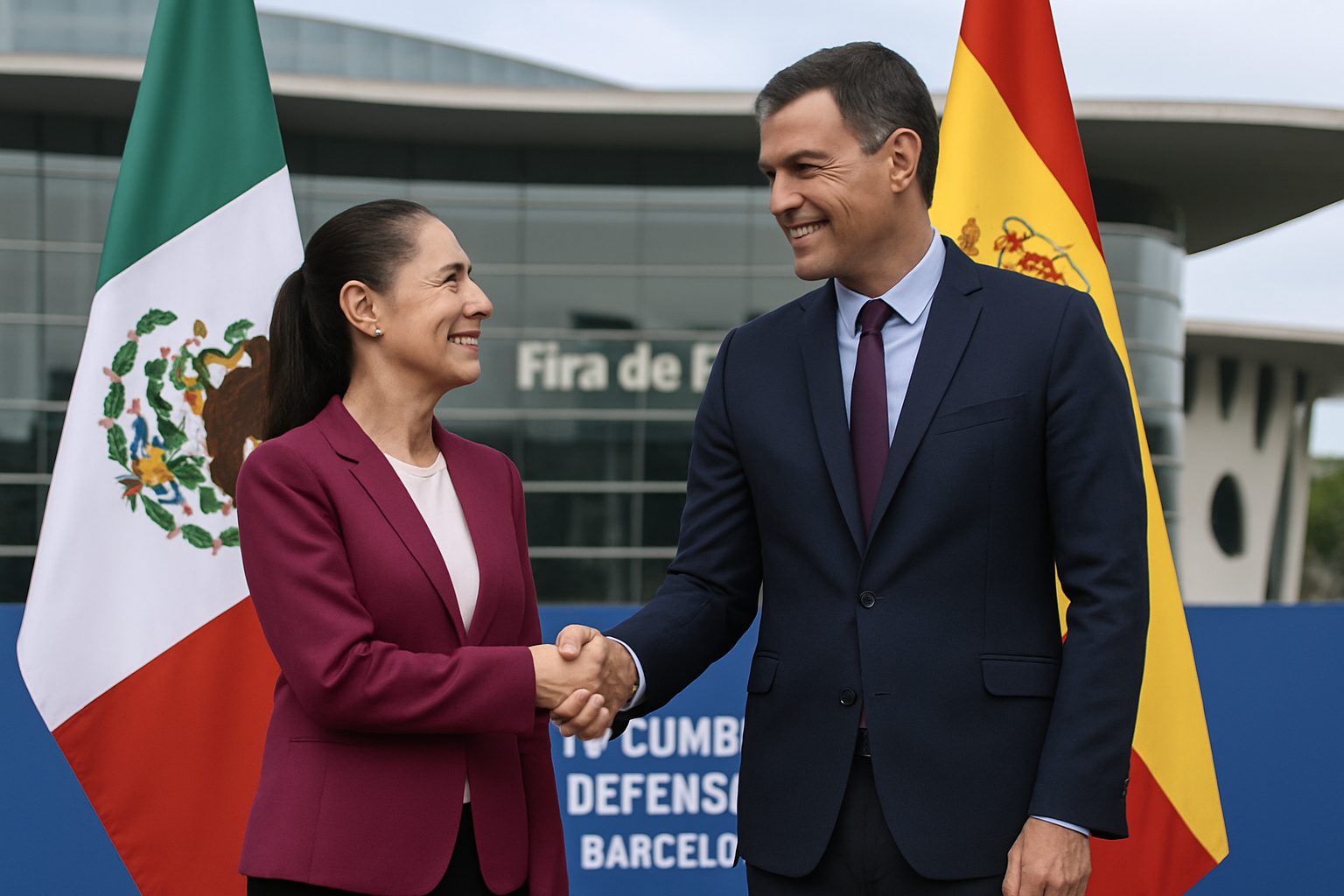
Mexican President Claudia Sheinbaum officially declared there was never a diplomatic crisis between Mexico and Spain during her first European visit as president, effectively normalizing relations between the two nations at the IV Summit in Defense of Democracy in Barcelona.
Speaking to media outside the Fira de Barcelona before joining the progressive leaders summit, Sheinbaum emphatically stated "No hay crisis diplomática. Nunca la ha habido" (There is no diplomatic crisis. There never has been), putting to rest years of tension that had characterized Mexico-Spain relations under her predecessor.
Barcelona Summit Provides Diplomatic Stage
The IV Summit in Defense of Democracy, co-chaired by Spanish Prime Minister Pedro Sánchez and Brazilian President Lula da Silva, brought together more than a dozen progressive leaders responding to the global rise of far-right movements. Sheinbaum's participation marked her first major international engagement in Europe since taking office, providing an ideal diplomatic platform to reset relations with Madrid.
The Mexican president highlighted the importance of the summit's democratic defense mission, offering Mexico as a potential host for future meetings. This gesture of cooperation represents a dramatic shift from the confrontational approach that characterized previous administrations' relations with Spain.
Historical Context of Tensions
Relations between Mexico and Spain had been strained since 2019 when former President Andrés Manuel López Obrador sent a letter to Spanish King Felipe VI demanding an apology for colonial-era abuses during Spain's conquest of the Americas. The Spanish government rejected the request, leading to a diplomatic rift that saw Spain boycott López Obrador's 2018 inauguration.
The breakthrough came in March 2026 when King Felipe VI made an unprecedented acknowledgment of colonial-era abuses, stating there were "many abuses" and "ethical controversies" during Spanish colonization. This royal concession, welcomed by Sheinbaum as a "gesture of rapprochement," marked the beginning of improved bilateral relations.
"This represents a notable departure from several years ago when there were different approaches to historical reconciliation."
— Claudia Sheinbaum, President of Mexico
Progressive Alliance Building
The Barcelona summit itself represents a strategic shift for progressive movements globally. Prime Minister Sánchez announced that "the response cannot be only defensive, not enough to resist, we have to propose, we have to lead," signaling a move from reactive anti-populism to proactive governance initiatives.
Key attendees included Colombian President Gustavo Petro, who is ending his presidency in August 2026, and South African President Cyril Ramaphosa. The leaders focused on wealth taxes targeting the ultra-rich as an inequality reduction tool, reflecting a progressive consensus that extreme wealth concentration threatens democratic governance.
Cuba Policy Divergence Addressed
During the summit discussions, Sheinbaum also addressed her administration's approach to regional issues, including a proposal for a "declaration against military intervention in Cuba" and emphasizing that "dialogue and peace should prevail." This represents Mexico's traditional pacifist stance in regional conflicts while maintaining diplomatic independence.
The Mexican president's comments came amid broader discussions about Latin American unity and the region's relationship with global powers, demonstrating Mexico's role as a bridge-builder in hemispheric relations.
Spain's Regional Strategy
For Spain, Sheinbaum's declaration provides diplomatic validation during a period of significant international challenges. The Spanish government has faced criticism over its positions on various international conflicts while simultaneously trying to maintain productive relationships with Latin American partners.
Prime Minister Sánchez's emphasis on UN reform and female organizational leadership, alongside calls for "true multilateralism," aligns with Mexico's own diplomatic priorities, creating common ground for enhanced cooperation.
Future Cooperation Framework
The normalization of Mexico-Spain relations opens opportunities for expanded cooperation in multiple areas, including trade, cultural exchanges, and multilateral diplomacy. Both countries have emphasized their commitment to democratic values and international law, providing a foundation for strengthened partnership.
Economic cooperation could prove particularly beneficial, with Spain positioned to serve as Mexico's gateway to European markets while Mexico offers Spanish companies expanded access to North American trade networks through the USMCA agreement.
Looking Ahead
Sheinbaum's pragmatic approach contrasts sharply with her predecessor's confrontational stance, suggesting Mexico is prepared for substantially improved relations with Spain. The president noted that while "more work needs to be done," the foundation for continued dialogue and cooperation has been established.
The Barcelona Declaration emerging from the summit commits participating nations to regular coordination meetings and shared policy development, particularly on wealth taxation and democratic institutional reforms. This framework provides ongoing opportunities for Mexico-Spain collaboration within broader progressive governance initiatives.
As both countries face domestic and international challenges, the restoration of productive bilateral relations provides a valuable diplomatic asset. The symbolic importance of addressing historical grievances while building future partnerships demonstrates how effective diplomacy can overcome even deep-seated tensions when there is political will for reconciliation.