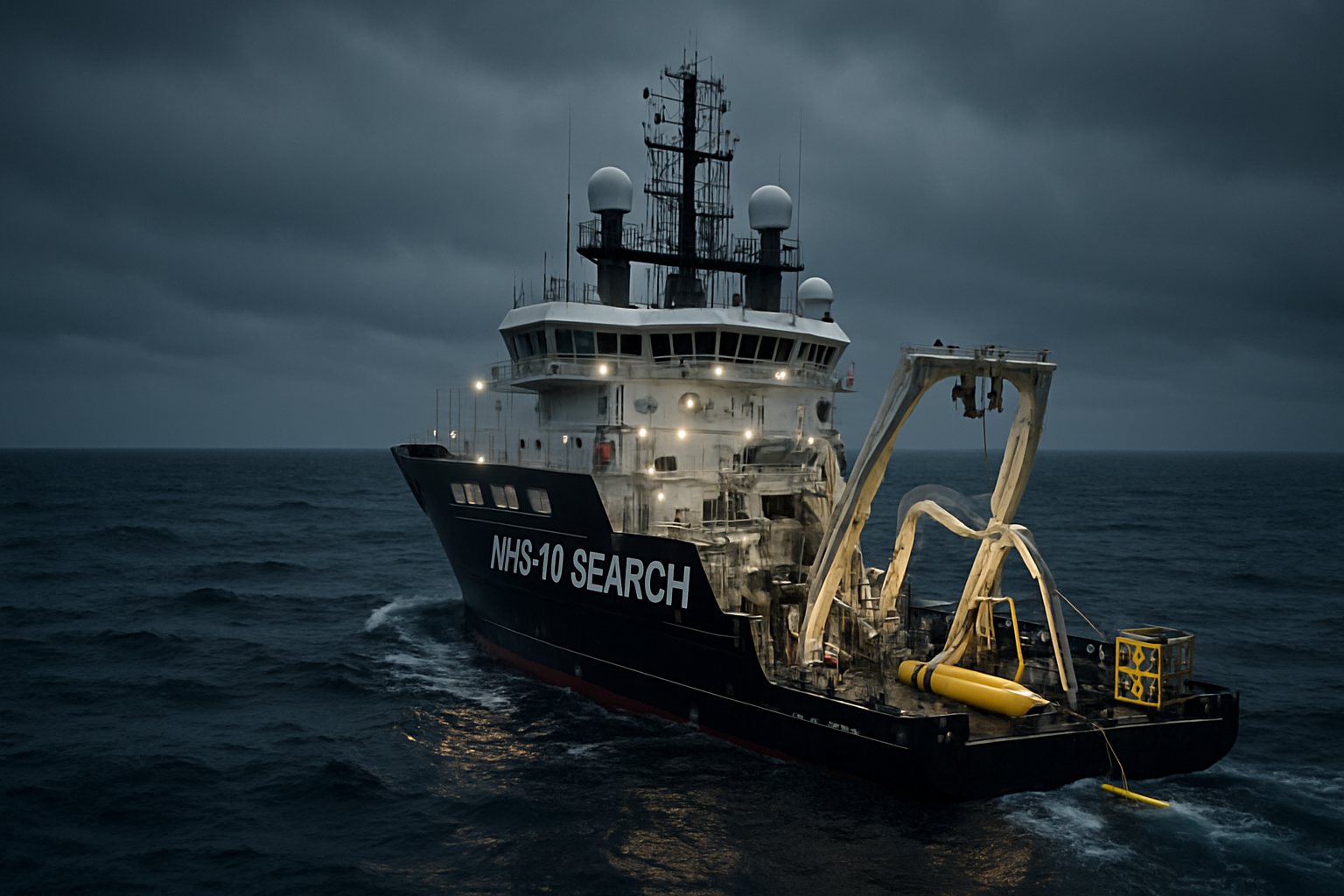
Twelve years after Malaysia Airlines flight MH370 vanished without a trace, the families of 239 souls aboard the Boeing 777 continue their relentless pursuit of answers, urging the Malaysian government to extend its contract with deep-sea exploration firm Ocean Infinity as the latest search phase concludes without breakthrough.
The aircraft carrying 227 passengers and 12 crew members disappeared en route from Kuala Lumpur to Beijing on March 8, 2014, spawning one of aviation's most enduring mysteries. Despite multiple international search operations spanning vast areas of the Indian Ocean, the primary wreckage remains elusive, leaving families in agonizing uncertainty.
Latest Search Operations End Without Results
Malaysia announced that the newest search operations launched in late December 2025 concluded in January 2026 without yielding any significant discoveries. The operations, conducted by Ocean Infinity under contract with the Malaysian government, represented another chapter in the exhaustive international effort to locate the missing aircraft.
According to reports from multiple sources, the search utilized advanced deep-sea exploration technology to scan previously unexplored areas of the Indian Ocean. However, the complex underwater terrain and vast search area continue to pose formidable challenges to recovery efforts.
On Sunday, March 8, 2026 – marking exactly twelve years since MH370's disappearance – families gathered to commemorate their lost loved ones and renew calls for continued search efforts. The anniversary serves as a stark reminder of the unresolved questions surrounding one of commercial aviation's greatest mysteries.
Families Demand Continuation of Search Efforts
Family members of MH370 passengers and crew have issued urgent appeals to Malaysian authorities to extend Ocean Infinity's exploration contract. The deep-sea search company has developed sophisticated autonomous underwater vehicles and advanced sonar mapping capabilities specifically designed for complex oceanic searches.
The families' advocacy reflects their unwavering determination to secure closure and answers about the fate of their relatives. Their campaign emphasizes the moral imperative to continue the search, regardless of the technical challenges and financial costs involved.
"We cannot abandon hope. These 239 people deserve to be found, and their families deserve answers. The technology exists, and we must use it."
— Family advocacy representative, speaking at the 12th anniversary commemoration
The emotional toll on families has been compounded by years of conflicting theories, incomplete investigations, and the gradual reduction in search intensity as time has passed.
Ocean Infinity's Advanced Technology Approach
Ocean Infinity has emerged as a leading player in deep-sea search operations, utilizing cutting-edge autonomous underwater vehicles (AUVs) capable of mapping vast ocean floor areas with unprecedented precision. The company's technology represents a significant advancement over earlier search methods employed in the initial years following MH370's disappearance.
The firm's approach involves deploying multiple AUVs simultaneously, creating detailed three-dimensional maps of the seafloor while searching for aircraft debris. This methodology has proven successful in other maritime search operations and offers renewed hope for potentially locating MH370's primary wreckage site.
Previous search efforts coordinated by the Australian Transport Safety Bureau covered approximately 120,000 square kilometers of the Indian Ocean between 2014 and 2017, making it one of the largest maritime search operations in history. Ocean Infinity's involvement has brought fresh technological capabilities and renewed systematic approaches to the investigation.
Broader Aviation Safety Implications
The MH370 case continues to influence international aviation safety protocols and tracking requirements. The incident exposed critical gaps in aircraft monitoring systems, particularly over oceanic routes where traditional radar coverage is limited or nonexistent.
Since 2014, the International Civil Aviation Organization (ICAO) has implemented enhanced tracking requirements for commercial aircraft, including mandatory position reporting at 15-minute intervals for flights operating in oceanic airspace. These measures aim to prevent future aircraft from disappearing without trace.
Additionally, the case has prompted improvements in aircraft data recording systems, satellite communication protocols, and international coordination mechanisms for search and rescue operations. The lessons learned from MH370 have fundamentally altered how the aviation industry approaches safety monitoring and emergency response.
Ongoing Investigation Challenges
The investigation into MH370's disappearance remains officially active, though progress has been limited by the absence of the primary wreckage and flight data recorders. Debris pieces recovered from various locations along the Western Indian Ocean coastline have provided some insights into the aircraft's final moments but have not resolved the fundamental questions about what caused the deviation from its planned flight path.
Satellite data analysis suggests the aircraft flew for several hours after losing contact with air traffic control, ultimately ending somewhere in the southern Indian Ocean. However, the precise location and the sequence of events leading to the aircraft's loss remain subjects of intense speculation and investigation.
The Malaysian government has maintained its commitment to transparency while managing the complex international dimensions of the investigation, which involves multiple countries' aviation authorities, satellite data providers, and search organizations.
International Cooperation and Diplomatic Efforts
The MH370 search has demonstrated both the potential for international cooperation in aviation emergencies and the challenges of coordinating complex multinational operations. Countries including Australia, China, France, and the United States have contributed resources, expertise, and technology to the search efforts.
The case has also highlighted the importance of satellite data in modern aviation investigations, with companies like Inmarsat providing crucial communication records that helped narrow the search area. This technological collaboration has established precedents for future aviation emergencies requiring international response.
Diplomatic considerations continue to influence the search operations, as families navigate various national jurisdictions and legal frameworks in their quest for answers. The international nature of the tragedy – involving passengers from 14 different countries – has required sustained multilateral engagement and coordination.
Looking Forward: Technology and Hope
As Ocean Infinity continues to refine its deep-sea search capabilities, the possibility of eventually locating MH370 remains alive. Advances in autonomous underwater vehicle technology, artificial intelligence for data analysis, and ocean mapping techniques provide reasons for cautious optimism.
The company's success in other high-profile maritime searches has demonstrated the effectiveness of modern deep-sea exploration technology. Each technological advancement brings new possibilities for resolving cases that previously seemed impossible to solve.
The families' persistence in advocating for continued search efforts reflects their belief that technological progress will eventually provide the breakthrough needed to locate their loved ones. Their dedication serves as a powerful reminder of the human dimension underlying one of aviation's most complex technical mysteries.
A Legacy of Determination
As the world marks twelve years since MH370's disappearance, the case continues to resonate far beyond aviation circles. The families' unwavering determination to seek answers has inspired improvements in aviation safety, international cooperation protocols, and deep-sea search capabilities.
The ongoing efforts to locate MH370 represent more than a search for physical evidence – they embody the fundamental human need for closure, understanding, and justice. The technological advances spurred by this search have benefited other maritime investigations and will continue to serve future search and rescue operations worldwide.
Whether Ocean Infinity's contract will be extended remains a crucial decision for Malaysian authorities, one that will significantly impact the families' hopes for resolution. The choice reflects broader questions about the obligations of governments, the value of technological capability, and the enduring power of human determination in the face of seemingly insurmountable challenges.