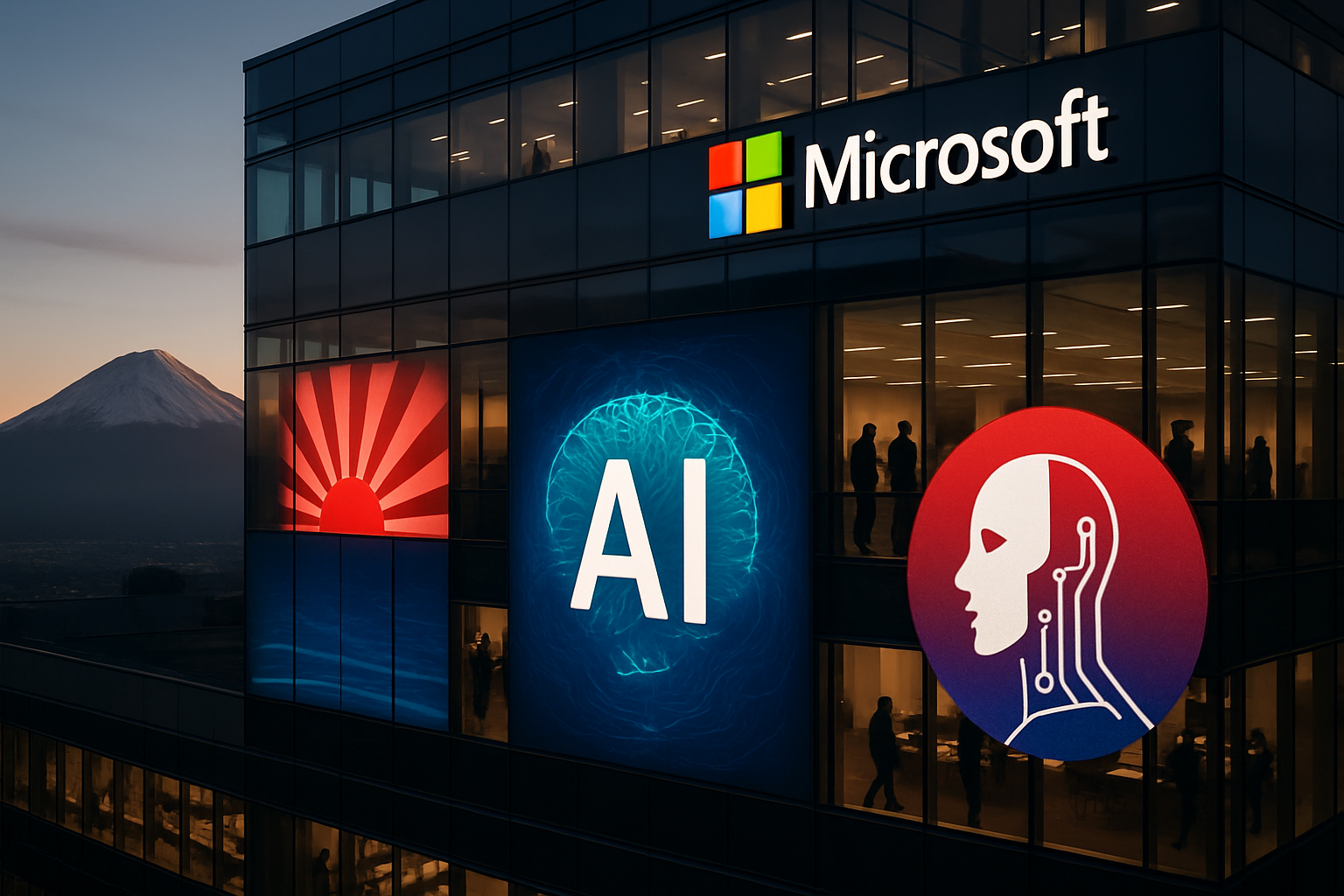
Microsoft Corporation has announced a landmark $10 billion investment plan focused on artificial intelligence and cyber defense expansion in Japan, marking the latest escalation in the global technology race as major American tech giants battle for dominance in one of Asia's most strategically important markets.
The comprehensive investment initiative comes as Japan commits billions in public and private funding to develop a robust artificial intelligence ecosystem designed to help the nation catch up with technological leaders United States and China. Microsoft is now directly competing with Amazon.com and Alphabet's Google for market share in Japan's rapidly expanding AI sector.
Strategic AI Infrastructure Development
According to sources familiar with the announcement, Microsoft's $10 billion commitment will focus on establishing comprehensive AI infrastructure and cyber defense capabilities across Japan. The investment represents one of the largest single technology commitments by an American company in Japan and underscores the strategic importance of the Japanese market in the global AI competition.
The timing is particularly significant as it occurs during what industry experts are calling the "March 2026 Critical Inflection Point" – a watershed moment when artificial intelligence transitions from experimental technology to essential business infrastructure worldwide. Japan's government has simultaneously been investing heavily in AI development through public-private partnerships, creating an attractive environment for foreign technology investment.
"Japan is spending billions to develop an artificial intelligence ecosystem and catch up to the U.S. and China. Microsoft's massive investment demonstrates the country's growing importance as a global AI hub."
— Industry Analysis, The Japan Times
Intensifying Global Competition
The announcement comes amid unprecedented competition among American technology giants for international market share. Microsoft's investment strategy in Japan reflects broader patterns of aggressive global expansion by major AI companies, despite significant infrastructure constraints affecting the entire technology sector.
Amazon and Google have similarly announced substantial commitments to Asian markets, but Microsoft's Japan-specific investment represents a focused approach to capturing market share in one of the world's most technologically sophisticated economies. The competition is particularly intense given Japan's strategic position as a gateway to broader Asian markets and its advanced manufacturing capabilities.
This competitive landscape has been shaped by several key factors documented in recent industry analysis. The global semiconductor crisis has driven memory chip prices sixfold higher, affecting major manufacturers like Samsung, SK Hynix, and Micron. Despite these constraints, technology companies continue making massive infrastructure investments, with Alphabet committing $185 billion to AI infrastructure in 2026 and Amazon planning over $1 trillion in AI development through the decade.
Historical Context and Regulatory Challenges
Microsoft's Japan expansion occurs against a complex regulatory backdrop. In February 2026, Japan's Fair Trade Commission conducted an on-site inspection of Microsoft's Japanese subsidiary over suspected Antimonopoly Act violations, specifically investigating potential restrictions on rival services. This regulatory scrutiny represents significant escalation in international oversight of Microsoft amid its aggressive AI expansion and OpenAI partnership integration.
The investigation was part of broader international regulatory pressure facing Microsoft during its rapid AI deployment. European nations have implemented criminal executive liability frameworks for technology platforms, while the United Nations established an Independent Scientific Panel with 40 experts to provide the first fully independent global AI assessment.
However, the substantial investment announcement suggests Microsoft views Japan as essential to its long-term AI strategy despite regulatory challenges. The company's approach appears focused on building comprehensive local partnerships and infrastructure that can withstand regulatory scrutiny while delivering technological capabilities Japanese businesses demand.
Japan's AI Ecosystem Ambitions
Japan's government has made artificial intelligence development a national priority, viewing AI capabilities as essential for maintaining economic competitiveness and addressing demographic challenges. The country faces unique pressures from an aging population and requires technological solutions to maintain productivity and economic growth.
The Japanese approach emphasizes "AI Plus" as a national priority within the 15th Five-Year Plan, focusing on "safe orderly development" while maintaining competitive advantage. This includes substantial investments in AI-integrated education, with Japan approving 220 textbooks across 11 subjects teaching generative AI aspects, representing systematic national AI literacy curriculum development.
Industry analysis suggests Japan's demographic pressures – including the "4-2-1 problem" where single children must support four aging parents and grandparents – make AI adoption particularly urgent. China faces similar challenges and has responded with massive AI and robotics investments, including scaling humanoid robot production and systematic AI implementation across logistics and manufacturing sectors.
Cyber Defense Integration
Microsoft's investment encompasses both AI development and cyber defense capabilities, reflecting growing recognition that advanced AI systems require sophisticated security infrastructure. The dual focus addresses Japan's national security priorities while building commercial opportunities in both sectors.
The cyber defense component comes as digital infrastructure faces increasing threats globally. Recent incidents have highlighted vulnerabilities in AI systems, including safety breaches documented by government-funded AI Safety Institutes showing fivefold increases in AI misbehavior between October 2025 and March 2026.
Japan's approach to cyber defense integrates with broader Asia-Pacific security cooperation, including partnerships with Australia, India, and the United States. The Microsoft investment could strengthen these relationships by providing advanced technological capabilities supporting regional security cooperation frameworks.
Economic and Industry Impact
The $10 billion investment is expected to create significant employment opportunities across Japan's technology sector while supporting broader economic transformation. Industry analysis suggests that AI infrastructure investments typically generate $3-4 in economic returns per dollar invested over a decade, with multiplier effects across supporting industries.
Microsoft's commitment also signals confidence in Japan's long-term economic prospects despite global technology sector volatility. The "SaaSpocalypse" has eliminated hundreds of billions in traditional software market capitalization as AI systems directly replace conventional solutions, but Microsoft's investment suggests strong growth potential in next-generation AI services.
The announcement occurs during documented employment transformation across the technology sector. While Microsoft executives have predicted majority office worker replacement within two years through AI automation, successful human-AI collaboration models have emerged in various countries, including Canada's AI teaching assistants maintaining critical thinking standards and Singapore's WonderBot 2.0 heritage education success.
Global Technology Infrastructure Transition
Microsoft's Japan investment represents part of a broader global transition toward AI-essential infrastructure. The World Bank projects AI systems will require 4.2-6.6 billion cubic meters of water annually by 2027 for data center cooling, equivalent to 4-6 times Denmark's total consumption, driving renewable energy investments worldwide.
Despite infrastructure constraints, technology companies continue making unprecedented commitments to AI development. The global memory crisis paradoxically drives innovation toward memory-efficient algorithms and sustainable deployment strategies, potentially democratizing AI access through constraint-driven technological advancement.
International cooperation frameworks are evolving to address the challenges of AI governance and development. Spain has implemented the world's first criminal executive liability framework for technology platforms, while France has conducted AI cybercrime raids. The UN's Independent Scientific Panel represents the most sophisticated global technology governance attempt since internet commercialization.
Strategic Implications
Microsoft's $10 billion Japan commitment signals the company's recognition that success in the global AI economy requires substantial regional investments and local partnerships. The approach contrasts with purely centralized development models, suggesting distributed capabilities may be essential for long-term competitive advantage.
The investment also reflects Microsoft's assessment that Japan represents a critical market for AI adoption across multiple sectors, from manufacturing and logistics to healthcare and education. Japan's advanced manufacturing capabilities, sophisticated business culture, and government support for AI development create an attractive environment for comprehensive technology deployment.
Industry experts characterize the current period as a "civilizational choice point" determining whether AI serves human flourishing versus exploitation. Microsoft's approach in Japan, emphasizing both technological advancement and responsible deployment, may provide a template for AI development that balances innovation with social responsibility.
Looking Forward
The success of Microsoft's Japan investment will likely influence how other American technology companies approach international expansion during the AI transition period. The combination of substantial financial commitment, comprehensive infrastructure development, and integration with local partners represents a sophisticated approach to global technology deployment.
As the global AI competition intensifies, Microsoft's Japan strategy demonstrates the importance of long-term regional partnerships in building sustainable competitive advantages. The investment's success could establish precedents for technology cooperation that enhance both commercial competitiveness and international stability during a period of rapid technological change.
The announcement marks a significant milestone in the evolving relationship between American technology companies and Asian markets, suggesting that future AI development will require unprecedented levels of international cooperation and investment to achieve transformative potential while addressing legitimate governance concerns.