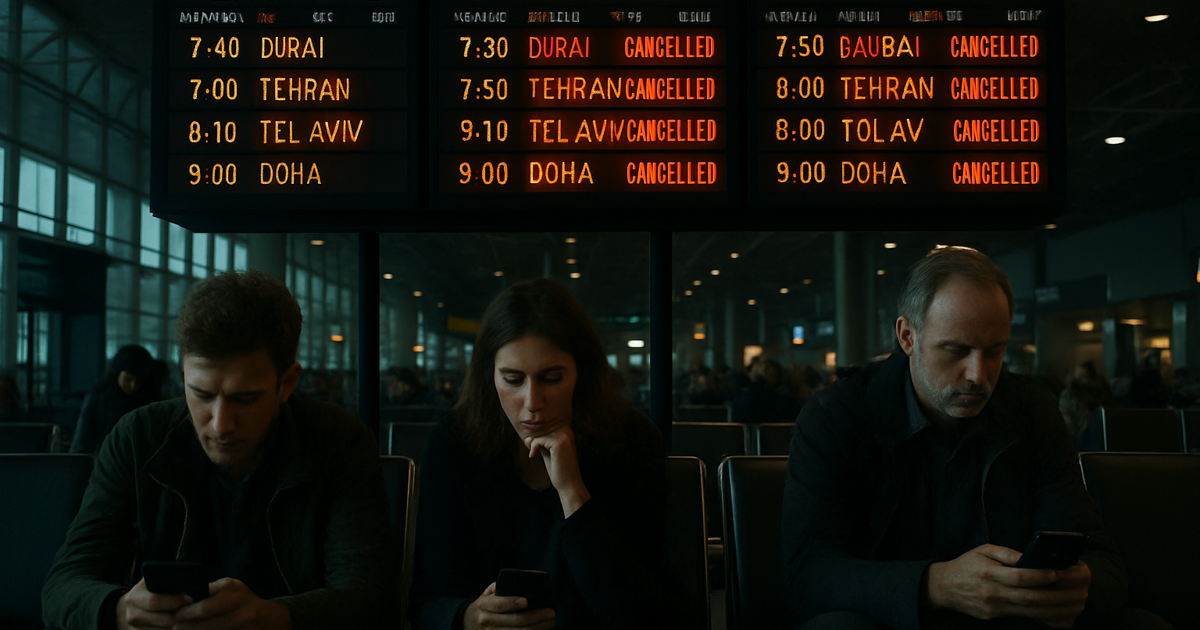
A massive aviation crisis is unfolding across the Middle East as countries slam their airspace shut and airlines cancel thousands of flights following coordinated US-Israeli military strikes on Iran, creating the most significant regional flight disruption since the pandemic.
Multiple countries including Iran, Iraq, Israel, Syria, Kuwait, and the United Arab Emirates announced complete or partial airspace closures on Saturday as smoke began rising over Tehran and Iranian forces launched retaliatory attacks across the Gulf region. Flight tracking data from Flightradar24 showed vast empty airspace over much of the Middle East, with normally busy air corridors completely devoid of civilian traffic.
Unprecedented Scale of Flight Cancellations
Airlines across the globe have suspended operations to key Middle Eastern destinations, with almost 40% of flights to Israel cancelled and 6.7% of flights to the broader region affected by Saturday afternoon. Major carriers including Emirates, Air France-KLM, Wizz Air, and Bulgaria Air have suspended services to Dubai, Tel Aviv, Beirut, and other regional hubs until at least March 2nd.
Pakistan International Airlines (PIA) announced the suspension of all flights to the United Arab Emirates, Bahrain, Doha, and Kuwait, with services expected to remain grounded "until tomorrow evening or until the restoration of airspace, whichever comes later." The airline has shifted flights to Saudi Arabia to Boeing 777 aircraft and implemented longer routing to avoid affected airspace.
Latvian carrier airBaltic cancelled all flights to and from Tel Aviv until March 4th and Dubai services until March 2nd, citing the "uncertainty related to the current situation in Israel." Dutch airlines have similarly cancelled and rerouted Middle East services, while Turkish Airlines suspended flights to Tehran.
Regional Aviation Hubs in Crisis
Dubai International Airport, the world's busiest for international passenger traffic, ceased all operations due to Iranian missile strikes targeting the UAE. The airport's Al Maktoum facility has also suspended flights "until further notice," with passengers advised to contact airlines directly for flight updates rather than travel to the airport.
Saudia, Saudi Arabia's national carrier, confirmed the cancellation of flights to eight destinations including Amman, Kuwait, Dubai, Abu Dhabi, Doha, Bahrain, Moscow, and Peshawar. "These cancellations are effective until March 2 at 23:59 GMT," the airline stated, emphasizing that "the safety of our guests and crew remains our highest priority."
Egypt's Ministry of Civil Aviation announced heightened operational readiness across all airports nationwide, with Minister Sameh El-Hefny maintaining round-the-clock monitoring through the central operations room. Egyptian authorities are coordinating to receive diverted aircraft forced to alter their routes due to regional airspace restrictions.
Military Escalation Triggers Closures
The aviation crisis follows the launch of "Operation Epic Fury," coordinated US-Israeli military strikes against Iranian government facilities and military infrastructure. Israeli Defense Minister Israel Katz announced "preemptive attacks to eliminate threats," while President Trump declared the operations aimed at regime change, urging Iranians to "take control of their country."
Iran's immediate retaliation included launching missiles and drones targeting Israeli and US military installations across the region. The Islamic Revolutionary Guard Corps (IRGC) declared "no red lines remain," with Iranian officials stating that all US and Israeli assets in the region are now "legitimate targets."
"The safety of our guests and crew remains our highest priority. We are monitoring the situation closely and will provide updates as necessary."
— Saudia Airlines Statement
Global Economic Impact
The crisis threatens global energy security, with the Strait of Hormuz—through which 40% of the world's oil transits—now at risk. Oil prices rose immediately following the outbreak of hostilities, while natural gas prices increased 24% in Europe and 78% in the United States amid fears of supply disruption.
The Middle East serves as a critical connecting hub for flights between Europe and Asia, with Russian and Ukrainian airspace already closed due to the ongoing conflict. The aviation industry now faces the challenge of maintaining global connectivity while navigating multiple conflict zones simultaneously.
Widespread Embassy Evacuations
The United States has authorized the departure of non-essential embassy personnel from both Israel and Lebanon, with Ambassador Mike Huckabee advising staff wanting to leave to "do so today." Sweden and Serbia have issued immediate evacuation orders for their citizens in Iran, citing "extremely uncertain" security conditions.
Multiple European governments including the UK, France, Germany, and Poland have issued urgent travel warnings, advising against travel to the region while commercial flights remain available.
Breakdown of Nuclear Diplomacy
The military escalation follows the dramatic collapse of US-Iran nuclear negotiations, despite achieving what negotiators called "broad agreement on guiding principles"—the most significant diplomatic progress since the 2018 collapse of the Joint Comprehensive Plan of Action (JCPOA).
Iran has been enriching uranium to 60% purity, approaching the 90% threshold needed for weapons-grade material. Former IAEA inspector Dr. Yusri Abu Shadi confirmed that Iran possesses over 400 kilograms of enriched uranium, making nuclear weapons capability "easily achievable."
The talks foundered on fundamental disagreements over scope, with Iran excluding ballistic missiles and regional proxy activities as "red lines" while demanding nuclear-only negotiations. The United States insisted on a comprehensive agreement addressing missiles, armed groups, and human rights violations.
International Response
An emergency UN Security Council session has been convened following joint requests from France, China, Russia, Colombia, and Bahrain. UN Secretary-General António Guterres condemned the actions as "undermining international peace and security."
A rare joint statement from France, Germany, and the UK condemned Iranian retaliations while clarifying their non-participation in US-Israeli strikes. The European Union has called an emergency security meeting, with leaders urging all parties to seek a "negotiated solution."
The crisis has severely strained an unprecedented regional coalition of Saudi Arabia, UAE, Qatar, and Egypt that had been backing the diplomatic process. Egypt condemned attacks on "sisterly Arab countries," warning of "comprehensive chaos," while Saudi Arabia called the strikes "blatant and cowardly."
Template-Setting Crisis
The rapid transition from intensive diplomacy to military escalation within days represents a critical test of 21st-century crisis management mechanisms. The breakdown occurs against the backdrop of broader nuclear governance challenges, including the recent expiration of the New START treaty between the US and Russia—the first time in over 50 years without such constraints.
Aviation industry experts describe this as the most comprehensive regional flight disruption since the COVID-19 pandemic, affecting hundreds of thousands of passengers worldwide. The complex rerouting challenges for long-haul services that rely on Middle Eastern stopovers have created operational nightmares for airlines globally.
Uncertain Recovery Timeline
With Iranian officials declaring that "no red lines remain" and suggesting broader retaliatory campaigns are possible, the aviation industry faces an uncertain recovery timeline. Airlines are implementing emergency protocols, alternative routing strategies, and enhanced fuel planning while being forced to navigate an increasingly unstable geopolitical landscape.
The crisis demonstrates the aviation industry's vulnerability to regional conflicts, particularly in strategically important areas like the Middle East that serve as crucial transportation hubs. As military operations continue and diplomatic channels remain severed, the global aviation network must adapt to one of the most challenging operational environments in decades.
The coming days will be critical in determining whether the conflict can be contained or if it will expand into a broader regional war that could reshape Middle Eastern geopolitics for decades to come, with profound implications for global transportation, energy security, and international stability.