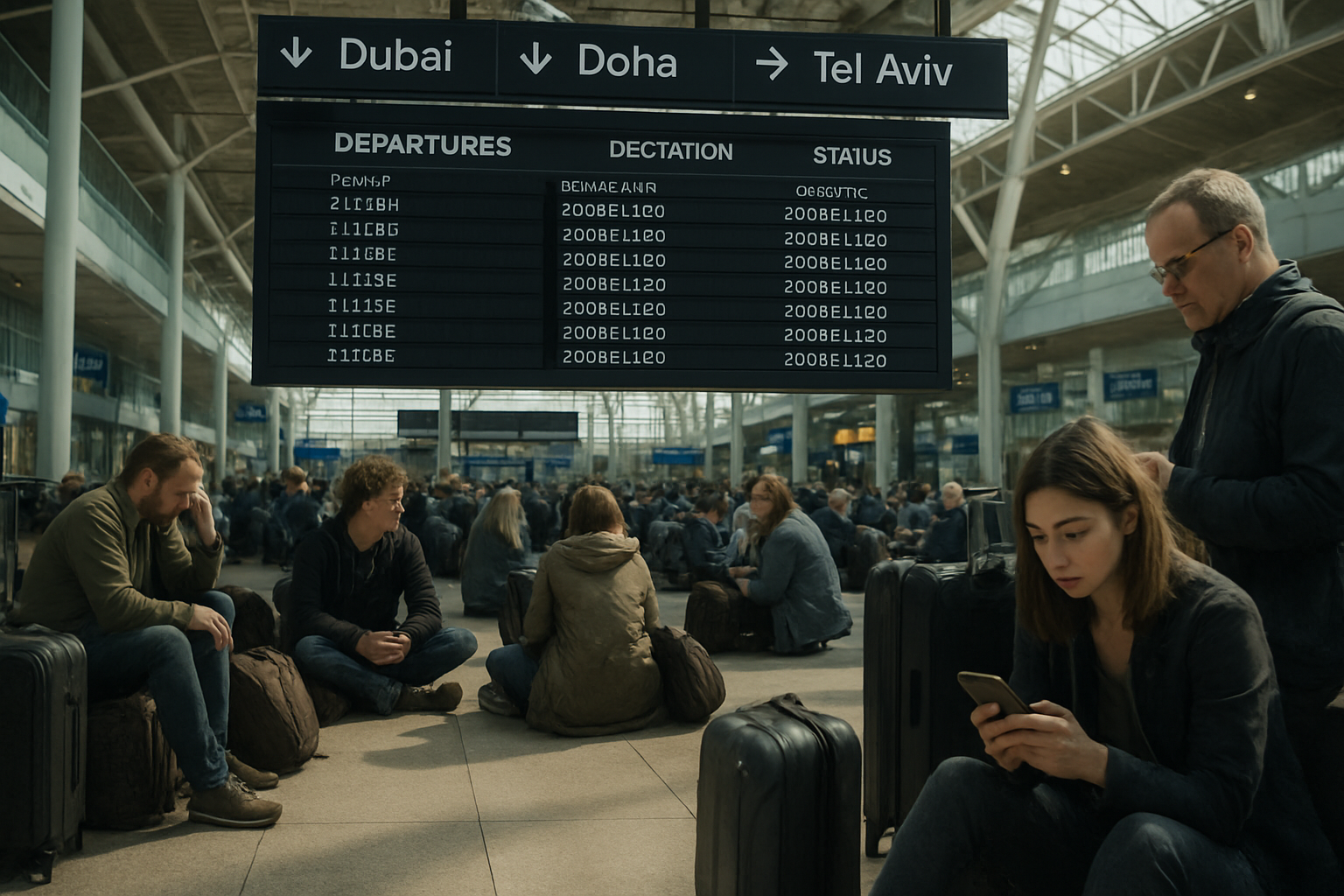
The Middle East conflict has triggered an unprecedented global aviation crisis, with over 18,000 flights cancelled worldwide and major international airports shuttered across the region. The disruption represents the most comprehensive aviation emergency since the COVID-19 pandemic, affecting hundreds of thousands of passengers globally and threatening critical tourism and business travel networks.
The crisis escalated dramatically as Iran, Iraq, Israel, UAE, Qatar, Syria, Kuwait, and Bahrain simultaneously closed their airspace following military operations in the region. Dubai International Airport, the world's busiest international hub handling over 86 million passengers annually, has been completely shut down after sustaining missile damage, creating cascading effects throughout the global aviation network.
Major Airline Suspensions and Operational Crisis
Emirates and Etihad Airways, two of the region's flagship carriers, face operational collapse as their Dubai and Abu Dhabi hubs become inaccessible. The suspension has eliminated critical Europe-Asia connections that millions of travelers depend on annually. Air France-KLM has cancelled all flights to Tel Aviv, Beirut, Dubai, and Riyadh, while Wizz Air has suspended operations to Israel, Dubai, Abu Dhabi, and Amman until at least March 7.
European carriers have implemented comprehensive regional suspensions: Bulgaria Air cancelled Tel Aviv routes through March 2, airBaltic suspended all Tel Aviv operations until March 4, and Cyprus Airways cancelled multiple Dubai flights. The coordinated nature of these suspensions reflects the severity of security concerns across the aviation industry.
"For a second consecutive day following the escalation of military operations in the Middle East, British airline EasyJet has cancelled its arrival at Paphos International Airport," tourism officials confirmed, describing the decision as particularly concerning given that Cyprus is not directly involved in the conflict.
— Cyprus Tourism Officials
Passenger Chaos and Government Evacuations
The crisis has stranded hundreds of thousands of passengers worldwide, forcing governments to implement massive evacuation operations. Philippine Airlines and Cebu Pacific cancelled several Middle East flights on March 3, while Uganda Airlines suspended its critical Dubai route, cutting a vital Asian gateway for African travelers.
Denmark reports that 12,000 air travelers in Copenhagen have been affected by the Middle East unrest, while Formula 1 management has been forced to charter special flights to transport key personnel to Melbourne for the Australian Grand Prix, highlighting the crisis's impact on international sporting events.
Vietnam has taken the unprecedented step of suspending the deployment of workers to the Middle East until the security situation stabilizes, affecting thousands of planned overseas employment opportunities.
Regional Hub Disruption
The closure of Middle Eastern hubs has created a critical gap in global aviation networks. Dubai International's shutdown is particularly devastating, as it serves as a primary connection point between Europe, Asia, Africa, and Australia. With Russian and Ukrainian airspace already closed due to ongoing conflict, airlines have lost multiple routing options for long-haul international flights.
Japan's aviation market faces particular strain as flight prices soar on Asia-Europe routes. Key hubs including Dubai, which normally handles over 1,000 flights daily, remain closed, drastically reducing capacity on popular international routes and forcing expensive rerouting through alternative airports.
Romanian authorities report 28 flights to or from Israel, Dubai, Bahrain, Qatar, and Jordan were cancelled on Tuesday alone, demonstrating the widespread nature of the disruption across European departure points.
Economic and Energy Market Impact
The aviation crisis coincides with a broader economic emergency as oil prices have surged 10% to $80 per barrel following concerns over the Strait of Hormuz, which handles 40% of global seaborne oil transit. Natural gas prices have jumped 24% in Europe and 78% in the United States, reflecting market fears about broader regional instability.
Major shipping companies including Maersk and MSC have suspended operations in the Persian Gulf, with over 150 oil and LNG tankers currently anchored and unable to reach their destinations. This has created a supply chain crisis extending far beyond the aviation sector.
Tourism Industry Devastation
The Middle East has long served as a crucial hub for international tourism, connecting travelers between continents and serving as a destination in its own right. The current crisis threatens to devastate tourism-dependent economies across the region and beyond.
Sweden's travel agencies report their busiest crisis period since COVID-19, with thousands of nationals stranded across the Middle East. Travel manager Åsa Morell from Ticket agency in Eskilstuna and Västerås describes overwhelming emergency calls from trapped travelers, with one customer, Emily Grosser, paying 6,000 SEK for alternative routing from Paris to Australia after her Dubai connection was cancelled.
The ripple effects extend to unexpected areas: West Indies and Zimbabwe cricket teams remain stranded in India following the T20 World Cup due to the airspace closures, while New Zealand's tourism recovery faces new threats as international visitor spending, which reached a record NZ$18.1 billion, still trails behind dairy exports.
Government Response and International Coordination
Multiple governments have activated emergency evacuation protocols. Estonia has advised 3,000 nationals in the Middle East to contact authorities immediately, while Kenya faces the challenge of coordinating evacuations for over 66,000 nationals in Qatar and 23,000-40,000 in the UAE.
Thailand has ordered urgent evacuation preparations with embassy and consulate safety protocols activated. South Korea's President Lee Jae Myung has ordered an emergency response system, with Finance Minister Koo Yun-cheol warning of "heightened market volatility."
Ireland's senior officials are meeting in Dublin to address the escalating crisis, with Irish citizens in the UAE potentially requiring bus transport to Oman if flight restrictions in Dubai and Abu Dhabi continue.
Historical Context and Unprecedented Scale
Aviation experts describe this as the most comprehensive regional airspace closure in modern history, exceeding even the disruptions during the 1991 Gulf War. The simultaneous closure of multiple countries creates unprecedented challenges for global aviation networks, which have become increasingly dependent on Middle Eastern hubs over the past two decades.
The crisis exposes the vulnerability of modern transportation systems to geopolitical instability. Unlike weather-related disruptions, which typically have predictable timelines for recovery, the current situation depends entirely on the resolution of military operations and diplomatic tensions.
Industry Adaptation and Future Planning
Airlines are implementing emergency protocols including enhanced fuel loading to avoid refueling in affected zones, complex rerouting around multiple closed airspaces, and dramatically increased operational costs. Some carriers are exploring Caribbean stopovers for trans-Pacific routes, while others face reduced passenger capacity due to longer flight times.
The crisis is forcing the aviation industry to reconsider its heavy reliance on Middle Eastern hubs and accelerate investments in route diversification. Industry analysts predict that recovery will require not just the reopening of airspace, but also the restoration of passenger confidence in regional stability.
Recovery Timeline Uncertain
Unlike natural disasters or technical failures, the resolution of this aviation crisis depends on factors beyond the control of airlines or aviation authorities. The timeline for recovery remains entirely uncertain, contingent on the resolution of military operations and the normalization of diplomatic relations in the region.
Airlines are conducting daily operational reviews but cannot make long-term scheduling decisions while the situation remains volatile. The industry faces the challenge of maintaining essential global transportation links while navigating an increasingly complex geopolitical environment.
This crisis serves as a template-setting moment for 21st-century aviation crisis management, demonstrating both the fragility and interconnectedness of modern transportation networks. The successful resolution of this emergency could provide frameworks for managing future geopolitical disruptions, while failure to contain the situation may lead to fundamental changes in how the global aviation industry operates in an era of increased regional instability.