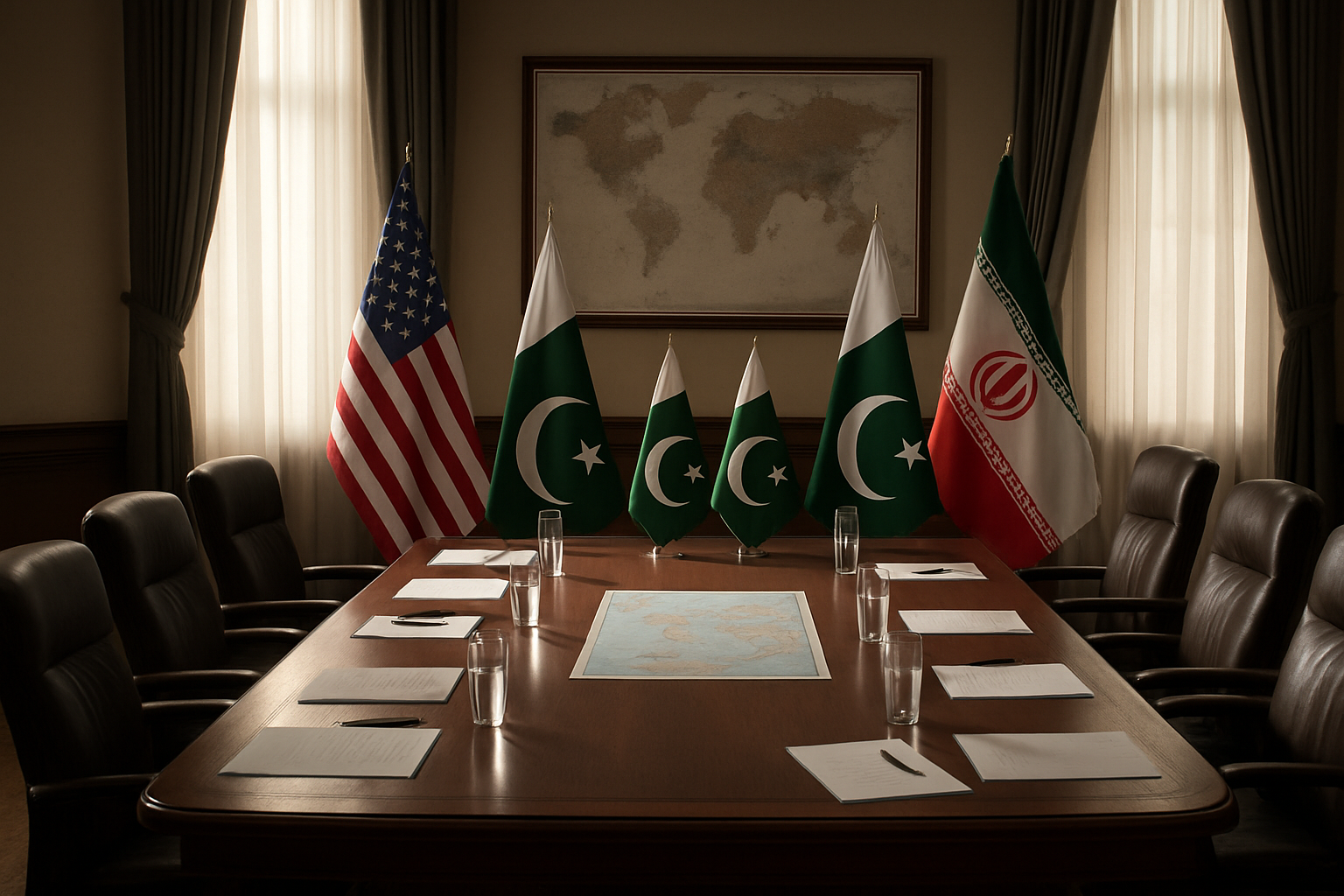
President Donald Trump announced Monday that the fragile ceasefire between the United States and Iran will expire Wednesday evening, warning that extension remains unlikely without a comprehensive peace deal as nuclear program disagreements continue to overshadow Pakistan-mediated diplomatic efforts.
The announcement comes as the world watches nervously for signs of progress in what has been described by UN Secretary-General António Guterres as "the greatest test of multilateral cooperation in the modern era." The current ceasefire, achieved through Pakistan's historic "Islamabad Accord" framework, prevented what could have been a catastrophic escalation of the most dangerous international crisis since the Cold War.
Current State of Negotiations
Speaking to Bloomberg, Trump adopted a measured tone, stating, "I'm not going to let myself be pressured into making a bad deal. We have all the time in the world." This marks a dramatic shift from his earlier apocalyptic threats, when he warned that "whole civilization will die tonight" just hours before Pakistan successfully mediated a breakthrough ceasefire on April 8, 2026.
The ceasefire was achieved just 88 minutes before Trump's deadline, causing oil prices to crash nearly 20% from $119.50 to below $100 per barrel in the steepest decline in six years. The Strait of Hormuz, which handles 40% of global oil transit, was partially reopened under Iranian coordination during the two-week diplomatic window.
However, the fundamental obstacles that have prevented US-Iran breakthroughs for decades remain unchanged. Iran maintains its position on uranium enrichment at 60% purity with over 400kg of weapons-grade material, while the US demands a commitment against nuclear weapons development. Iranian Foreign Minister Abbas Araghchi has repeatedly stated that "Iran will never abandon enrichment even if war is imposed."
Nuclear Program at the Core
The nuclear issue remains the primary sticking point in negotiations. Iran's current stockpile of highly enriched uranium approaches weapons-grade levels, with experts confirming that multiple weapons could be "easily achievable" if Iran chooses to weaponize its material. This crisis unfolds against the backdrop of the New START treaty's expiration in February 2026, marking the first time in over 50 years without US-Russia nuclear constraints.
The scope disagreement between the two nations appears insurmountable: Iran seeks nuclear-only discussions while excluding ballistic missiles and regional proxy support as "red lines," while the US demands comprehensive arrangements covering missiles, armed groups, and human rights concerns. This same structural obstacle prevented breakthrough agreements since the JCPOA collapse in 2018.
Lebanon Complicates Diplomatic Efforts
A critical factor threatening the negotiations is what diplomats call the "Lebanon loophole." Israeli Prime Minister Netanyahu explicitly excluded Lebanon from the ceasefire framework, leading to continued strikes that killed over 254 people in a single day during previous talks. With 1.2 million Lebanese displaced—25% of the population—Iran has threatened withdrawal from negotiations unless comprehensive enforcement covers all fronts.
Vice President JD Vance, who led the marathon 21-hour negotiations in Islamabad, acknowledged Iran's "legitimate misunderstanding" about Lebanon's inclusion but emphasized that the US never agreed to include Israeli-Hezbollah operations in the ceasefire scope.
Pakistan's Historic Mediation Role
Pakistan has emerged as an unprecedented mediator in this crisis, with Prime Minister Shehbaz Sharif and Field Marshal Asim Munir developing an innovative "message relay system" that facilitated communication when direct US-Iran contact was impossible. This middle-power diplomacy demonstrated that innovative solutions are possible even in the most dangerous circumstances.
The Pakistani framework received international support, with Chinese Foreign Minister Wang Yi expressing "full support" for the initiative and German officials noting "positive signs" for direct talks. This template-setting approach shows how middle powers can bridge major adversaries when traditional mechanisms fail.
Economic and Energy Implications
The current diplomatic window has provided crucial economic relief globally. The initial ceasefire triggered a massive market rally, with Pakistan's KSE-100 index achieving a record 8.15% gain. Aviation recovery began as the industry planned to resume Middle East routes after 18,000+ flight cancellations during the peak crisis.
Consumer relief is beginning to materialize: Bangladesh is reviewing fuel rationing for 170 million people, Pakistan is considering reversing wartime austerity measures, and European households anticipate energy cost reductions. Qatar has resumed LNG production, representing 20% of global exports, while shipping companies are mobilizing over 150 stranded tankers worth billions in cargo.
However, the energy sector remains vulnerable. Iran's cryptocurrency payment system requiring $1 per barrel for oil tankers continues to affect the strategic 21-mile chokepoint, with vessel owners reluctant to commit ships fearing potential stranding if the framework collapses.
Military and Congressional Pressure
Operation Epic Fury, which cost $11.3 billion in its first week, represents the largest Middle East operation since 2003. Congressional opposition has reached unprecedented levels, with only 25% American support—historically low for early-stage operations. Senator Blumenthal expressed being "more concerned than ever" about potential ground troops, while Pentagon operations are projected through September, far beyond initial timelines.
The dual-carrier deployment of the USS Gerald Ford and USS Abraham Lincoln represents approximately one-third of the US Navy fleet, demonstrating the enormous military resources committed to the region. The crisis also marked the first enemy vessel sunk by a US submarine since World War II, when USS Charlotte sank the Iranian frigate IRIS Dena.
Regional Coalition Under Strain
The crisis has severely tested regional relationships. Saudi Arabia, UAE, Qatar, and Egypt maintained unprecedented consensus supporting diplomatic solutions, despite Iranian "Operation True Promise 4" attacks that caused casualties across their territories. UAE suffered one civilian death in Abu Dhabi, Kuwait had 32 injured in airport strikes, and Qatar experienced 8 casualties despite intercepting 65 missiles and 12 drones with Patriot systems.
Egyptian President Sisi's warnings about "comprehensive chaos in sisterly countries" proved prophetic as the diplomatic challenges mounted. The coalition's preservation depends heavily on successful conflict resolution.
International Law and European Security
The crisis expanded beyond the Middle East when Iranian drones struck RAF Akrotiri in Cyprus, marking the first attack on European territory since World War II. This unprecedented expansion prompted the EU to activate its ESTIA crisis mechanism for the first time in the bloc's history.
The response included an unprecedented naval coalition featuring HMS Dragon alongside Spanish, Italian, French, Dutch, and Greek vessels. However, European allies have largely rejected broader US demands for Strait of Hormuz military support, with UK Prime Minister Starmer declaring Britain "will not be dragged into Iran war."
Looking Ahead: Critical Decisions
As Wednesday's deadline approaches, the stakes could not be higher. The crisis affects territorial sovereignty enforcement, energy security paradigms, nuclear governance credibility, and international law enforcement mechanisms with implications extending decades beyond current events.
The humanitarian toll continues to mount, with Iran's Red Crescent reporting over 787 civilian casualties, including Pentagon-acknowledged elementary school strikes that killed 165-185 students due to "outdated targeting data." War crimes investigations are ongoing, while international evacuations have reached Arab Spring scale, with Australia reporting 115,000 trapped citizens and Germany evacuating 30,000.
Success in converting the temporary ceasefire into a lasting framework would provide a template for 21st-century crisis resolution, demonstrating that diplomatic innovation can prevail even in the darkest hours. Failure, however, could accelerate military solutions globally, undermining diplomatic credibility and encouraging proliferation worldwide.
Template for Future Crisis Management
The Pakistan-mediated framework represents more than just a bilateral US-Iran issue—it has become a template-setting moment for international relations. The innovative "message relay system" and middle-power mediation success demonstrate that multilateral cooperation can be effective in a volatile, interconnected world.
Whether diplomatic innovation ultimately triumphs or military confrontation reshapes international relations will determine precedents for conflict resolution extending decades into the future. The crisis has exposed critical vulnerabilities in global energy architecture, with the 21-mile Strait of Hormuz representing a catastrophic single-point failure in modern logistics requiring fundamental transformation.
As the Wednesday deadline looms, the world watches to see whether Pakistan's historic achievement in bringing the world's most bitter adversaries to the negotiating table can convert into lasting peace, or whether the world will return to the most dangerous international crisis since the Cold War ended.