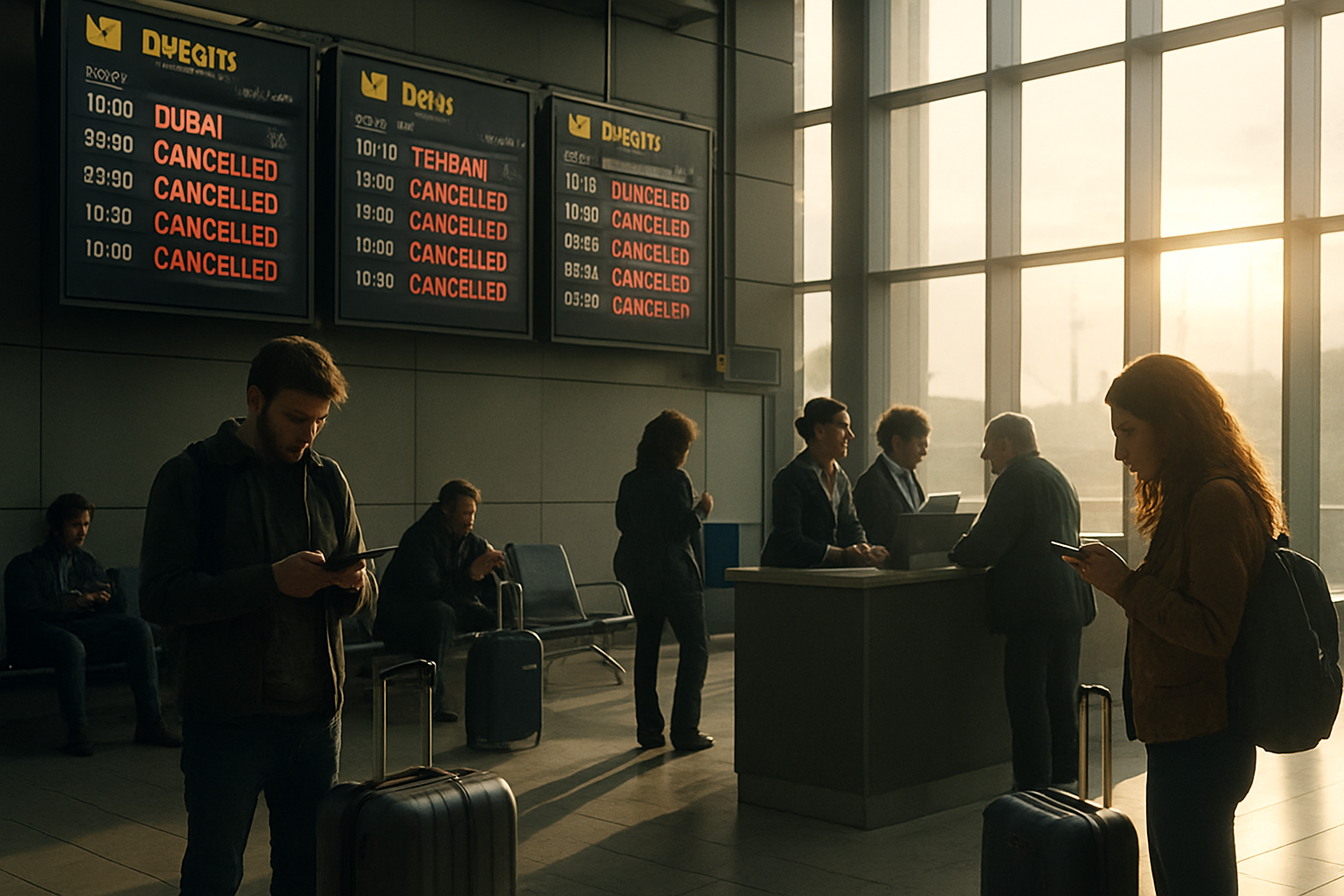
The Middle East conflict that erupted in March 2026 has created the most comprehensive disruption to global aviation and tourism since the COVID-19 pandemic, forcing the industry into an unprecedented transformation as traditional travel patterns collapse and new alternatives emerge.
Over 18,000 flights have been cancelled worldwide since March 1, 2026, as eight Middle Eastern countries simultaneously closed their airspace following escalating conflicts involving Iran, Israel, and the United States. The crisis has stranded hundreds of thousands of passengers globally and forced airlines to fundamentally rethink their route networks.
Unprecedented Aviation Shutdown
The scale of aviation disruption is staggering. Dubai International Airport, the world's busiest with over 86 million passengers annually, remains completely shut down after sustaining missile damage. This closure alone has eliminated the critical Europe-Asia hub that millions of travelers depend on for connecting flights.
Vietnam has warned its aviation industry to prepare for potential flight reductions from April after China and Thailand halted jet fuel exports due to the Iran war, creating the likelihood of severe shortages. Vietnam imports more than two-thirds of its jet fuel needs, with 60% coming from China and Thailand, according to documents seen by Reuters.
"There are risks of jet fuel shortages for Vietnamese airlines," officials warned, demonstrating how the conflict's ripple effects extend far beyond the immediate region.
— Vietnamese Aviation Regulator
Major carriers including Emirates, Etihad, Air France-KLM, Wizz Air, and Bulgaria Air have suspended Middle East operations indefinitely. The simultaneous closure of airspace by Iran, Iraq, Israel, UAE, Qatar, Syria, Kuwait, and Bahrain represents the most comprehensive regional aviation disruption in modern history.
Tourism Industry in Crisis Mode
Cyprus has emerged as one of the most affected destinations, despite not being directly involved in the conflict. President Annita Demetriou called for an immediate crisis management strategy to protect Cyprus' tourism industry from the economic fallout, warning that uncertainty is already affecting visitor numbers.
The tourism sector faces significant risks at a crucial time for seasonal planning. "The only thing certain is that there is uncertainty and a comprehensive management plan is required immediately," Demetriou said after meeting with representatives from major tourism and business organizations.
The island nation had achieved record performance with 4.5 million visitors in 2025 generating €3.6 billion in revenue, but now faces severe disruption to its spring and summer booking seasons.
Massive International Evacuations
The crisis has triggered the largest coordinated international evacuation since the Arab Spring in 2011. Australia faces the challenge of extracting 115,000 trapped nationals, while Germany is working to repatriate 30,000 stranded tourists. Cyprus activated its ESTIA evacuation plan for the first time in history, coordinating the extraction of over 2,000 EU nationals from the UAE.
Individual stories highlight the human cost of the crisis. Swedish traveler Emily Grosser was forced to pay 6,000 SEK ($560) for alternative routing from Paris to Australia after her Dubai connection was cancelled, demonstrating the extreme costs passengers face when requiring emergency rerouting.
Economic Shockwaves Across the Industry
The aviation crisis has coincided with a severe energy crisis that is compounding the industry's challenges. Oil prices have surged past $80 per barrel due to Iran's closure of the Strait of Hormuz, which affects 40% of global oil transit. Natural gas prices have jumped 24% in Europe and 78% in the United States.
Airlines are implementing emergency protocols including enhanced fuel loading to avoid refueling in affected zones, complex rerouting through Caribbean stopovers for trans-Pacific routes, and dramatically increased operational costs. The crisis exposes the industry's dangerous over-dependence on Middle Eastern hubs for Europe-Asia connectivity.
Regional Winners and Losers
While some destinations suffer, others are capitalizing on the crisis. Croatia is reporting tourism advantages as travelers seek safer European alternatives, with industry experts predicting a strong season for destinations positioning themselves as secure options.
Spain, which already leads Europe with 513.6 million tourist nights annually, is capturing additional redirected demand from traditional Middle East-accessible destinations. The Caribbean, however, faces a "perfect storm" with the Middle East disruptions combining with Cuba's aviation isolation to create unprecedented challenges.
New Zealand's tourism recovery is threatened as one-third of European travelers typically use Middle Eastern hubs to reach the country. Finland is responding by launching international marketing campaigns transforming cottage holidays into a new tourism brand, targeting travelers seeking peaceful destinations.
Travel Insurance Gaps Exposed
The crisis has revealed critical gaps in travel protection. Standard travel insurance policies exclude war-related cancellations, leaving individual travelers financially exposed while package tour operators develop comprehensive coverage frameworks. This is driving a fundamental shift toward organized travel over independent tourism as travelers seek additional protections.
Industry Transformation Accelerated
Airlines are being forced to accelerate route diversification strategies to reduce their dependency on Middle Eastern hubs. Enhanced security screening, mandatory conflict-coverage insurance, and pre-approval systems for high-risk destinations are likely to become standard features of international travel.
The crisis is also driving consumer behavior changes, with a shift toward last-minute bookings and flexible arrangements forcing airlines and tour operators to adopt more agile business models. Recovery timelines remain uncertain, as unlike weather disruptions, this crisis depends entirely on military and diplomatic resolution.
Template-Setting Crisis for the Future
March 2026 represents a watershed moment that could determine whether the tourism industry maintains its global connectivity role or evolves into more regionalized, security-conscious patterns. The crisis demonstrates how rapidly regional conflicts can become global transportation challenges in an interconnected world.
The successful management of this crisis will provide frameworks for future international emergencies, while failure could fundamentally reshape international aviation approaches to geopolitical risk for decades to come. The stakes extend far beyond immediate operational challenges to fundamental questions about the nature of international mobility in an increasingly unstable world.
As the crisis continues to unfold, the travel industry faces a choice between developing safer regional travel enclaves or building more robust systems that can enable global mobility despite security challenges. The decisions made in these critical months will influence how millions of people travel for generations to come.