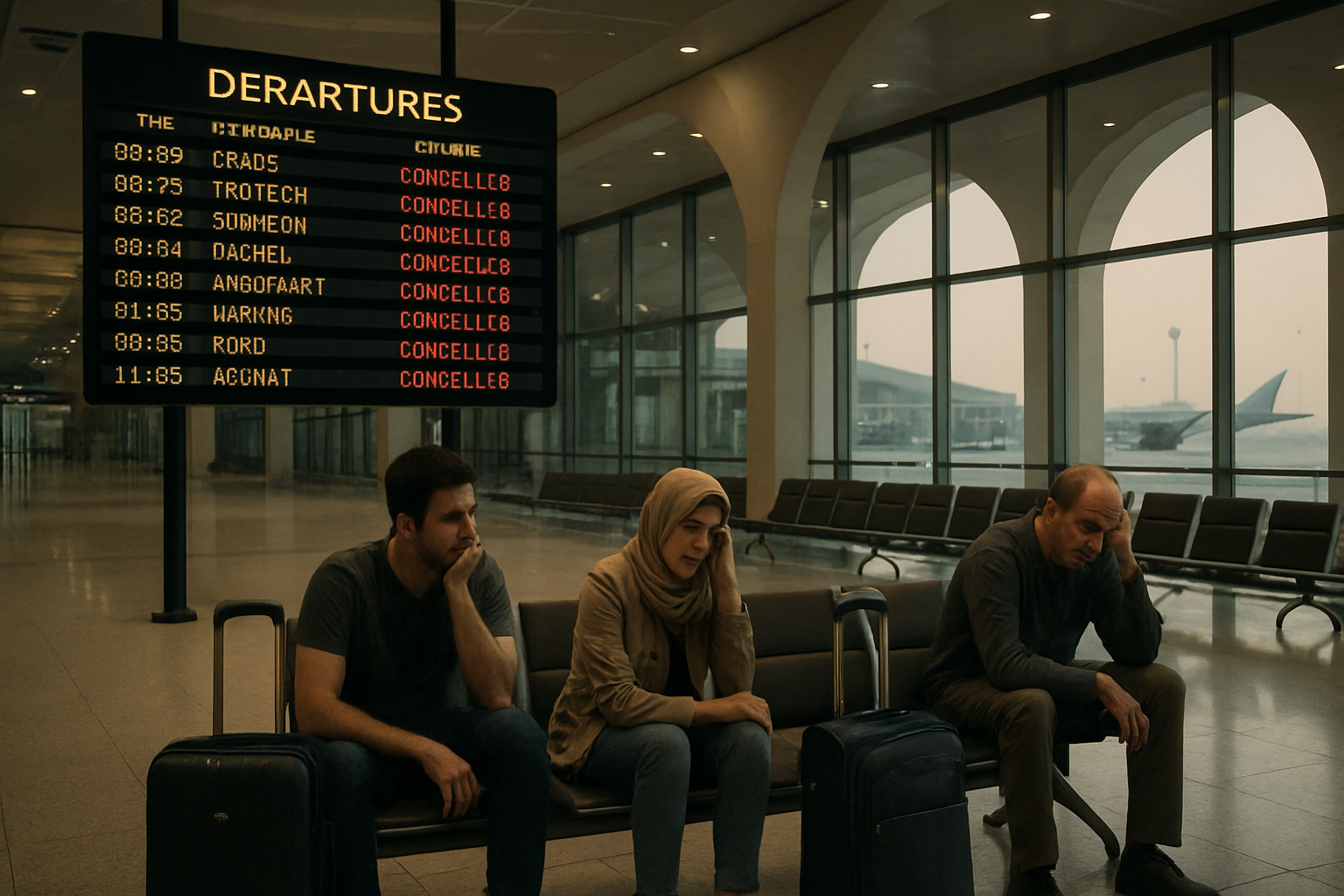
The Middle East crisis has unleashed the most extensive travel and aviation disruption since the COVID-19 pandemic, fundamentally reshaping global tourism patterns as conflicts force the closure of critical transportation hubs and trigger massive international evacuations.
With over 18,000 flights cancelled worldwide and eight countries simultaneously closing their airspace, the tourism industry faces an unprecedented challenge that extends far beyond the immediate conflict zone. The crisis, which began with US-Israeli operations against Iran and subsequent retaliation, has created a domino effect impacting travelers from Estonia to Jordan to Romania and beyond.
Aviation Network Collapse Creates Global Chaos
Dubai International Airport, the world's busiest with 86 million passengers annually, remains completely shut down after sustaining missile damage during Iranian retaliation strikes. This closure has severed critical Europe-Asia connections, forcing airlines to implement complex alternative routing strategies that have dramatically increased costs and travel times.
Major carriers including Emirates, Etihad, Air France-KLM, Wizz Air, and Bulgaria Air have suspended Middle East operations indefinitely. The simultaneous airspace closures of Iran, Iraq, Israel, UAE, Qatar, Syria, Kuwait, and Bahrain represent the most comprehensive regional aviation disruption in modern history, exceeding even the 1991 Gulf War's impact on international travel.
"This is a historic disruption that forces the industry to reconsider fundamental assumptions about global connectivity."
— Aviation Industry Expert
Tourism Industry Faces Massive Cancellation Wave
The crisis has triggered a wave of cancellations that tourism experts believe could affect the industry for years to come. In Jordan, tourism officials report that hotel and tour operator booking cancellations have reached an unprecedented 90% for the current month, with many operators describing a complete loss of the current tourism season.
Cyprus, Europe's closest country to the Middle East, is experiencing significant tourism disruption despite not being directly involved in the conflict. Hoteliers report declining reservations as flight cancellations and security warnings make travelers think twice about planning vacations to the region.
Travel experts predict that North Africa and Southern Europe will likely benefit from this disruption as tourists seek alternative destinations perceived as safer. Spain, already leading Europe with 513.6 million tourist nights annually, is positioned to capture additional redirected demand.
Mass Evacuations Create Humanitarian Crisis
The conflict has triggered the largest coordinated international evacuation since the Arab Spring in 2011, with over 500,000 citizens being extracted from Middle East conflict zones. Australia faces the challenge of evacuating 115,000 trapped nationals, while Germany is coordinating the return of 30,000 stranded tourists.
Cyprus activated its ESTIA evacuation plan for the first time in history, coordinating the safe return of 2,000+ EU and third-country nationals from the UAE. This represents a watershed moment in European crisis management, demonstrating unprecedented coordination capabilities among EU member states.
Individual travelers are bearing enormous costs to escape the crisis zone. Swedish traveler Emily Grosser paid 6,000 SEK ($560) for alternative routing from Paris to Australia, highlighting the extreme financial burden placed on passengers caught in the disruption.
Energy Crisis Compounds Travel Woes
The conflict has created a parallel energy crisis that compounds travel industry challenges. Oil prices have surged 10% past $80 per barrel as Iran declared the Strait of Hormuz, which handles 40% of global oil transit, "unsafe" for shipping. This has forced major shipping companies Maersk and MSC to suspend operations, leaving 150+ tankers stranded in the Persian Gulf.
Natural gas prices have exploded by 24% in Europe and 78% in the US, creating additional cost pressures for airlines already struggling with complex rerouting requirements. The energy market volatility directly impacts tourism operational costs and traveler confidence across the globe.
Insurance Gaps Expose Traveler Vulnerabilities
The crisis has revealed critical gaps in travel insurance coverage, with standard policies excluding war-related cancellations. This protection gap is driving a shift toward package tours over independent travel, as tour operators develop comprehensive coverage frameworks that individual travelers cannot access.
Austrian consumer protection agencies confirm that travelers with "anxiety" about regional security have no insurance recourse unless they book through organized tour operators. This fundamental flaw in travel protection is forcing the industry to reconsider how it safeguards travelers in an increasingly volatile world.
Long-term Industry Transformation
Aviation experts warn that the crisis exposes dangerous over-dependence on Middle Eastern hubs for Europe-Asia connectivity. With Russian and Ukrainian airspace already closed due to ongoing conflict, the loss of Middle Eastern routes creates unprecedented routing challenges for international airlines.
The industry is accelerating discussions about route diversification and enhanced contingency planning to reduce dependency on single regional hubs. Airlines are implementing emergency protocols including enhanced fuel loading to avoid refueling in affected zones and complex rerouting through Caribbean stopovers for trans-Pacific routes.
"We're witnessing a template-setting crisis that will influence aviation policy and emergency planning for decades to come."
— Crisis Management Specialist
Recovery Timeline Remains Uncertain
Unlike weather-related disruptions with predictable timelines, recovery from this crisis depends entirely on military operations resolution and diplomatic normalization. Airlines are conducting daily operational reviews but cannot make long-term scheduling decisions due to the volatile security environment.
Even when flights resume, clearing the massive backlog of cancelled flights and stranded passengers could take weeks. The crisis is forcing fundamental reconsideration of route planning, risk assessment procedures, and international cooperation frameworks for managing geopolitical travel disruptions.
Regional Winners and Losers
While Middle Eastern destinations face unprecedented challenges, other regions are positioned to benefit from redirected tourism demand. Croatia is reporting advantages as travelers seek safer European alternatives, while the Caribbean faces a "perfect storm" with the Middle East disruptions coinciding with Cuba's aviation isolation.
New Zealand's tourism recovery faces new threats as one-third of European travelers typically use Middle Eastern hubs for connectivity. This demonstrates how regional conflicts can have far-reaching impacts on destinations thousands of miles from the actual conflict zone.
Finland is launching international marketing campaigns to transform cottage holidays into a new tourism brand, targeting travelers seeking peaceful destinations away from conflict zones.
Industry Adaptation Strategies
The tourism industry is rapidly adapting to the new reality through enhanced monitoring systems, flexible booking policies, and security consultancy partnerships. Technology-based mobile applications for instant updates are becoming standard, while blockchain documentation is being explored for tracking infrastructure disruptions.
Tour operators are developing comprehensive conflict-coverage insurance frameworks, while cruise lines demonstrate adaptability through rapid itinerary modifications. The industry is learning that agile operational models are essential for navigating an increasingly unpredictable geopolitical landscape.
Historical Significance and Future Implications
The March 2026 crisis represents a watershed moment for international tourism, demonstrating how regional conflicts can instantly create global humanitarian and economic challenges. The successful multilateral coordination of mass evacuations provides a template for future international crises, while exposed vulnerabilities reveal areas requiring urgent improvement.
Enhanced security screening, mandatory conflict-coverage insurance, and pre-approval systems for high-risk destinations are likely to become industry standards. The crisis is accelerating consumer shifts toward last-minute bookings and flexible arrangements, forcing tourism businesses to adopt more agile operational models.
The choice facing the industry is clear: develop robust systems that enable continued global mobility despite security challenges, or accept a more fragmented, security-conscious era of international travel. The decisions made in response to this crisis will determine the fundamental nature of international tourism for decades to come.
As the situation continues to evolve, the travel and tourism industry faces its greatest test since World War II, with implications extending far beyond operational challenges to fundamental questions about the role of tourism in an increasingly interconnected but unstable world.