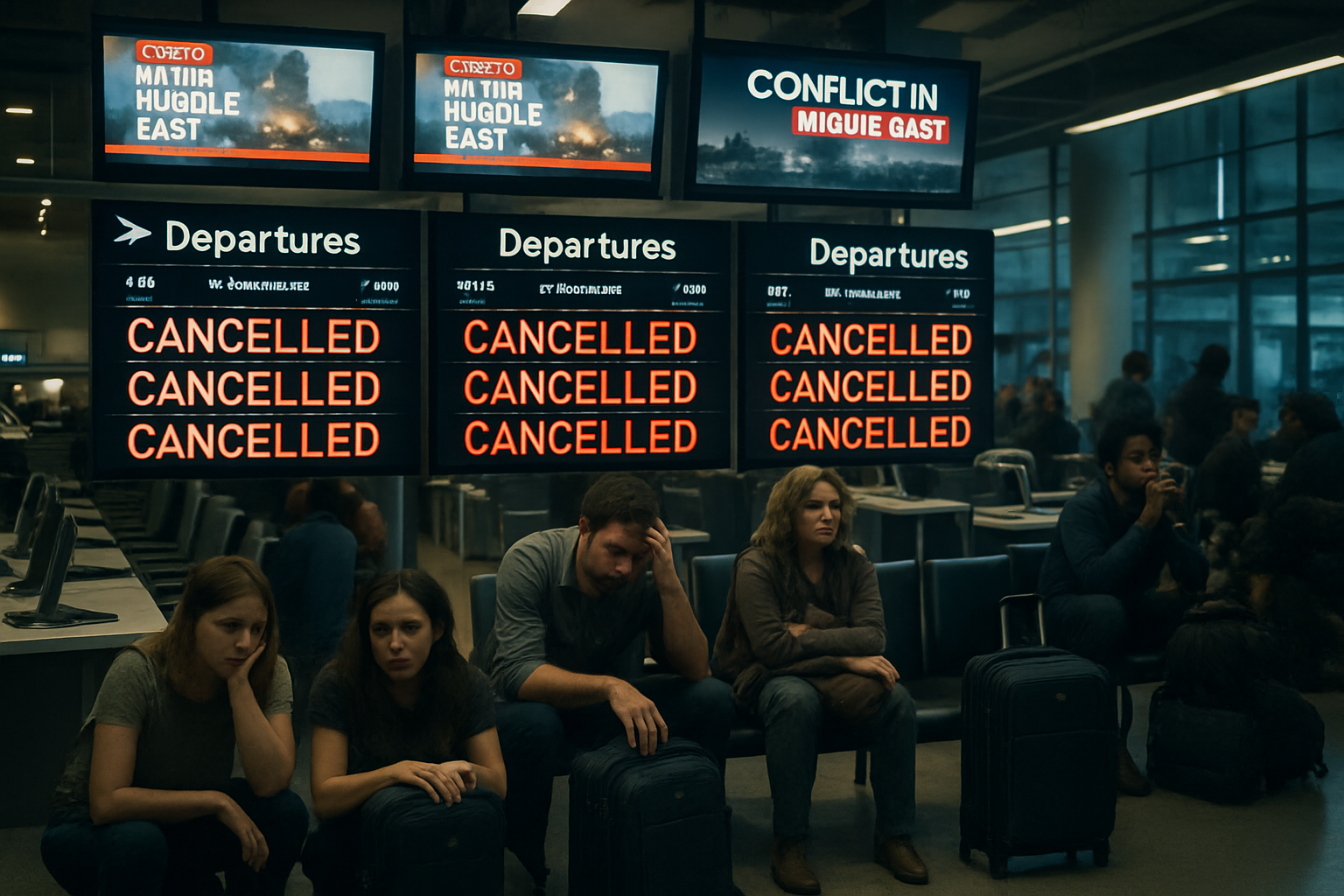
A week-long Middle East conflict has triggered the most severe global travel industry crisis since the COVID-19 pandemic, with over 18,000 flights cancelled worldwide and hundreds of thousands of passengers stranded across multiple continents as aviation networks collapse under unprecedented geopolitical pressure.
The crisis began March 1, 2026, following the escalation of conflicts between Iran, the United States, and Israel, creating a cascading series of disruptions that have exposed critical vulnerabilities in the global travel infrastructure. From panic buying in Cyprus supermarkets to Danish couples sleeping in Thai airports, the human cost of this transportation breakdown extends far beyond the Middle East region.
Aviation Network Collapse
The most dramatic impact has been the simultaneous closure of civilian airspace by eight Middle Eastern countries—Iran, Iraq, Israel, UAE, Qatar, Syria, Kuwait, and Bahrain—creating the most comprehensive regional aviation shutdown in modern history. Dubai International Airport, the world's busiest with over 86 million passengers annually, remains completely shut down after sustaining missile damage during Iranian retaliation strikes.
Major international carriers have suspended operations indefinitely. Emirates and Etihad Airways face operational collapse as their Dubai hub becomes inaccessible, while European carriers including Air France-KLM, Wizz Air, and Bulgaria Air have cancelled all Middle Eastern routes. The disruption has severed critical Europe-Asia connections, forcing airlines to implement complex alternative routing through the Caribbean for trans-Pacific flights.
"This is the most extensive aviation disruption we've seen since COVID-19, but unlike the pandemic, we can't predict when normal operations will resume because it depends entirely on military and diplomatic developments."
— Aviation Industry Analyst
Individual Stories of Desperation
Behind the statistics lie individual stories of travelers caught in unprecedented circumstances. Thomas Runge, a Danish tourist, remains stranded in Khao Lak, Thailand, without funds, now facing the prospect of sleeping in airports as his insurance company, Codan, refuses coverage for war-related disruptions. His situation reflects thousands of similar cases where standard travel insurance policies exclude conflict-related cancellations.
Swedish traveler Emily Grosser exemplifies the extreme costs facing passengers, paying 6,000 SEK (approximately $560) for alternative routing from Paris to Australia. Such price inflation has become routine as available flight capacity shrinks dramatically while demand from stranded passengers surges.
Russian tourists on Sri Lanka face potential eviction from hotels as tour operators struggle with payment systems disrupted by the broader economic crisis, while 28 Romanian students remain blocked at Dubai Airport, describing "panic moments" without adequate food or water supplies.
Regional Panic and Supply Disruptions
The crisis has triggered panic buying across affected regions, with Cyprus experiencing scenes not witnessed since the early COVID-19 pandemic. Cypriots are rushing to fuel stations and supermarkets, creating queues and empty shelves for basic goods including pasta, rice, tinned food, and infant formula. Remarkably, heating fuel purchases have surged despite the spring season, reflecting unprecedented anxiety about supply chain stability.
Fuel prices have skyrocketed across the region. In Cyprus, 95-octane petrol has increased 20-25% while diesel and heating oil have jumped 40-45% in a single week. Similar patterns are emerging globally, with Sweden predicting electricity price increases of 10-20 öre and gasoline rises of 1-2 kronor per liter.
Largest Evacuation Since Arab Spring
Governments worldwide have activated the largest coordinated international evacuation since the Arab Spring of 2011, with over 500,000 citizens requiring extraction from Middle Eastern countries. Australia faces the massive challenge of evacuating 115,000 trapped nationals, while Germany contends with 30,000 stranded tourists.
Cyprus has activated its ESTIA evacuation plan for the first time in history, coordinating the rescue of 2,000+ European and third-country nationals from the UAE. The operation represents a watershed moment for EU crisis management capabilities, demonstrating unprecedented coordination in sharing evacuation schedules and resources.
Successful operations have included Australia's first repatriation flight via Emirates EK414, bringing 200+ passengers to Sydney, and Cyprus Airways flight CYP107 carrying 180 citizens from Dubai to Larnaca. However, logistical challenges persist, with some government-arranged flights departing half-empty due to safety concerns and late confirmation processes.
Energy Crisis Compounds Travel Woes
The travel industry crisis runs parallel to a severe energy emergency as Iran's Revolutionary Guard declared the Strait of Hormuz "unsafe," effectively closing a chokepoint that handles 40% of global seaborne oil transit. Oil prices have surged 10% to over $80 per barrel, while natural gas prices have exploded by 24% in Europe and 78% in the United States.
Major shipping companies Maersk and MSC have suspended Persian Gulf operations, leaving over 150 oil and LNG tankers stranded with billions of dollars in cargo. Qatar has halted LNG production at its Ras Laffan and Mesaid facilities, affecting approximately 20% of global LNG exports and triggering force majeure declarations.
Tourism Industry Adaptations
The crisis has accelerated significant shifts in global tourism patterns. TUI, Europe's largest tour operator, expects Spain to benefit substantially as travelers grow reluctant to visit Egypt and Turkey due to regional instability. Spain, already leading Europe with 513.6 million tourist nights annually, is positioned to capture additional redirected demand.
Croatia is reporting advantages as travelers seek safer European alternatives, while the Caribbean faces a "perfect storm" with Cuba's complete aviation isolation (zero jet fuel through March 11) compounding Middle East disruptions. New Zealand's tourism recovery faces threats as one-third of European travelers typically use Middle Eastern hubs for connectivity.
Finland has launched an international marketing campaign transforming cottage holidays into a new tourism brand, targeting travelers seeking peaceful destinations amid global uncertainty.
Insurance and Industry Evolution
The crisis has exposed critical gaps in travel protection, as standard insurance policies exclude war-related cancellations. This revelation is driving a shift toward package tours over independent travel, as tour operators develop comprehensive coverage frameworks that individual policies cannot match.
Airlines are implementing emergency protocols including enhanced fuel loading to avoid refueling in affected zones, complex rerouting strategies, and dramatically increased operational costs. The industry faces fundamental questions about over-reliance on Middle Eastern hubs for global connectivity, accelerating discussions about route diversification and enhanced contingency planning.
Long-term Implications
Unlike weather-related disruptions with predictable recovery timelines, this crisis depends entirely on military operations resolution and diplomatic normalization. Airlines cannot make long-term scheduling decisions while multiple airspaces remain closed, and even when operations resume, clearing passenger backlogs could take weeks.
The crisis represents a template-setting moment for 21st-century tourism and aviation management during regional conflicts. Enhanced security screening, mandatory conflict-coverage insurance, and pre-approval systems for high-risk destinations may become industry standards.
Industry experts emphasize the watershed nature of current events in determining whether tourism maintains its role in global connectivity or fragments into a more security-conscious era of international travel. The choice lies between developing safe enclaves versus building robust systems that enable global mobility despite security challenges.
"This crisis is forcing a fundamental reconsideration of how the travel industry operates in an increasingly volatile geopolitical environment. Success in adaptation could provide templates for future emergencies, while failure may reshape international travel for decades."
— Travel Industry Crisis Management Expert
As the situation continues to evolve, the travel industry faces its greatest test of resilience and adaptation since World War II, with implications extending far beyond immediate operational challenges to the fundamental nature of international mobility in an interconnected yet increasingly unstable world.