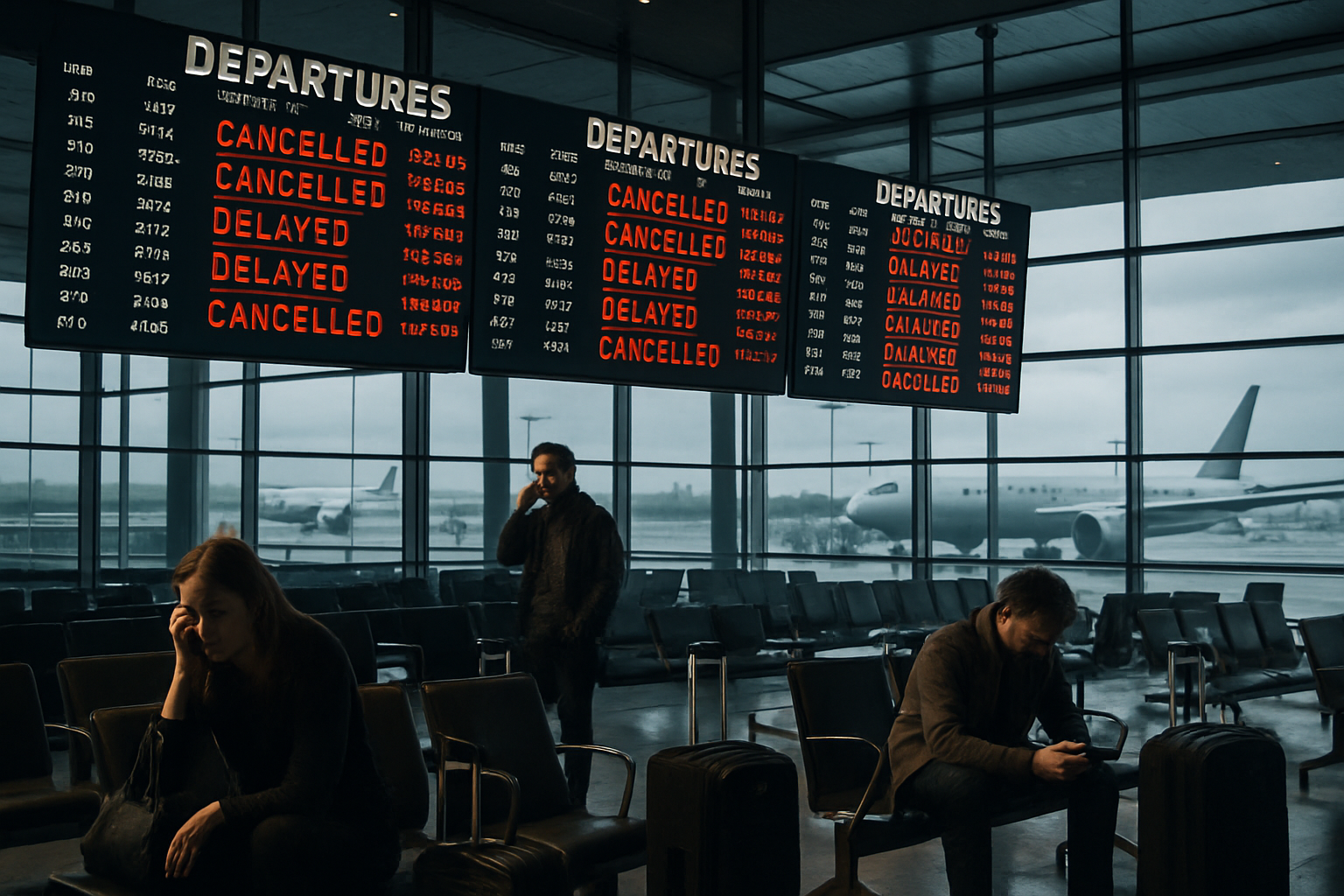
The ongoing Middle East crisis has unleashed the most catastrophic aviation and tourism disruption since the COVID-19 pandemic, with over 18,000 flights cancelled globally and hundreds of thousands of passengers stranded as military conflicts force unprecedented airspace closures across critical transport hubs.
The crisis, triggered by escalating military operations between the United States, Israel, and Iran, has created a domino effect that extends far beyond the Middle East, devastating tourism economies from the Caribbean to New Zealand and exposing the fragility of global transportation networks in an interconnected world.
Unprecedented Scale of Aviation Disruption
The simultaneous closure of airspace by Iran, Iraq, Israel, UAE, Qatar, Syria, Kuwait, and Bahrain has created what aviation experts describe as the most comprehensive regional disruption in modern history. Dubai International Airport, the world's busiest with over 86 million passengers annually, remains completely shut down after sustaining missile damage during Iranian retaliation strikes.
Major carriers have suspended operations across the region, with Emirates and Etihad Airways facing operational crises that have severed critical Europe-Asia connectivity. Air France-KLM cancelled all Tel Aviv, Beirut, Dubai, and Riyadh routes, while Wizz Air suspended flights to Israel, Dubai, Abu Dhabi, and Amman until March 7. The ripple effects have spread globally, with carriers from Bulgaria Air to Cyprus Airways grounding hundreds of flights.
"This represents a complete breakdown of one of the world's most critical aviation hubs," said aviation analyst Marcus Chen. "The Middle East has long served as the connecting point between Europe and Asia, and its sudden unavailability is forcing airlines to completely rethink their route networks."
— Marcus Chen, Aviation Industry Analyst
Tourism Industries Under Siege Globally
While the aviation crisis began in the Middle East, its impact on global tourism has been swift and severe. The West Indies and Zimbabwe cricket teams found themselves stranded in India after their Twenty20 World Cup exit, unable to return home due to Middle East airspace closures affecting their planned routes.
The crisis has also exposed existing vulnerabilities in other tourism-dependent regions. New Zealand's tourism industry, still recovering from pandemic impacts, faces additional pressure as visitor spending of NZ$18.1 billion (US$11 billion) in the year through March 2025 remains below the dairy industry's NZ$23.1 billion in exports. The aviation disruptions threaten to further delay tourism's recovery to pre-pandemic levels.
Ireland has activated emergency protocols to assist stranded citizens in the UAE, with senior officials meeting in Dublin to discuss the escalating crisis. The Irish government is considering bussing Irish nationals from Dubai and Abu Dhabi to Oman if flight restrictions continue, highlighting the desperate measures required to manage the crisis.
Caribbean Aviation Networks Collapse
The aviation crisis comes at a particularly devastating time for the Caribbean, which was already grappling with Cuba's complete aviation isolation due to fuel shortages. With zero jet fuel available at Cuban airports through March 11, Air Canada, WestJet, and Air Transat have suspended all flights, stranding 21,000 Canadian tourists who represent nearly half of Cuba's foreign visitor base.
This dual crisis – Middle East conflicts disrupting global routing combined with Caribbean fuel shortages – has created what tourism experts describe as a "perfect storm" for the industry. Spanish hotel chains including Meliá and Iberostar have been forced to close facilities in Varadero and northern coastal areas, while Canada has issued "high degree of caution" advisories that have effectively ended the winter tourism season.
Economic Ripple Effects Across Industries
The aviation crisis has triggered broader economic disruptions that extend far beyond tourism. Oil prices have surged 10% to $80 per barrel as Iran has effectively closed the Strait of Hormuz, through which 40% of global seaborne oil transits. Major shipping companies Maersk and MSC have suspended operations in the Persian Gulf, with over 150 oil and LNG tankers now anchored and unable to reach their destinations.
Natural gas prices have spiked 24% in Europe and 78% in the United States, with Sweden predicting electricity increases of 10-20 öre and gasoline price rises of 1-2 kronor. The energy crisis is compounding transportation costs and threatening to trigger broader inflationary pressures across global economies.
Stock markets have responded with panic, with Pakistan's KSE-100 crashing 8.97%, forcing trading suspensions. US Dow futures dropped 400-570 points overnight, while the S&P 500 and Nasdaq futures both declined over 1%, reflecting investor fears about the broader economic implications of the crisis.
Alternative Transportation Networks Emerge
As aviation networks collapse, alternative transportation modes are seeing unprecedented demand. In Egypt, the Arab Bridge for Navigation company has emerged as a maritime alternative, providing regular sea connections to ensure passenger travel continuity amid ongoing aviation disruptions in the region.
However, these alternatives cannot match the scale and speed of aviation networks. The crisis has exposed how dependent modern economies have become on air travel for both passenger transport and cargo logistics. Supply chains that rely on Middle Eastern hubs for connecting Asia to Europe and Africa are facing severe disruptions that could take months to fully resolve.
Government Emergency Responses
Governments worldwide have activated emergency protocols to assist stranded nationals. Sweden and Serbia have ordered immediate evacuations from Iran citing "extremely uncertain" security conditions, while Estonia has advised 3,000 nationals across the Middle East to contact authorities immediately.
Kenya faces a particularly complex challenge with over 66,000 nationals in Qatar and 23,000-40,000 in the UAE at risk. Thailand has ordered urgent evacuation preparations with embassy and consulate safety protocols activated, while South Korea's President Lee Jae Myung has ordered an emergency response system led by the Prime Minister.
The scale of these evacuation operations represents the largest coordinated international effort since the Arab Spring in 2011, highlighting how quickly regional conflicts can create global humanitarian crises in an interconnected world.
"We're seeing the most extensive international evacuation operations since 2011," said Dr. Sarah Mitchell, a crisis management expert at Georgetown University. "The speed with which a regional conflict has created global passenger displacement demonstrates the vulnerability of our interconnected transportation systems."
— Dr. Sarah Mitchell, Georgetown University Crisis Management Expert
Long-term Industry Transformation
Aviation industry experts predict that this crisis will fundamentally reshape how airlines plan routes and manage geopolitical risks. The over-reliance on Middle Eastern hubs for connecting Europe to Asia has been exposed as a critical vulnerability, potentially accelerating investments in alternative routing through Africa or extended direct flights.
The crisis is also highlighting the need for enhanced contingency planning and more diversified route networks. Airlines are being forced to implement emergency protocols including enhanced fuel loading, complex rerouting around multiple closed airspaces, and dramatically increased operational costs that may be passed on to consumers.
For tourism-dependent economies, the crisis serves as a stark reminder of the industry's vulnerability to external shocks. Countries like New Zealand, which saw tourism overtake dairy as the nation's top overseas earner in 2016, are now reconsidering the wisdom of relying so heavily on international visitor spending.
Recovery Timeline Uncertain
Unlike weather-related disruptions, which typically have predictable recovery timelines, the current crisis depends entirely on the resolution of underlying military operations and diplomatic tensions. Airlines are conducting daily operational reviews but cannot make long-term scheduling decisions while the geopolitical situation remains volatile.
The International Air Transport Association (IATA) has warned that the recovery from this crisis could take weeks or months, even after flights resume, due to the massive backlog of displaced passengers and the need to rebuild confidence in Middle Eastern routing.
Meanwhile, alternative transportation networks are struggling to handle the displaced volume. Maritime routes, while providing some relief, cannot match the speed and capacity of aviation networks. The crisis has demonstrated how quickly modern transportation systems can be disrupted and how difficult they are to replace once disabled.
A Template for 21st Century Crisis Management
This aviation and tourism crisis represents a template-setting moment for how geopolitical conflicts can rapidly evolve into global economic disruptions in the 21st century. The rapid transition from diplomatic frameworks to military escalation demonstrates the fragility of modern crisis management mechanisms in a multipolar world.
The interconnected nature of global transportation networks means that regional conflicts can instantly become global crises affecting hundreds of thousands of civilians who have no connection to the underlying disputes. This reality is forcing governments and international organizations to reconsider how they manage and contain regional conflicts.
As the crisis continues to unfold, it serves as a stark reminder of how quickly the foundations of global mobility can be shaken. The coming weeks will determine whether this remains a contained regional disruption or evolves into a more fundamental reshaping of international transportation and tourism patterns.
For now, hundreds of thousands of passengers remain stranded worldwide, tourism industries from the Caribbean to New Zealand face unprecedented challenges, and the global economy grapples with supply chain disruptions that extend far beyond the aviation sector. The Middle East crisis has become a global crisis, with implications that will be felt long after the last flight is restored.