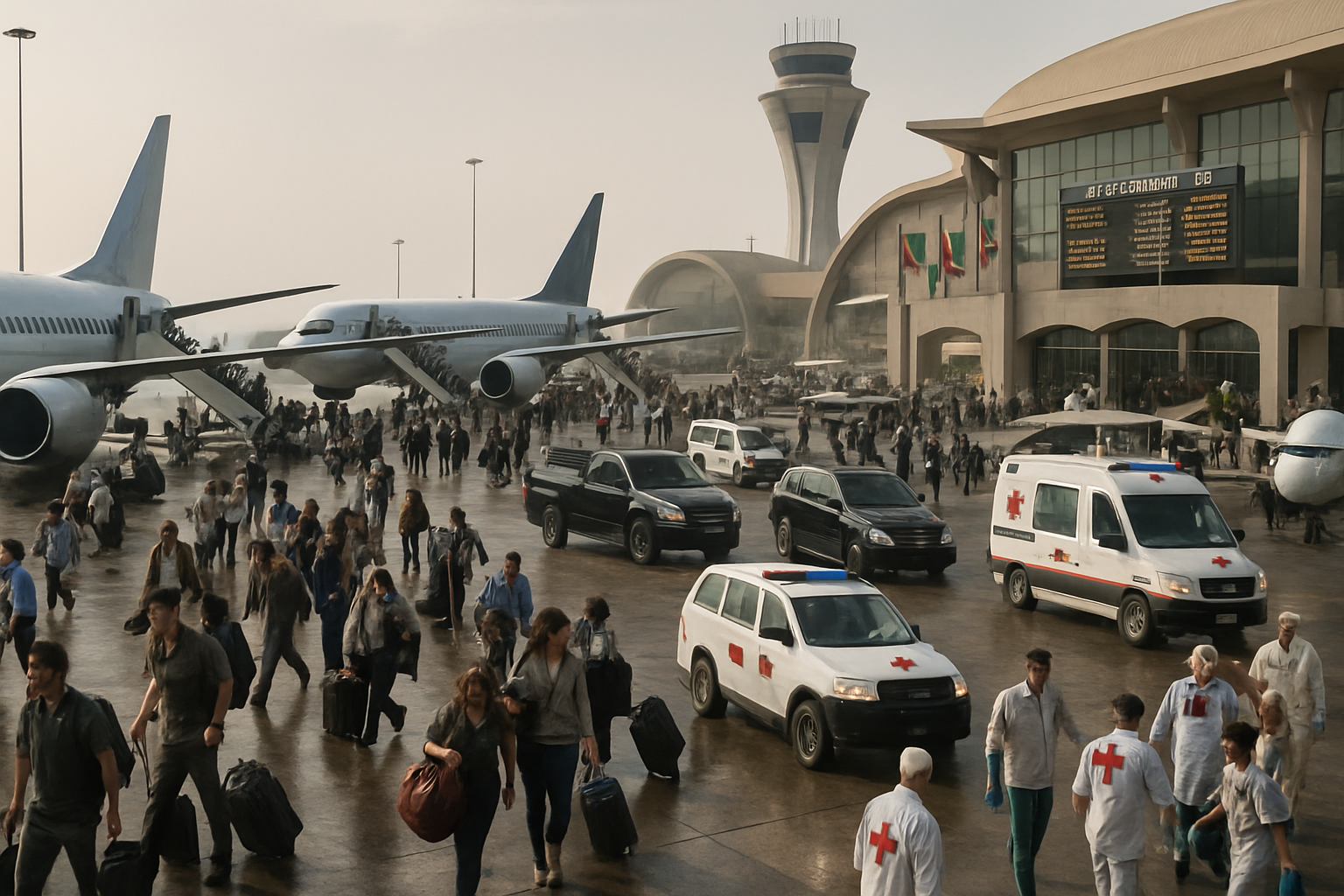
The largest coordinated international evacuation operation since the Arab Spring of 2011 is underway as governments worldwide scramble to extract hundreds of thousands of citizens stranded across the Middle East following the devastating escalation of warfare between Iran and the US-Israeli coalition.
The crisis, now in its fourth day, has forced the closure of eight Middle Eastern airspaces simultaneously—Iran, Iraq, Israel, UAE, Qatar, Syria, Kuwait, and Bahrain—creating the most comprehensive aviation disruption since the COVID-19 pandemic. Over 18,000 flights have been cancelled globally, with Dubai International Airport, the world's busiest, completely shut down after sustaining missile damage during Iranian retaliatory strikes.
Unprecedented Scale of International Response
The scope of evacuation efforts reveals the true magnitude of this crisis. According to official government sources, Australia has 115,000 nationals trapped in affected regions, while Germany reports 30,000 tourists stranded and Austria has registered 18,000 citizens requiring assistance. Italy counts 30,000 nationals in the UAE alone, and Malta has identified 1,619 citizens across the broader region.
Cyprus has activated its ESTIA evacuation plan for the first time ever, coordinating not just for Cypriot nationals but European and third-country citizens as well. Government spokesman Konstantinos Letymbiotis announced that charter flights for over 2,000 registered Cypriots in the UAE are scheduled to begin Wednesday, though operations remain subject to regional security conditions.
"Charter flights have been launched for their repatriation. The necessary arrangements have been completed and the relevant procedures are in progress."
— Konstantinos Letymbiotis, Cyprus Government Spokesman
Aviation Industry in Crisis
The aviation sector faces its most severe challenge since 2020. Dubai International Airport, which handles 86 million passengers annually, remains closed indefinitely after Iranian missiles damaged key infrastructure during "Operation True Promise 4"—Tehran's systematic retaliation for the US-Israeli "Operation Epic Fury" strikes that killed Iran's Supreme Leader Ali Khamenei.
Major carriers have suspended operations across the board. Emirates and Etihad Airways face an operational crisis as their Dubai hub becomes inaccessible. Air France-KLM has cancelled all routes to Tel Aviv, Beirut, Dubai, and Riyadh. Wizz Air suspended operations to Israel, Dubai, Abu Dhabi, and Amman until March 7, while Bulgarian Air and Cyprus Airways have implemented comprehensive cancellations.
The disruption extends far beyond the immediate conflict zone. Queen's University students from Kingston, Ontario, found their plane turned around mid-air on February 28, leaving 16 students and their professor stranded in Doha, Qatar. The West Indies cricket team remains in India after their return from the T20 World Cup was delayed due to the security situation.
Individual Stories of Crisis
Behind the statistics are countless personal dramas. Australian travelers, who had planned Dubai as a routine stopover on their journey to Europe, now find themselves indefinitely stranded with no return date, hoping for a ceasefire and airspace reopening.
In Bosnia and Herzegovina, citizens report over 1,000 projectiles intercepted in UAE airspace alone, with authorities working to accommodate stranded passengers in hotels while coordinating evacuations through Turkey. A 12-year-old British boy, Ahmad Ali from Swindon, spent three nights sleeping in Dubai airport while traveling back from Pakistan, highlighting how the crisis affects the most vulnerable travelers.
Emily Grosser, a Swedish traveler, paid 6,000 SEK (approximately $560) for alternative routing from Paris to Australia after her Dubai connection was cancelled—a cost that travel agencies warn may become standard as alternative routes face overwhelming demand.
Energy and Economic Implications
The crisis extends far beyond aviation. Iran's closure of the Strait of Hormuz—through which 40% of global seaborne oil transits—has sent oil prices surging 10% to over $80 per barrel. Natural gas prices have jumped 24% in Europe and 78% in the United States. Major shipping companies Maersk and MSC have suspended Persian Gulf operations, leaving over 150 tankers anchored with billions of dollars in stranded cargo.
Stock markets have crashed globally, with Pakistan's KSE-100 falling 8.97% in a single day, forcing trading suspensions. The energy crisis has prompted multiple governments to warn of impending fuel price increases, with Sweden predicting electricity increases of 10-20 öre and gasoline price rises of 1-2 kronor.
Diplomatic Efforts Amid Military Escalation
The evacuation crisis stems from the complete breakdown of nuclear diplomacy between Iran and the United States, despite achieving what officials called "broad agreement on guiding principles"—the most progress since the JCPOA collapse in 2018. The fundamental disagreement over scope proved insurmountable: Iran excluded ballistic missiles and proxy groups as "red lines," demanding nuclear-only talks, while the US insisted on comprehensive agreements including missiles, armed groups, and human rights.
Ireland's Foreign Minister Helen McEntee announced plans to charter flights for approximately 280 Irish citizens, with operations planned from Oman "subject to airspace being open." Iceland has coordinated with partner European countries to offer limited seats on evacuation flights departing from Jordan to Slovakia and from Saudi Arabia to Austria.
Luxembourg hopes to launch evacuations Wednesday or Thursday, with a Boeing aircraft on standby near the Gulf region and additional military coordination with Belgium. Slovakia has already completed its first repatriation flights, bringing over 100 citizens home from the region.
Regional Coalition Under Strain
The crisis has severely tested the unprecedented regional coalition of Saudi Arabia, UAE, Qatar, and Egypt that had supported the diplomatic process. Egyptian President Abdel Fattah el-Sisi condemned Iranian attacks on "sisterly Arab countries," warning of "comprehensive chaos" as Iranian retaliation directly targeted coalition member territories.
The UAE reported one civilian death in Abu Dhabi from missile debris, Kuwait's international airport was struck by drones injuring employees, and Qatar intercepted 65 ballistic missiles and 12 drones using Patriot systems, with 8 people injured by fragments despite successful interceptions.
Technical and Logistical Challenges
The complexity of coordinating mass evacuations while multiple airspaces remain closed presents unprecedented logistical challenges. Airlines are implementing emergency protocols including enhanced fuel loading to avoid refueling in affected zones, complex rerouting through Caribbean stopovers for trans-Pacific routes, and dramatically increased operational costs.
Unlike weather-related disruptions with predictable timelines, this geopolitical crisis depends entirely on military operations resolution and diplomatic tension normalization. Airlines are conducting daily operational reviews but cannot make long-term scheduling decisions, creating uncertainty that extends far beyond the immediate evacuation needs.
Historical Context and Global Significance
Aviation experts describe this as the most comprehensive regional airspace closure in modern history, exceeding the disruption during the 1991 Gulf War. The simultaneous closure of multiple countries affects the critical Europe-Asia transit hub while Russian and Ukrainian airspace already remain unavailable due to that ongoing conflict.
The crisis occurs against the broader backdrop of nuclear governance breakdown—the New START treaty expired on February 5, marking the first time in over 50 years without US-Russia nuclear constraints, while China continues its nuclear expansion. UN Secretary-General António Guterres has warned that nuclear risks are at their "highest in decades."
Recovery Timeline Uncertain
Unlike natural disasters or technical failures, recovery from this crisis depends entirely on political and military developments. Even when flights resume, clearing the backlog of cancelled flights and stranded passengers could take weeks. The aviation industry faces fundamental questions about route planning, risk assessment, and contingency planning for navigating geopolitical volatility in strategic regions.
The crisis has exposed the vulnerability of modern transportation networks to geopolitical instability and the over-reliance on Middle Eastern hubs for global connectivity. Industry experts predict accelerated discussions about route diversification and enhanced resilience planning to reduce dependency on single regional hubs.
Template for 21st Century Crisis Management
This evacuation crisis represents a template-setting moment for international crisis management in an increasingly multipolar world. The rapid transition from diplomatic breakthrough to military escalation demonstrates the fragility of modern crisis management systems when multiple strategic interests collide.
The success or failure of containing this crisis could influence international approaches to conflict resolution for decades. If contained, it might provide a framework for managing similar regional confrontations. If it escalates into broader Middle Eastern warfare, it could accelerate preferences for military solutions over diplomatic engagement, with implications extending far beyond the current crisis.
As governments worldwide work around the clock to bring their citizens home safely, the world watches to see whether this crisis can be contained or whether it marks the beginning of a broader transformation in Middle Eastern geopolitics with global implications for energy markets, supply chains, and the fundamental mechanisms of international stability.