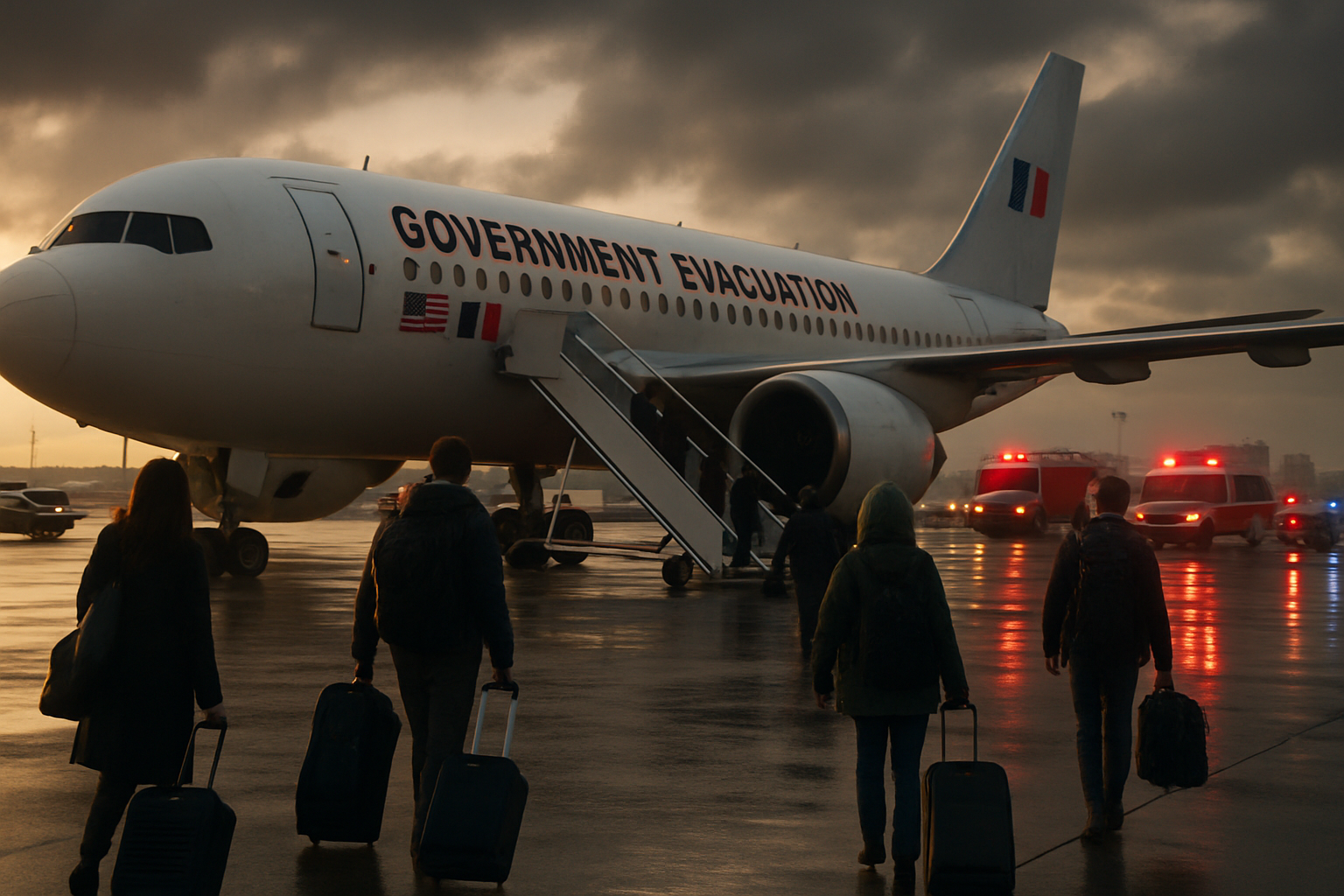
European governments are coordinating the largest international evacuation operation since the Arab Spring of 2011, as escalating conflict in the Middle East has forced the cancellation of over 18,000 flights worldwide and left hundreds of thousands of travelers stranded across the region.
The crisis reached a critical point on March 8, 2026, as multiple European nations successfully completed major repatriation operations while airlines began cautiously resuming limited services to the region. Finland became the latest country to organize evacuation flights from Oman, while airBaltic prepared its fourth repatriation flight from Dubai to Riga.
Unprecedented Aviation Disruption
The travel chaos began following military escalation in the region, with eight Middle Eastern countries simultaneously closing their airspace to civilian traffic. Dubai International Airport, the world's busiest with over 86 million passengers annually, remains completely shut down after sustaining missile damage during Iranian retaliation strikes.
Major carriers including Emirates, Air France-KLM, Wizz Air, and Bulgaria Air have suspended all Middle East operations indefinitely, creating the most comprehensive regional aviation disruption since the COVID-19 pandemic. Greek airline Sky Express announced the cancellation of all flights to and from Tel Aviv through March 14, citing the suspension of Israeli airspace operations.
The scale of the disruption has forced airlines to implement emergency protocols including enhanced fuel loading to avoid refueling in affected zones, complex rerouting through Caribbean stopovers for trans-Pacific routes, and dramatically increased operational costs.
Coordinated European Response
The European Union has activated unprecedented crisis management mechanisms, with Cyprus leading the charge by implementing its ESTIA evacuation plan for the first time in history. The plan coordinates the evacuation of both EU and third-country nationals from the UAE, representing a watershed moment in European crisis management capabilities.
Italy's Foreign Minister Antonio Tajani announced that the emergency phase is nearly concluded after successfully repatriating over 5,000 Italian nationals from the Middle East between Saturday evening and Sunday morning. "The situation is being managed effectively through our coordinated European response," Tajani stated, noting that the majority of evacuations have been completed.
Latvia's national carrier airBaltic conducted its fourth repatriation flight from Dubai on Sunday evening, as confirmed by the Foreign Ministry. The Baltic nation has been at the forefront of the evacuation efforts, working closely with other European partners to ensure safe passage for stranded citizens.
Individual Stories of Resilience
The human cost of the crisis extends far beyond statistics, with individual travelers facing extraordinary challenges and expenses. Norwegian Start-leader Erik Riis Jacobsen was in Dubai when the city was hit by rocket attacks, describing the experience as terrifying but expressing relief at finally returning home safely.
"We are tired and exhausted, but incredibly happy to be home."
— Erik Riis Jacobsen, Norwegian evacuee
Romanian authorities report that over 1,500 Romanian citizens have safely returned to the country through evacuation flights, assisted repatriation, or flights facilitated by the Foreign Ministry. An estimated additional 1,000 Romanian citizens have left the region through commercial flights operated by various airlines, though many faced significant delays and additional costs.
Global Economic Impact
The crisis has created ripple effects throughout the global economy, with oil prices surging over 10% to above $80 per barrel due to concerns about the Strait of Hormuz, through which 40% of global oil transit passes. Iran's declaration that the strait is "unsafe" for shipping has led major companies like Maersk and MSC to suspend operations, leaving over 150 tankers stranded in the Persian Gulf.
Natural gas prices have increased by 24% in Europe and 78% in the United States, while stock markets worldwide have experienced significant volatility. The Pakistan Stock Exchange's KSE-100 index recorded its largest single-day decline in history, falling 8.97%.
Diplomatic Breakdown Context
The current crisis stems from the complete collapse of US-Iran nuclear negotiations, despite what had been described as a "broad agreement on guiding principles" breakthrough – the most progress made since the 2018 JCPOA collapse. The fundamental disagreement centered on Iran's exclusion of ballistic missiles and proxy groups as "red lines" versus US demands for a comprehensive approach including missiles, armed groups, and human rights issues.
This diplomatic failure led to Operation Epic Fury, the largest US-Israeli coordinated military operation since 2003, followed by massive Iranian retaliation that has drawn the entire region into conflict.
Recovery Timeline Uncertain
Unlike weather-related travel disruptions, the recovery timeline for this crisis depends entirely on military operations resolution and diplomatic normalization efforts. Airlines are conducting daily operational reviews but cannot make long-term scheduling decisions due to the volatile security environment.
Qatar's Civil Aviation Authority announced that its temporary airspace closure continues due to ongoing security concerns, with flight operations limited to evacuation corridors requiring specific authorization. Regular operations will only resume after an official announcement that it is safe to reopen.
The Kuwait Armed Forces successfully intercepted 12 missiles and 12 drones during recent attacks, preventing casualties but highlighting the ongoing security risks that make commercial aviation impossible in much of the region.
Long-term Industry Implications
This crisis has exposed the fundamental vulnerability of global transportation networks to geopolitical instability in strategic regions. The over-dependence on Middle Eastern hubs for Europe-Asia connectivity has been dramatically highlighted, with aviation industry leaders calling for enhanced route diversification and contingency planning.
The template-setting nature of this crisis will likely influence aviation policy, emergency planning, and international cooperation frameworks for decades to come. Enhanced security screening, mandatory conflict coverage insurance, and pre-approval systems for high-risk destinations may become standard industry practices.
Success of International Cooperation
Despite the challenges, the coordinated international response has demonstrated the effectiveness of multilateral cooperation in crisis management. The successful activation of Cyprus's ESTIA plan provides a valuable model for future civilian protection mechanisms in volatile geopolitical environments.
Slovenia concluded its evacuation operations on March 7, having successfully transported 912 Slovenian citizens and 146 passengers of other nationalities through nine government-chartered flights between March 4 and 7. Prime Minister Robert Golob and Foreign Minister Tanja Fajon personally welcomed the final passengers at Brnik Airport.
"The situation is very serious and conditions are changing hourly, making the coordination of evacuation activities very demanding. Without the help of our friends in Jordan and the Gulf countries we would not have been able to make it."
— Robert Golob, Slovenian Prime Minister
As the crisis continues to evolve, the international community faces ongoing challenges in balancing diplomatic efforts to de-escalate tensions while ensuring the safety and repatriation of hundreds of thousands of citizens caught in the crossfire. The success of these evacuation operations represents a testament to international solidarity, even as the underlying conflict continues to reshape global travel patterns and geopolitical relationships.