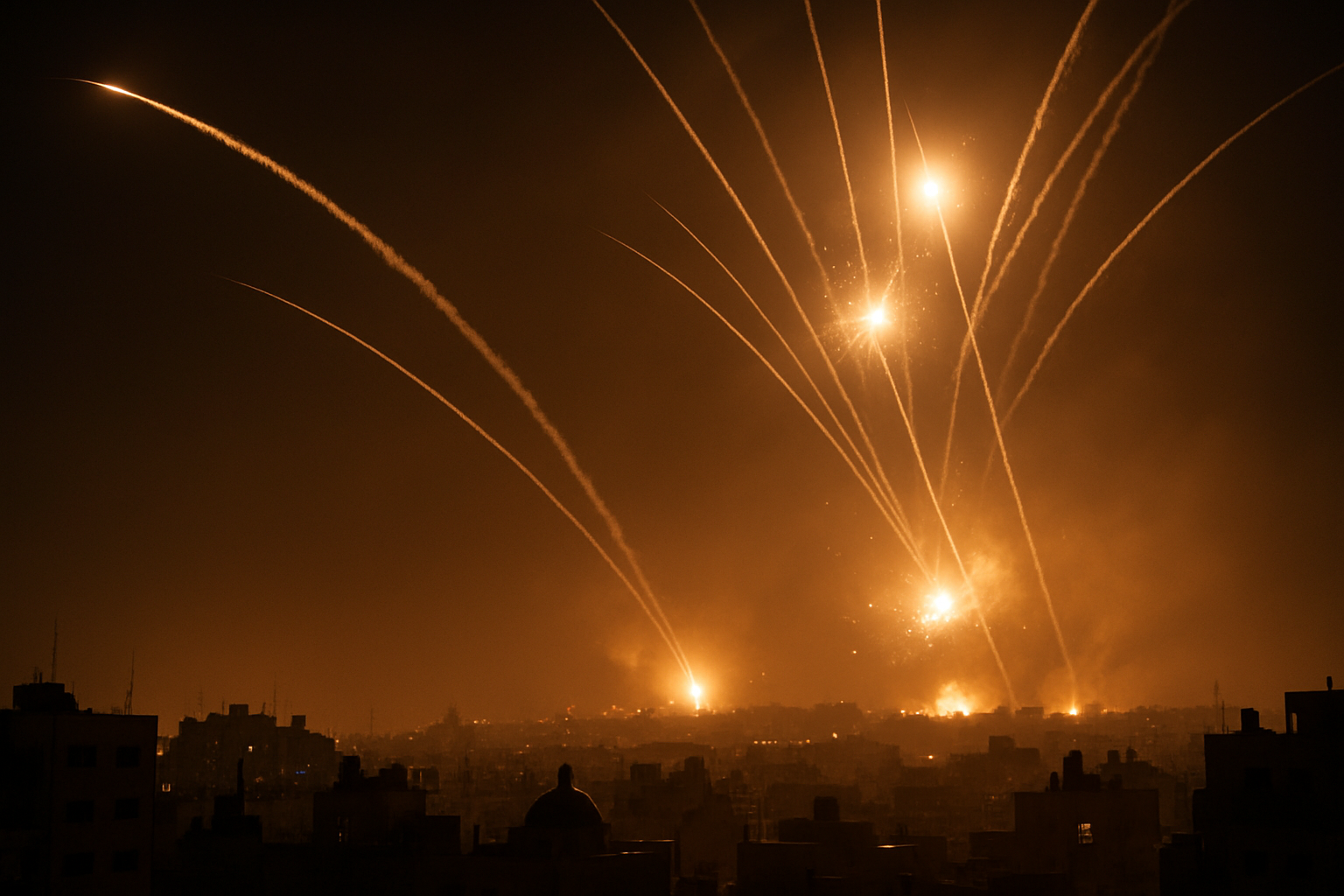
Iranian missile strikes on Israel continue to escalate as the Middle East conflict enters its most dangerous phase since the Cold War, with US military involvement expanding globally after a US submarine torpedoed and sank an Iranian warship off Sri Lanka, killing at least 80 crew members.
The conflict, dubbed "Operation Epic Fury" by the United States and "Operation True Promise 4" by Iran, has now spread far beyond traditional Middle Eastern boundaries, marking the first enemy vessel sunk by a US submarine since World War II according to Defense Secretary Pete Hegseth.
Global Military Escalation
The Iranian frigate IRIS Dena was returning from naval exercises in India when it was struck by a torpedo from the USS Charlotte, a Los Angeles-class attack submarine, approximately 800 kilometers off the coast of Sri Lanka. The massive explosion lifted the ship's stern out of the water before the vessel sank completely, with 32 crew members rescued and 148 still missing.
This dramatic expansion of hostilities comes as part of the largest coordinated US-Israeli military operation since the 2003 Iraq invasion, featuring an unprecedented dual-carrier deployment of the USS Gerald R. Ford and USS Abraham Lincoln representing approximately one-third of the active US Navy fleet.
"We have only just begun," US Secretary of War Pete Hegseth declared, warning that American military forces "could fight as long as needed."
— Pete Hegseth, US Secretary of War
Regional Impact and Casualties
The conflict has devastated the broader Middle East region, with Iranian Revolutionary Guard forces declaring "no red lines remain" and systematically targeting US facilities and Gulf allies. Confirmed casualties include:
- UAE: 1 civilian killed in Abu Dhabi from missile debris, Dubai International Airport shut down
- Kuwait: 32 foreign nationals injured in airport drone strikes
- Qatar: 8 people injured from fragments despite intercepting 65 missiles and 12 drones
- Israel: 9 civilians killed and 28 wounded in Beit Shemesh residential strikes
- Bahrain: Fifth Fleet headquarters targeted
The death of Iran's Supreme Leader Ali Khamenei, officially confirmed by Iranian state media on March 1, has created a constitutional succession crisis that has further destabilized the region. His son Mojtaba Khamenei has emerged as the favored successor in what would be the first hereditary succession in the Islamic Republic's history.
Global Aviation and Economic Crisis
The conflict has triggered the most extensive global aviation disruption since COVID-19, with over 18,000 flights cancelled worldwide. Eight Middle Eastern countries have simultaneously closed their airspace, including Iran, Iraq, Israel, UAE, Qatar, Syria, Kuwait, and Bahrain.
Dubai International Airport, the world's busiest, remains completely shut down due to missile damage, while major carriers including Emirates, Air France-KLM, Wizz Air, and Bulgaria Air have suspended operations affecting hundreds of thousands of passengers globally.
Oil prices have surged 10% to over $80 per barrel as Iran has effectively closed the Strait of Hormuz, which handles 40% of global oil transit. Major shipping companies Maersk and MSC have suspended operations, leaving over 150 tankers anchored in the Persian Gulf with billions of dollars in stranded cargo.
Nuclear Diplomacy Collapse
The military escalation followed the complete breakdown of nuclear negotiations despite achieving a "broad agreement on guiding principles" in Geneva talks - the most significant diplomatic progress since the 2018 JCPOA collapse. The fundamental disagreement centered on scope: Iran excluded ballistic missiles and regional proxies as "red lines" for nuclear-only talks, while the US demanded comprehensive agreements covering missiles, armed groups, and human rights.
Iran continues enriching uranium to 60% purity with over 400 kilograms of material approaching weapons-grade levels, making nuclear weapons capability "easily achievable" according to former IAEA inspector Dr. Yusri Abu Shadi.
International Response
The UN Security Council has convened multiple emergency sessions, with Secretary-General António Guterres warning of a "serious threat to international peace and security." Russia condemned what it called "reckless actions by Washington and West Jerusalem," while China issued its strongest condemnation in years, calling the strikes a "serious violation of Iran's sovereignty."
Mass evacuations are underway across 15 Middle Eastern countries, representing the largest coordinated evacuation since the Arab Spring in 2011. Australia has 115,000 nationals trapped in the region, while Germany has 30,000 tourists stranded.
Regional Coalition Under Strain
The unprecedented coalition of Saudi Arabia, UAE, Qatar, and Egypt that had supported diplomatic efforts is now severely strained as Iranian retaliation has directly targeted member territories. Egyptian President Abdel Fattah el-Sisi condemned attacks on "sisterly Arab countries," warning of "comprehensive chaos" spreading across the region.
"The crisis is grave," sources from the Italian Quirinale Palace reported, as European leaders scrambled to coordinate their response to the expanding conflict.
— Italian Government Sources
First US Military Casualties
The conflict has claimed its first American military casualties, with US Central Command confirming three service members killed and five wounded - the first confirmed deaths in the largest Middle East operation since 2003. Trump has warned that "the big one is still to come" and predicted the campaign could last 4-5 weeks.
Congressional lawmakers from both parties are demanding answers about the administration's strategy, costs, and potential ground troop deployment, with Democratic Senator Richard Blumenthal expressing being "more concerned than ever" about the possibility of "boots on the ground."
Historical Significance
Military analysts describe this as the most dangerous international crisis since the end of the Cold War, occurring amid a broader nuclear governance breakdown following the expiration of the New START treaty on February 5 - the first time in over 50 years without US-Russia nuclear constraints.
The rapid transition from diplomatic engagement to military escalation demonstrates the fragility of modern crisis management in the multipolar era. Success in containing the conflict could provide a template for future nuclear crisis resolution, while failure may accelerate military solutions over diplomatic approaches globally.
As the conflict enters its sixth day, the stakes include regional war prevention, global energy security, nuclear governance credibility, and the fundamental principles of the post-World War II international order - all being tested simultaneously in what experts are calling a watershed moment for 21st-century geopolitics.