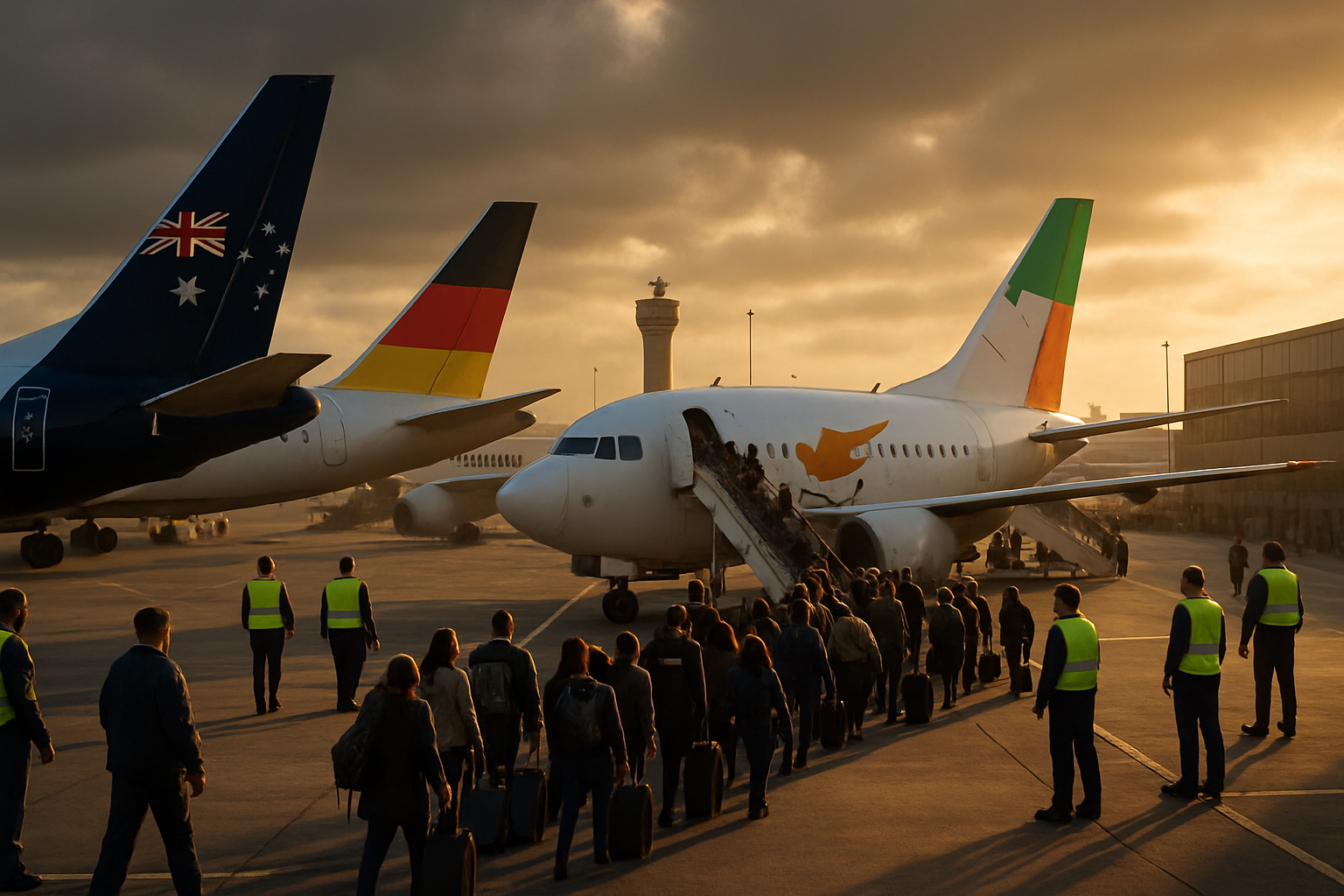
The largest coordinated international evacuation operation since the Arab Spring of 2011 is currently underway, as multiple nations extract hundreds of thousands of their citizens from Middle East conflict zones amid an unprecedented regional crisis that has grounded commercial aviation and threatened global energy security.
The massive repatriation effort, involving over 30 countries, comes as the Middle East faces its most dangerous crisis since the Cold War, with more than 18,000 flights cancelled worldwide and eight nations simultaneously closing their airspace to civilian traffic.
Scale of Evacuation Operations
Australia leads the evacuation numbers with 115,000 nationals trapped across the region, while Germany coordinates the extraction of 30,000 stranded tourists. The crisis has prompted Cyprus to activate its ESTIA national evacuation plan for the first time in history, coordinating the safe return of over 2,000 nationals from the UAE.
Bosnia and Herzegovina has successfully completed its first evacuation flight, with 156 citizens arriving safely at Sarajevo International Airport on Thursday evening. The passengers, who had been stranded in the UAE during escalating regional conflicts, expressed relief at their safe return.
"It had become unbearable, we're fortunate we were evacuated,"
— Bosnian citizen upon arrival in Sarajevo
Ireland has confirmed the safe arrival of hundreds of passengers on the first two flights to land on Irish soil since the conflict escalated, with citizens expressing joy at returning home. Meanwhile, Finland has arranged repatriation flights from Oman, with prices dropping over €1,000 as more evacuation options become available.
Aviation Crisis Compounds Challenges
The evacuation operations are taking place against the backdrop of an unprecedented global aviation crisis. Iran, Iraq, Israel, UAE, Qatar, Syria, Kuwait, and Bahrain have simultaneously closed their airspace, creating the most comprehensive regional disruption since the COVID-19 pandemic.
Dubai International Airport, the world's busiest with over 86 million passengers annually, remains completely shut down due to missile damage, eliminating a critical Europe-Asia transit hub. This has forced evacuating nations to rely on alternative routes through Oman, Egypt, and other regional partners.
Israel has managed to facilitate the return of 3,500 Israeli citizens on the first day of repatriation flights, despite ongoing missile alerts that forced one aircraft from Tbilisi to abort its landing. Additional flights are being added to help bring home an estimated 120,000 Israelis stranded abroad.
European Coordination Efforts
European nations have demonstrated unprecedented coordination in their evacuation efforts. Norway has deployed a consular emergency team to Dubai to assist Norwegian citizens, while Latvia's national airline airBaltic is planning additional repatriation flights from Dubai to Riga.
However, coordination challenges have emerged. Norway's Foreign Ministry declined an offer from energy company Equinor for spare seats on corporate evacuation flights, drawing criticism from opposition politicians who questioned the decision not to utilize available evacuation capacity.
Portugal has confirmed the arrival of its first repatriation flight in Oman, while Serbia reported that a French repatriation flight was forced to return to the Emirates due to missile launches, highlighting the ongoing security challenges faced by evacuation operations.
Energy and Economic Impact
The crisis extends far beyond evacuation logistics. Oil prices have surged past $80 per barrel as Iran has effectively closed the Strait of Hormuz, through which 40% of global seaborne oil transits. Natural gas prices have increased by 24% in Europe and 78% in the United States.
Major shipping companies Maersk and MSC have suspended operations in the Persian Gulf, leaving over 150 tankers stranded with billions of dollars worth of cargo. Qatar has halted LNG production, affecting global energy supplies.
Regional Coalition Under Strain
The evacuation operations occur as an unprecedented regional coalition that had been supporting diplomatic solutions faces severe strain. Saudi Arabia, the UAE, Qatar, and Egypt had formed a rare consensus backing nuclear negotiations, but this unity has been threatened as Iranian retaliation has directly targeted coalition member territories.
Egyptian President Abdel Fattah el-Sisi condemned attacks on "sisterly Arab countries," warning of potential "comprehensive chaos" across the region. The UAE has reported one civilian killed in Abu Dhabi from missile debris, while Kuwait International Airport suffered drone strikes that injured airport personnel.
Diplomatic Context
The current crisis stems from the complete breakdown of nuclear diplomacy between the United States and Iran. Despite achieving what negotiators called "broad agreement on guiding principles" in Geneva talks—the most progress since the 2018 JCPOA collapse—fundamental disagreements over scope proved insurmountable.
Iran excluded ballistic missiles and regional proxies as "red lines," demanding nuclear-only discussions, while the United States insisted on comprehensive talks including missiles, armed groups, and human rights issues. The diplomatic failure led to "Operation Epic Fury," the largest US-Israeli coordinated military operation since the 2003 Iraq invasion.
Historical Significance
The current evacuation operation rivals the Arab Spring of 2011 in scope and complexity, but occurs in a more interconnected world where regional conflicts instantly create global humanitarian challenges. The crisis demonstrates both the strengths and limitations of international coordination mechanisms for protecting civilians during rapidly evolving conflicts.
Unlike natural disasters with predictable recovery timelines, this geopolitical crisis depends entirely on military and diplomatic resolution, making planning extremely challenging for aviation authorities and evacuation coordinators.
Nuclear Governance Crisis
The evacuation operations take place amid a broader nuclear governance crisis. The New START treaty between the United States and Russia expired on February 5, marking the first time in over 50 years without US-Russia nuclear constraints. Combined with China's nuclear expansion, UN Secretary-General António Guterres has warned that nuclear risks are at their "highest in decades."
This crisis serves as a template-setting moment for 21st-century diplomacy versus military confrontation in a multipolar era, with implications extending far beyond the current Middle East conflict.
Individual Stories of Resilience
Behind the massive coordination efforts are individual stories of resilience and adaptation. Jo Swain, stranded in Dubai, was unable to travel to attend her father's funeral and had to watch the service on Zoom due to flight groundings. Such personal impacts highlight the human cost of regional conflicts in an interconnected world.
Australian travelers who had been among the first to be evacuated expressed relief at reaching safety, while many others continue to wait in transit zones and airports across the region for available evacuation flights.
Recovery Timeline Uncertain
Aviation industry experts warn that even when flights resume, clearing the backlog of stranded passengers could take weeks. The crisis has forced a fundamental reconsideration of route planning, risk assessment procedures, and international cooperation frameworks for managing geopolitical travel disruptions.
The success or failure of these evacuation efforts will likely influence future international approaches to conflict resolution, energy security architecture, and civilian protection mechanisms for decades to come.
Looking Ahead
As evacuation operations continue, international observers note this crisis as potentially the most consequential test of multilateral cooperation and crisis management in the modern era. The coming days will determine whether this remains a contained regional crisis or expands into broader international disruptions with implications extending far beyond current evacuation challenges.
The unprecedented scale of coordination required—from flight scheduling to diplomatic clearances to emergency funding—has created a new template for international crisis response that may serve as a model for future global emergencies in an increasingly volatile geopolitical environment.