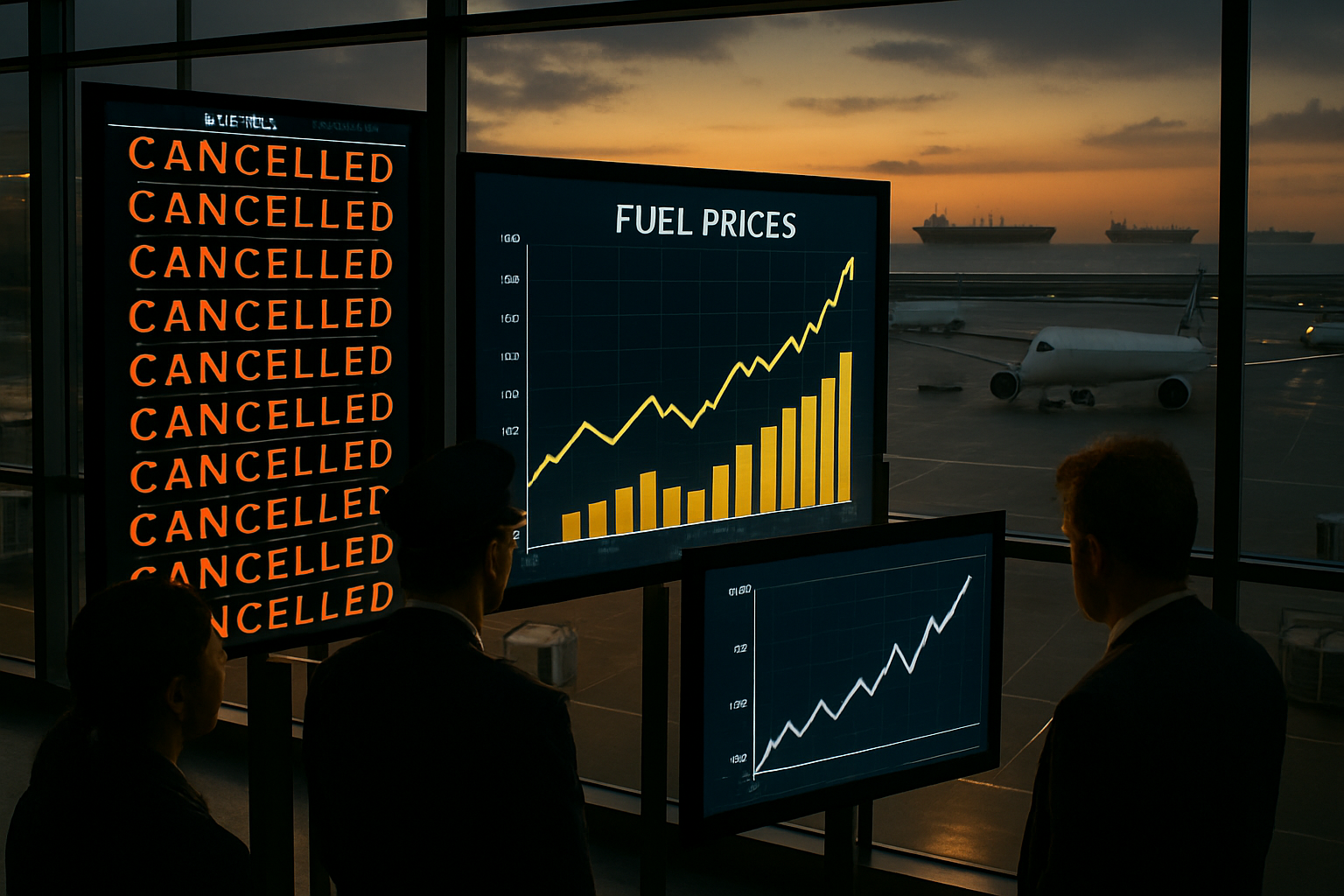
The ongoing Middle East conflict has triggered the most severe global aviation crisis since the COVID-19 pandemic, with jet fuel prices skyrocketing from $85-90 per barrel to between $150-200, forcing airlines worldwide to implement emergency fare increases and cancel thousands of flights.
Major carriers including Australia's Qantas Airways, Scandinavian Airlines (SAS), and Air New Zealand announced significant airfare hikes on Tuesday, citing an "abrupt spike" in fuel costs caused by the escalating Iran-US-Israel conflict that has disrupted critical oil supply routes through the Middle East.
Fuel Costs Reach Crisis Levels
The dramatic surge in aviation fuel prices represents the most significant cost shock the industry has faced in decades. Before the conflict began, jet fuel was trading at approximately $85-90 per barrel. The current range of $150-200 per barrel represents an increase of up to 122%, making flight operations unsustainable at previous fare levels.
"Increases of this magnitude make it necessary to react in order to maintain stable and reliable operations," an SAS spokesperson explained, adding that the airline had implemented a "temporary price adjustment" to cope with the unprecedented fuel cost surge.
The crisis stems from Iran's Revolutionary Guard declaring the Strait of Hormuz "unsafe for shipping," effectively closing a waterway that handles 40% of global seaborne oil transit. This 21-mile chokepoint has become the epicenter of a global energy crisis that extends far beyond aviation.
Airlines Implement Emergency Measures
Air New Zealand has suspended its financial outlook for 2026 due to uncertainty over the conflict's duration and fuel price trajectory. The carrier, along with many others, is passing the unsustainable fuel costs directly to consumers through fare increases and fuel surcharges.
Norwegian and multiple international carriers are implementing significant fare increases as the crisis deepens. The aviation industry is simultaneously dealing with the most extensive flight cancellation crisis since COVID-19, with over 18,000 flights cancelled worldwide due to airspace closures across eight Middle Eastern countries.
However, the impact varies significantly by route type. Shorter-haul flights have seen minimal disruption so far, with budget carrier Ryanair having hedged its summer fuel costs in advance, providing some protection against the current price volatility.
Global Supply Chain Disruption
The crisis extends well beyond passenger aviation. Qatar has halted LNG production at its Ras Laffan and Mesaid facilities, affecting approximately 20% of global LNG exports. Major shipping companies Maersk and MSC have suspended Persian Gulf operations, with over 150 oil and LNG tankers stranded, representing billions in cargo value.
Natural gas prices have exploded by 24% in Europe and 78% in the United States, reaching €47.32/MWh in Europe - the highest level since February 2025. This broader energy crisis is compounding the aviation industry's challenges, as airports and ground operations also face dramatically higher energy costs.
Consumer Impact Worldwide
The fuel crisis is creating immediate impacts for consumers across the globe. In Pakistan, fuel costs have reached Rs321.17 per liter, the highest in South Asia. Sweden is predicting electricity increases of 10-20 öre and gasoline increases of 1-2 kronor per liter, with the Malmö region most exposed due to continental market integration.
Ireland has seen "brazen rip-off" increases in heating oil and motor fuel, with prices approaching €2 per liter. Austria reports fuel cost increases of 20%, while Bangladesh has implemented fuel rationing affecting 170 million people.
Aviation expert Finlay Asher warns that "the Iran war's disruption to Middle East airspace could impact the aviation industry for months," even if the conflict ends soon. The recovery timeline remains uncertain, dependent on military operations resolution and diplomatic normalization rather than predictable factors like weather disruptions.
Market Response and Government Action
Financial markets have responded with alarm to the crisis. Pakistan's KSE-100 index suffered its largest single-day decline in history, falling 8.97%. South Korea's KOSPI dropped 12%, triggering circuit breakers, while the Korean won hit a 17-year low. Central banks including the European Central Bank and Bank of Japan are coordinating emergency liquidity measures.
G7 finance ministers are discussing coordinated strategic petroleum reserve releases through the International Energy Agency. Japan is considering deploying its national oil stockpiles for the first time since the 2011 Fukushima disaster, given its 95% dependence on Middle Eastern oil supplies, 70% of which transit through the now-closed Strait of Hormuz.
OPEC's emergency production increase of 206,000 barrels per day in April is insufficient to offset the shipping disruption caused by the Strait of Hormuz closure. Alternative routes through the Arabian Peninsula lack adequate capacity and involve significant time and cost penalties.
Industry Transformation Accelerated
The crisis is accelerating discussions about fundamental changes to the aviation industry's operational model. Airlines are implementing emergency protocols including enhanced fuel loading to avoid refueling in affected zones, complex rerouting that includes Caribbean stopovers for trans-Pacific routes, and dramatically increased operational costs.
The over-dependence on Middle Eastern hubs for Europe-Asia connectivity has been starkly exposed. With Russian and Ukrainian airspace already closed due to that conflict, airlines face unprecedented routing challenges that significantly increase flight times and fuel consumption.
Industry experts suggest this crisis will accelerate route diversification investments and enhanced contingency planning. The vulnerability of modern transportation networks to geopolitical instability in strategic regions has never been more apparent.
Long-Term Implications
Samuel Ciszuk, an energy analyst, describes this as "the most severe energy security crisis in decades, exposing single-chokepoint vulnerabilities." The crisis demonstrates how a 21-mile waterway can bring global transportation and energy systems to a near standstill.
Qatar's Energy Minister Saad Al Kaabi has warned that Gulf states may be forced to declare force majeure "within weeks" if the situation continues, potentially driving oil prices to $150 per barrel and threatening to "bring down economies of the world."
The aviation industry faces a template-setting moment for 21st-century crisis management. Unlike weather-related disruptions with predictable recovery timelines, this geopolitical crisis depends entirely on military operations resolution and diplomatic normalization.
The current crisis represents the most dangerous international situation since the Cold War ended, with implications extending far beyond aviation. Success in containing the crisis could provide a framework for future nuclear crisis resolution, while failure might accelerate military solutions and reshape Middle Eastern geopolitics for decades.
As airlines continue to implement fare increases and consumers face higher travel costs worldwide, the aviation industry confronts a fundamental reckoning with its dependence on volatile geopolitical regions for both fuel supplies and critical flight routes. The coming weeks will determine whether this crisis marks a temporary disruption or the beginning of a new era in global aviation.