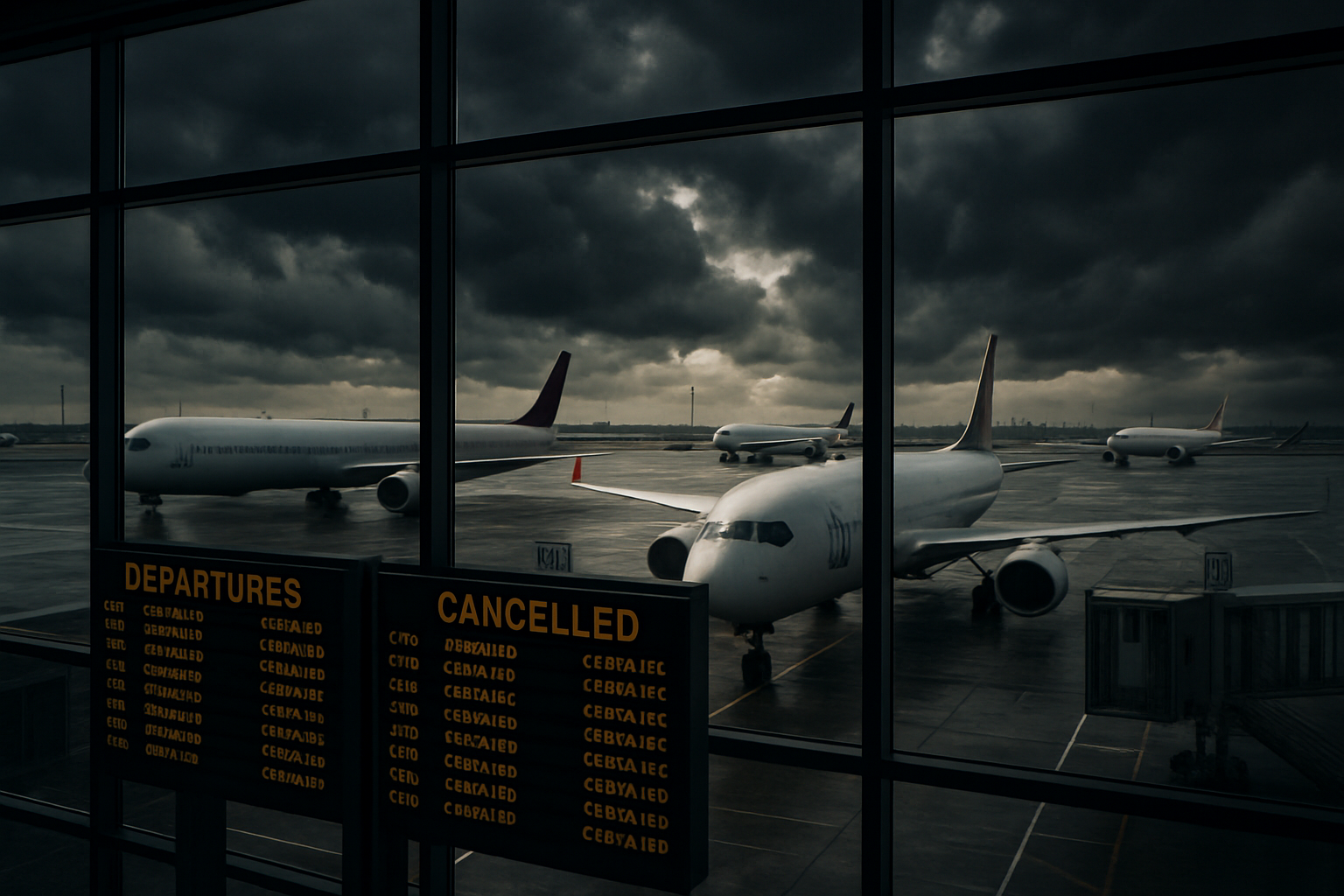
European aviation faces its most critical challenge since the COVID-19 pandemic as International Energy Agency Director Fatih Birol warns the continent has "perhaps six weeks of jet fuel" remaining before widespread flight cancellations become inevitable by early June 2026.
The crisis stems from Iran's Revolutionary Guard closure of the Strait of Hormuz, the strategic waterway that handles 40% of global seaborne oil transit through a 21-mile chokepoint. This unprecedented blockade has triggered the most severe energy crisis since the 1970s oil shocks, sending oil prices soaring past $100 per barrel for the first time since 2022.
Critical Aviation Fuel Shortages Emerge
The warning from the IEA represents the most dire assessment yet of the aviation industry's vulnerability to the ongoing Middle East conflict. Jet fuel prices have surged 122% from $85-90 to $150-200 per barrel, forcing airlines across the globe to implement emergency measures.
Wizz Air CEO József Váradi reports reactive jet fuel shortages at three Italian airports, while Lufthansa has grounded up to 27 aircraft and permanently closed its CityLine subsidiary, citing unsustainable fuel costs. Italian airports experiencing severe limitations include Brindisi, Bologna, Milan Linate, Treviso, Venice, Reggio Calabria, and Pescara.
"We're conducting daily emergency calls with fuel suppliers across Europe. The situation is unprecedented in my 30-year career."
— Michael O'Leary, Ryanair CEO
The scale of aviation disruption has reached COVID-19 levels, with over 18,000 flights cancelled worldwide. Eight Middle East countries maintain simultaneous airspace closures—Iran, Iraq, Israel, UAE, Qatar, Syria, Kuwait, and Bahrain—creating what industry experts describe as an "aviation black hole" severing Europe-Asia corridors.
Oil Price Volatility Reaches Historic Levels
The energy crisis has driven oil prices to historic peaks, with Brent crude reaching $119.50 and West Texas Intermediate (WTI) recording an 18.98% single-day jump to $108.15—the largest daily increase on record. Natural gas prices have exploded 24% in Europe and 78% in the United States, reaching €47.32/MWh, the highest level since February 2025.
The International Energy Agency has deployed the largest strategic petroleum reserve release in its 50-year history—400 million barrels from 32 countries, more than double the 182.7 million barrels released during the 2022 Ukraine crisis. Japan is contributing 80 million barrels, its first such release since the 2011 Fukushima disaster, despite the country's 95% dependence on Middle East oil, with 70% transiting through the now-blocked Strait of Hormuz.
Tourism Industry Scrambles for Alternatives
The crisis has forced a fundamental reshaping of global travel patterns. Asian tourists are abandoning European destinations due to Middle East transit problems, with Italian tourism officials expressing concern about the critical summer season. Travel influencer Francesca Di Pietro, who runs the Instagram page "Viaggiare da soli," advises travelers to "not wait to book because prices will rise, but have a backup plan in case of cancellation."
Domestic tourism has surged as international travel becomes increasingly expensive and unreliable. In New Zealand, skyrocketing fuel prices and Middle East instability are prompting locals to travel domestically during school holidays, representing a global trend of consumers adapting to volatile energy costs and geopolitical uncertainty.
Government Emergency Responses Intensify
European governments have abandoned free-market principles to protect consumers and critical industries. Hungary imposed immediate price caps on gasoline and diesel to counter "war-driven price explosions." France deployed 500 fuel inspectors to prevent price manipulation, while Romania outlined five emergency scenarios to prevent diesel from exceeding 10 lei per liter.
The European Council has called an emergency meeting in response to the IEA's warning, with EU parliamentarian Johan Danielsson (S) stating: "The world we lived in, which we perhaps naively thought we would continue to live in, no longer exists. We are in the midst of an awakening."
Nuclear Diplomacy Breakdown Triggers Crisis
The current crisis stems from the complete collapse of US-Iran nuclear negotiations despite what appeared to be breakthrough progress in Geneva. The talks, which had achieved a "broad agreement on guiding principles"—the most significant progress since the 2018 JCPOA breakdown—foundered on fundamental scope disagreements.
Iran maintained that ballistic missiles and regional proxies were "red lines" to be excluded from nuclear-only talks, while the United States demanded comprehensive agreements addressing missiles, armed groups, and human rights. This diplomatic failure led to Operation Epic Fury, the largest US-Israeli coordinated operation since 2003, triggering Iran's massive retaliation under "Operation True Promise 4."
"We are facing the greatest test of multilateral cooperation in the modern era, with nuclear risks at their highest levels in decades."
— António Guterres, UN Secretary-General
Financial Markets in Turmoil
Global financial markets have experienced historic crashes as the crisis intensifies. Pakistan's KSE-100 index suffered its largest single-day decline in history, dropping 8.97%, while South Korea's KOSPI fell 12%, triggering circuit breakers as the Korean won hit 17-year lows. PayPal postponed its $1.1 billion IPO indefinitely due to market volatility.
Central banks, including the European Central Bank and Bank of Japan, are coordinating emergency liquidity measures, but traditional monetary policy tools have proven limited in effectiveness against these structural geopolitical disruptions.
Consumer Impact Reaches Crisis Levels
The fuel crisis has created devastating consumer impacts worldwide. In Bangladesh, fuel rationing affects 170 million people, while Pakistan has implemented wartime austerity measures including four-day government work weeks, with fuel prices reaching Rs321.17 per liter—the highest in South Asia.
European consumers face similar pressures, with Swedish electricity prices rising 10-20 öre and gasoline increasing 1-2 kronor, with Malmö being the most exposed due to continental integration. In Ireland, heating oil prices approaching €2 per liter have been denounced as "brazen rip-offs" by consumer groups.
Supply Chain Vulnerabilities Exposed
The crisis has exposed dangerous vulnerabilities in global supply chains that extend far beyond energy. The Persian Gulf serves as a critical trade hub affecting consumer goods, industrial materials, and food distribution worldwide. With major shipping companies Maersk and MSC suspending all Persian Gulf operations, over 150 oil and LNG tankers worth billions in cargo remain stranded.
Manufacturing industries dependent on Gulf networks—including automotive, electronics, and textiles—face severe disruptions. China has suspended refined fuel exports, while Singapore reports 30% increases in logistics costs, demonstrating how the 21-mile Strait of Hormuz represents a dangerous single-point failure in modern logistics.
Energy Security Paradigm Shift
Energy security experts describe the crisis as a watershed moment requiring fundamental transformation of global energy architecture. Samuel Ciszuk, a leading energy analyst, characterizes it as "the most severe energy security crisis in decades, with single-chokepoint vulnerabilities completely exposed."
Qatar Energy Minister Saad Al Kaabi has warned that Gulf states may be forced to declare force majeure "within weeks," with oil potentially approaching $150 per barrel, threatening to "bring down the economies of the world." Strategic petroleum reserves, while providing temporary buffering, are insufficient against sustained disruptions of this magnitude.
Looking Forward: Uncertain Recovery Timeline
Unlike weather-related disruptions, the recovery timeline depends entirely on military and diplomatic developments rather than predictable economic factors. Airlines cannot maintain long-term scheduling with multiple airspaces closed and energy markets volatile due to blocked critical transit routes.
The crisis represents a template-setting moment for 21st-century international relations, simultaneously affecting regional war prevention, global energy security, nuclear governance credibility, and international law enforcement. Success in containing the escalation could provide a framework for future nuclear crisis resolution, while failure may accelerate military solutions, reshape Middle Eastern geopolitics for decades, encourage nuclear proliferation globally, and undermine diplomatic credibility worldwide.
As Europe faces the prospect of systematic aviation shutdowns during the peak summer travel season, the next six weeks will determine whether diplomatic solutions can prevail over military confrontation in defining how the international community addresses complex geopolitical crises in an increasingly interconnected but volatile world.