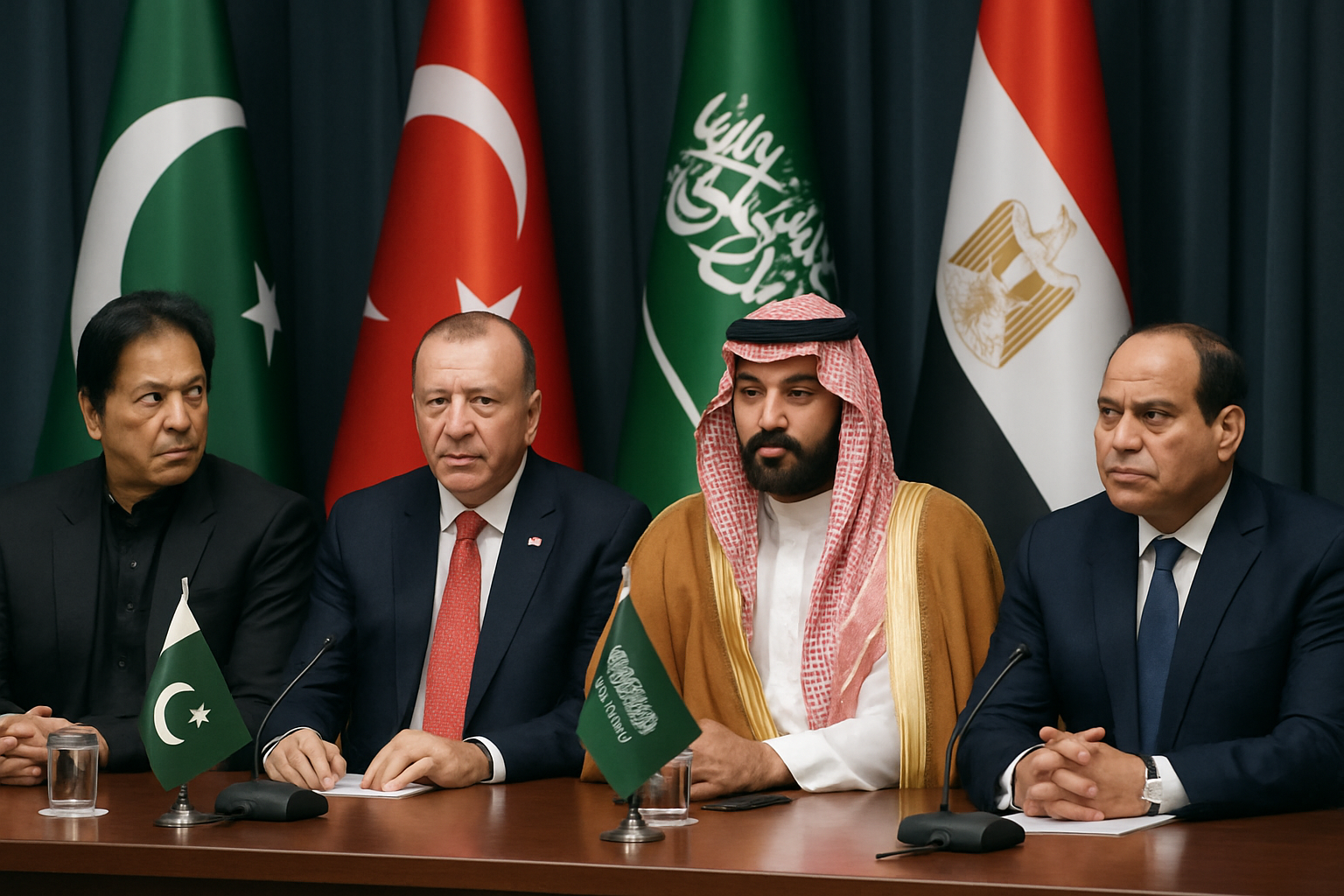
In a historic shift away from Western-led diplomatic frameworks, Pakistan, Turkey, Saudi Arabia, and Egypt have emerged as the Middle East's new power brokers, forging an unprecedented coalition that successfully mediated the world's most dangerous crisis since the Cold War while establishing new templates for 21st-century conflict resolution.
The transformation of regional diplomacy reached its zenith on April 8, 2026, when Pakistan's Prime Minister Shehbaz Sharif and Field Marshal Asim Munir successfully brokered a breakthrough US-Iran ceasefire just 88 minutes before President Trump's apocalyptic "whole civilization will die tonight" deadline. The Pakistani mediation, conducted through an innovative "message relay system," ended a crisis that had paralyzed global energy markets, cancelled 18,000+ flights worldwide, and brought the world closer to catastrophic conflict than the Cuban Missile Crisis.
Pakistan: The Unexpected Mediator
Pakistan's emergence as a crucial diplomatic mediator represents one of the most significant developments in modern international relations. Foreign Minister Ishaq Dar's public acknowledgment that Pakistan had been facilitating indirect US-Iran talks through a "message relay system" marked the formal recognition of the country's role as a "net regional stabilizer," as described by European diplomatic sources.
The quadrilateral framework established by Pakistan, bringing together foreign ministers from Saudi Arabia, Turkey, and Egypt in Islamabad, represents a departure from traditional Western-led mediation efforts. This innovative approach proved its worth when the "Islamabad Accord" framework prevented global catastrophe, demonstrating that middle powers can effectively bridge major adversary divides when traditional mechanisms fail.
"Pakistan's ability to maintain relationships across traditional alliance lines positions it as an increasingly valuable diplomatic asset in our multipolar world."
— European Diplomatic Source
Turkey's Strategic Bridge-Building
Turkey's role extends beyond traditional regional boundaries, with President Erdogan conducting strategic diplomatic tours that have reshaped Middle Eastern alliances. The Turkey-Saudi renewable energy agreement, signed during Erdogan's February 2026 diplomatic tour, exemplifies the pragmatic cooperation driving this new regional order.
Turkish Foreign Minister Hakan Fidan's emphasis on establishing "de-escalation mechanisms" has become central to the coalition's approach. Turkey's unique position as a NATO member with strong regional partnerships provides the coalition with crucial Western connectivity while maintaining independence from traditional alliance constraints.
Saudi Arabia: From Rivalry to Partnership
Perhaps most remarkably, Saudi Arabia has moved from regional rivalry to unprecedented cooperation with former adversaries. The Kingdom's $3 billion financial support package to Pakistan in April 2026 signaled a new era of strategic partnership that transcends traditional sectarian and geopolitical divisions.
Crown Prince Mohammed bin Salman's meetings with Turkish President Erdogan at Al Yamama Palace in February 2026 culminated in comprehensive energy agreements and business partnerships that demonstrate the Kingdom's commitment to diversified regional engagement. This represents a fundamental shift from Saudi Arabia's traditional approach of Western-aligned policies to a more independent regional strategy.
Egypt: The Arab World's Stabilizing Force
Egypt's participation through President Al-Sisi has provided crucial Arab legitimacy to the coalition's initiatives. Egyptian condemnation of Iranian attacks on "sisterly Arab countries" while maintaining support for diplomatic solutions demonstrates the delicate balance these new power brokers must maintain.
The second Turkish-Egyptian High-Level Strategic Cooperation Council meeting, co-chaired by Erdogan and Al-Sisi, focused on the Palestinian issue and regional developments, showing how former rivals have become partners in addressing the region's most complex challenges.
Innovation in Crisis Management
The coalition's success lies not just in bringing together unlikely partners, but in developing entirely new diplomatic methodologies. The "message relay system" pioneered by Pakistan represents a breakthrough in conflict mediation, allowing communication between adversaries when direct channels are impossible.
UN Secretary-General António Guterres described the April 2026 crisis as the "greatest test of multilateral cooperation in the modern era." The successful resolution through this new regional framework provides what experts are calling a template for 21st-century conflict resolution.
Economic Underpinnings of New Alliances
The coalition's strength is reinforced by substantial economic partnerships. Turkey's involvement in the 5,000 MW solar power projects in collaboration with Saudi Arabia, worth billions in investment, demonstrates how energy cooperation is binding these nations together beyond traditional diplomatic ties.
Pakistan's financial arrangements with Saudi Arabia, coupled with its growing role as a regional trade hub, create natural incentives for diplomatic engagement that extend far beyond immediate crisis management.
Challenges to Traditional Power Structures
This emerging coalition represents a fundamental challenge to post-World War II international order mechanisms. The success of the Pakistani-mediated ceasefire, despite the failure of traditional Western diplomatic channels, signals a shift toward multipolar diplomatic solutions.
The coalition maintained cohesion even when severely tested during the March-April 2026 crisis, when Iranian retaliation targeted coalition member territories directly. The UAE reported one civilian killed in Abu Dhabi, Kuwait suffered 32 injuries from airport strikes, and Qatar intercepted 65 missiles and 12 drones. Despite these attacks, the coalition preserved its diplomatic consensus—a remarkable achievement in regional politics.
Template for Future Cooperation
The success of this four-nation framework extends beyond immediate crisis resolution. European sources note that this model of regional cooperation could influence future international approaches to conflict management, demonstrating that innovative frameworks can emerge when traditional approaches struggle.
Chinese Foreign Minister Wang Yi's "full support" for the Pakistani initiative, along with German officials noting "positive signs" from the framework, indicates growing international recognition of these new diplomatic mechanisms.
Long-term Implications
The emergence of Pakistan, Turkey, Saudi Arabia, and Egypt as regional power brokers signals a broader transformation in global governance. Their success in preventing regional war while managing energy security concerns, nuclear governance challenges, and humanitarian crises simultaneously demonstrates the effectiveness of middle-power diplomacy.
This coalition's approach—combining religious diplomacy (leveraged by Saudi Arabia and Pakistan), strategic partnerships (developed by Turkey), and Arab world legitimacy (provided by Egypt)—offers a new model for addressing complex regional challenges that transcend traditional alliance structures.
As the world continues to grapple with multipolar challenges, the success of this Middle Eastern coalition provides hope that innovative diplomatic solutions can emerge from unexpected quarters. Their ability to bridge traditional divides while maintaining strategic autonomy may well define the future of international relations in an increasingly complex global landscape.