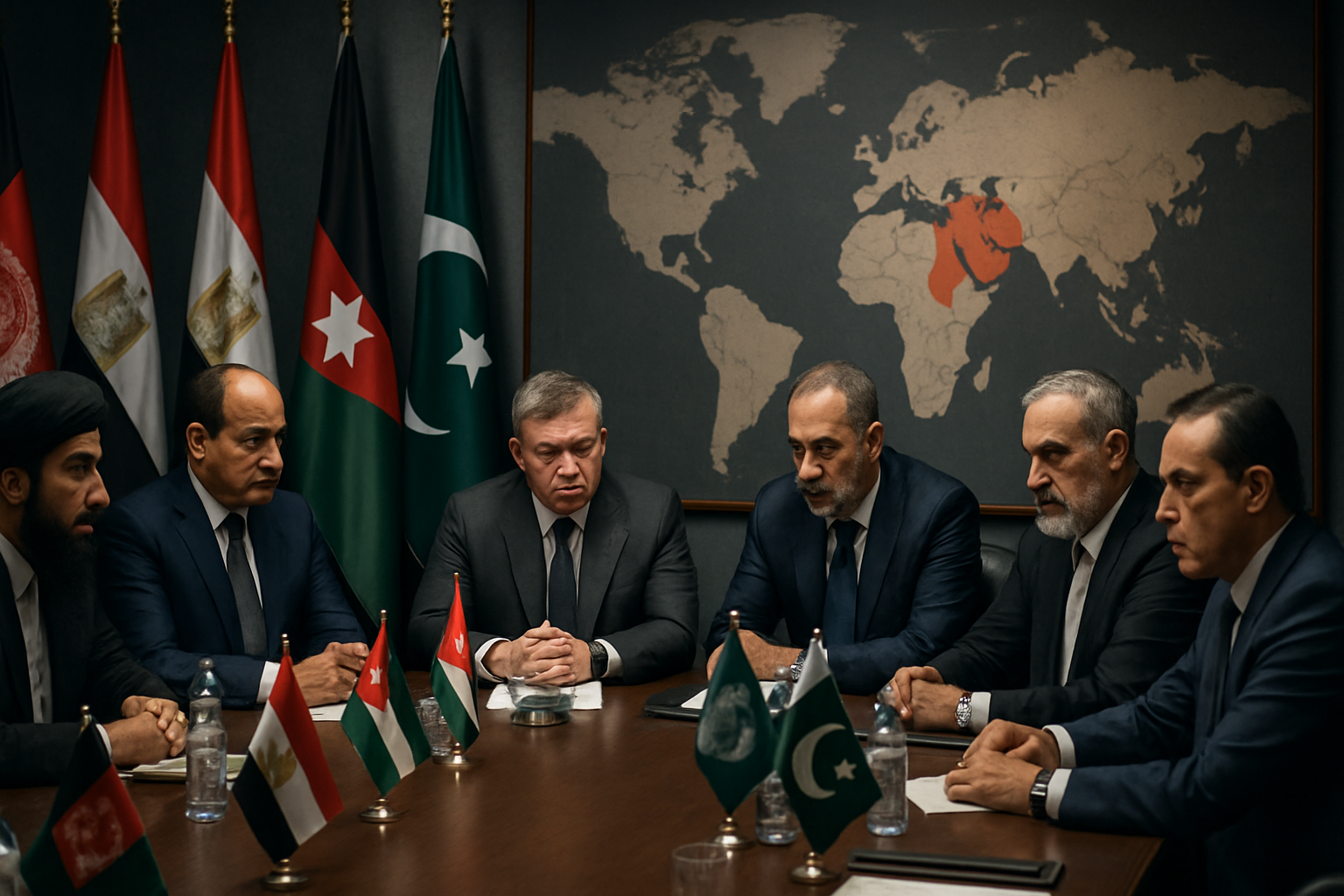
Countries across the Middle East and South Asia have expressed grave concerns over the escalating regional security crisis following the US-Israeli "Operation Epic Fury" strikes against Iran and subsequent Iranian retaliation, with officials warning that the military confrontation threatens to destabilize the entire region and beyond.
Afghanistan's Ministry of Foreign Affairs issued a strong statement Sunday expressing "serious concern over rapidly escalating political and security tensions in the region," warning that the consequences could "negatively affect all neighboring countries." The Islamic Emirate said it was "deeply worried" about recent strikes carried out by Israel and the United States on Iranian territory, as well as Iran's subsequent missile and drone attacks targeting Gulf states.
Egyptian Leadership Calls for Diplomatic Solutions
Egypt has emerged as a leading voice calling for restraint, with President Abdel Fattah Al-Sisi conducting urgent diplomatic consultations with regional leaders. In separate phone calls Sunday with Oman's Sultan Haitham bin Tariq and Iraqi Prime Minister Mohammed Shia Al-Sudani, President Sisi strongly condemned the targeting of civilian infrastructure and emphasized Egypt's position that regional crises must be resolved through dialogue and peaceful means.
Egyptian officials firmly refuted allegations that Israel had provided Cairo with advance notice of its plans to strike Iran, labeling such claims as "completely false." The Egyptian Ministry of Foreign Affairs warned that the conflict involving the U.S., Israel, and Iran could "spiral into chaos, threatening regional and international security."
"The ministry reiterated the urgent need for political solutions, emphasizing that reliance on military force would only result in increased violence and bloodshed."
— Egyptian Ministry of Foreign Affairs Statement
President Sisi particularly condemned the Iranian attack on Oman's Duqm Port, reaffirming Egypt's support for Arab sovereignty and commending Oman's mediation efforts in facilitating negotiations between the United States and Iran over Tehran's nuclear program.
Jordan Mobilizes National Security Response
Jordan has activated its highest level security protocols in response to the crisis. King Abdullah II convened an emergency meeting of the National Security Council on Sunday to discuss the current regional escalation, with Crown Prince Hussein bin Abdullah II in attendance. The King received briefings on contingency plans for dealing with developments while maintaining the Kingdom's security and ensuring citizen safety.
In a telephone call with Bahrain's King Hamad bin Isa Al Khalifa, both leaders condemned Iranian attacks on their territories and emphasized the need for diplomacy and dialogue to resolve tensions without exporting conflict to regional countries. King Abdullah stressed Jordan's commitment to taking all necessary measures to preserve its security, stability, and citizens' safety.
The Jordanian government has also moved to reassure citizens about essential supplies. Industry, Trade and Supply Minister Yarob Al-Qudah announced that the ministry has contingency plans to deal with emerging circumstances while ensuring supply chain continuity and market availability of goods and production requirements. He confirmed that strategic food reserves are secure and sufficient to cover domestic market needs for comfortable periods.
Pakistan Condemns Violations of International Law
Pakistan has taken a strong stance at the United Nations, with its Permanent Representative Asim Iftikhar Ahmad condemning attacks against Iran during UN Security Council proceedings. Speaking under the agenda item "The Situation in the Middle East," Ahmad stated that military action "will undermine the peace and stability of the entire region, with far-reaching consequences."
Pakistan also condemned retaliatory attacks against Saudi Arabia, Bahrain, Jordan, Kuwait, Qatar, and the United Arab Emirates, declaring its solidarity with "all these brotherly countries" and underscoring the need for "maximum restraint."
The Pakistani Foreign Office activated its crisis management unit to monitor developments and provide assistance to Pakistani nationals abroad. The unit, operational 24/7, strongly advised Pakistani nationals residing in the Gulf region to "exercise utmost caution" given the deteriorating security situation.
International Aviation and Economic Disruption
The crisis has triggered unprecedented disruptions to regional and global systems. Multiple countries including Iran, Iraq, Israel, UAE, and Qatar have closed their airspace to civilian traffic, resulting in the cancellation of over 18,000 flights worldwide. Dubai International Airport, the world's busiest international hub, sustained missile damage and was forced to completely shut down operations.
Malta's Deputy Prime Minister Ian Borg has been in contact with officials in Qatar and the UAE to monitor the situation for Maltese nationals in the region, condemning Iran's retaliation against countries not involved in the initial attacks.
The economic implications extend far beyond the region, with oil prices rising due to concerns about the Strait of Hormuz, through which 40% of global oil transits. Energy analysts warn that any prolonged disruption could trigger a global energy crisis affecting supply chains and economies worldwide.
Nuclear Diplomacy Collapse Context
The current crisis represents the complete breakdown of months of intensive nuclear negotiations between the United States and Iran. Despite achieving what Iranian Foreign Minister Abbas Araghchi had called "broad agreement on guiding principles" - the most significant diplomatic progress since the 2018 collapse of the Joint Comprehensive Plan of Action (JCPOA) - fundamental disagreements over the scope of any potential agreement proved insurmountable.
Iran had maintained that ballistic missiles and regional proxy relationships were "red lines" excluded from nuclear-only talks, while U.S. Secretary of State Marco Rubio insisted on a comprehensive agreement addressing missiles, armed groups, and human rights issues alongside nuclear concerns.
Regional Coalition Under Strain
The crisis has severely tested an unprecedented regional coalition of Saudi Arabia, UAE, Qatar, and Egypt that had backed diplomatic efforts to resolve the Iran-US nuclear standoff. These nations, which had formed an extraordinary consensus supporting peaceful resolution, now find themselves caught between their support for diplomatic solutions and the reality of direct Iranian attacks on their territories.
The targeting of civilian and military infrastructure across the Gulf states has prompted widespread evacuations and emergency protocols. Qatar successfully intercepted 65 ballistic missiles and 12 drones using Patriot defense systems, though debris still caused injuries. The UAE reported one civilian death in Abu Dhabi from missile debris, while Kuwait's international airport was struck by Iranian drones.
Broader Security Implications
Regional security experts warn that the current crisis represents a fundamental shift in Middle Eastern geopolitics, with implications extending far beyond the immediate participants. The breakdown of diplomatic frameworks that had shown promise of resolving long-standing nuclear concerns raises serious questions about the viability of peaceful conflict resolution in an increasingly multipolar world order.
The crisis occurs against the backdrop of broader nuclear governance challenges, including the expiration of the New START Treaty between the United States and Russia on February 5 - the first time in over 50 years that no nuclear arms control constraints exist between the superpowers. UN Secretary-General António Guterres has warned that nuclear risks are at their "highest in decades."
The international community now faces the urgent challenge of preventing further escalation while addressing the underlying issues that led to such a dramatic diplomatic breakdown. The success or failure of containment efforts could establish precedents for 21st-century conflict resolution that extend far beyond the Middle East, affecting how territorial, nuclear, and security disputes are addressed globally in the years to come.
As regional powers continue their diplomatic consultations and emergency preparations, the coming days will prove decisive in determining whether the crisis can be contained or whether it will escalate into a broader regional war with global implications for energy security, nuclear governance, and international stability.