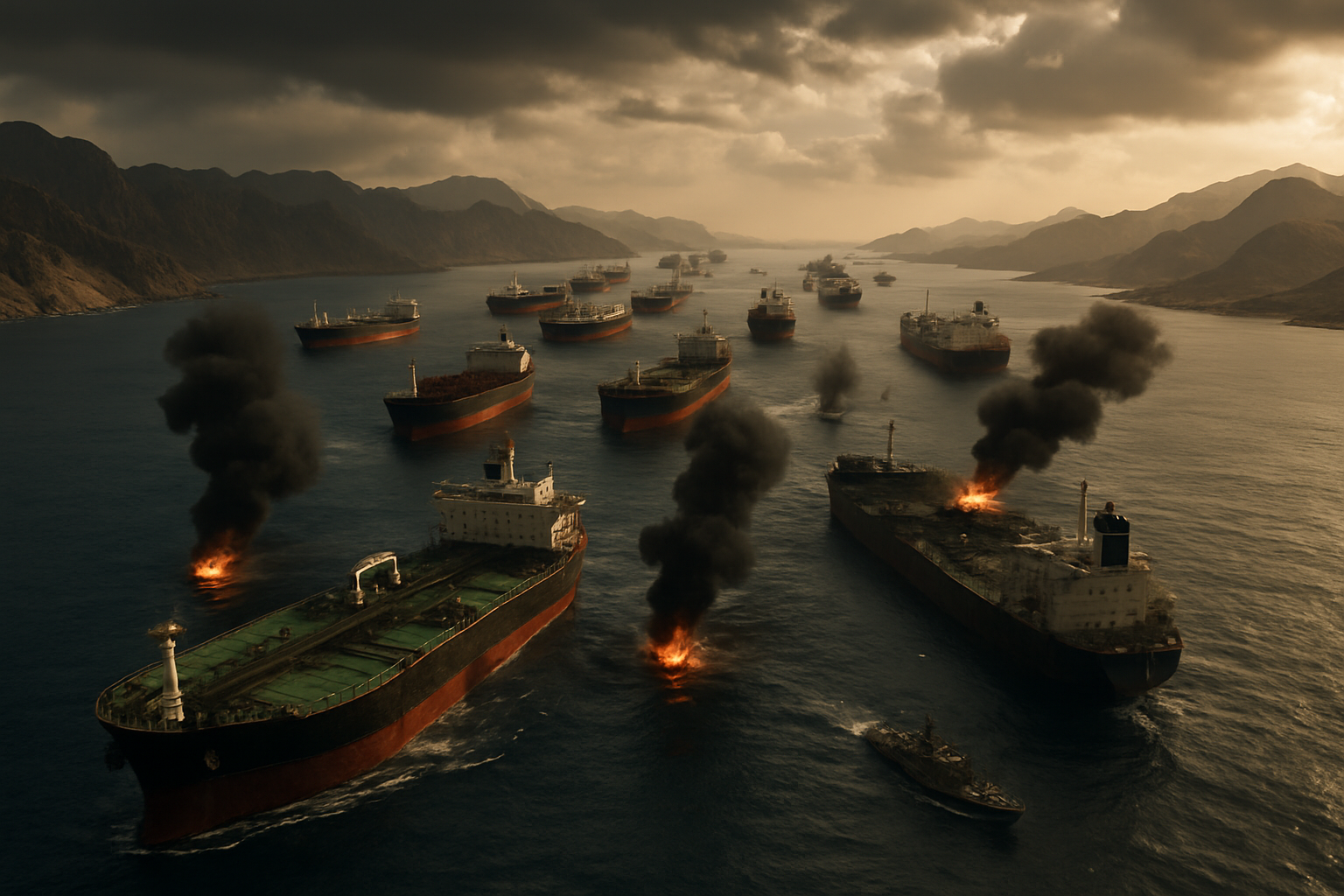
Iran's Revolutionary Guard has effectively blockaded the strategic Strait of Hormuz, declaring the 21-mile waterway "unsafe for shipping" and triggering the most severe global energy crisis since the 1970s oil shocks. With over 150 oil and LNG tankers stranded in the Persian Gulf and oil prices surging past $119 per barrel, the crisis threatens to destabilize the global economy.
Unprecedented Maritime Crisis
The Strait of Hormuz, through which 40% of the world's seaborne oil transit flows daily, has become the epicenter of a mounting crisis that began with Iran's "Operation True Promise 4" retaliation campaign. Major shipping companies Maersk and MSC have suspended all Persian Gulf operations, leaving billions of dollars worth of cargo stranded in what industry experts are calling the most severe maritime disruption in decades.
Iran has deployed an estimated 2,000 to 6,000 naval mines throughout the strategic chokepoint using small vessels, according to U.S. intelligence reports. American forces have destroyed 28 Iranian mine-laying ships in recent weeks, but the waterway remains effectively closed to commercial traffic.
"This is the most severe energy security crisis in decades, exposing our dangerous over-dependence on a single strategic chokepoint," said Samuel Ciszuk, senior energy analyst at Enverus Intelligence Research.
— Samuel Ciszuk, Enverus Intelligence Research
Global Energy Markets in Turmoil
Oil prices have experienced historic volatility, with Brent crude reaching a peak of $119.50 per barrel and West Texas Intermediate jumping 18.98% to $108.15 in what represents the largest single-day increase on record. Natural gas prices have exploded by 24% in Europe and 78% in the United States, reaching €47.32 per megawatt-hour, the highest level since February 2025.
The crisis deepened when Qatar was forced to halt LNG production at its Ras Laffan and Mesaid facilities, which together account for approximately 20% of global LNG exports. Qatar's Energy Minister Saad Al Kaabi has warned that Gulf states may be forced to declare force majeure "within weeks" if the situation continues, potentially driving oil prices toward $150 per barrel.
In response to the crisis, the International Energy Agency announced the largest strategic petroleum reserve release in its 50-year history, deploying 400 million barrels from 32 member countries. Japan is releasing 80 million barrels—its first such deployment since the 2011 Fukushima disaster—highlighting the country's vulnerability with 95% of its oil imports coming from the Middle East, 70% of which transit through the now-closed Strait of Hormuz.
Aviation Industry Paralyzed
The crisis has extended far beyond maritime shipping, with over 18,000 flights cancelled worldwide—the most extensive aviation disruption since COVID-19. Eight countries have simultaneously closed their airspace: Iran, Iraq, Israel, UAE, Qatar, Syria, Kuwait, and Bahrain, effectively creating an "aviation black hole" across critical Europe-Asia air corridors.
Dubai International Airport, the world's busiest with 86 million annual passengers, remains completely shut down due to missile damage. Major carriers including Emirates, Air France-KLM, Wizz Air, and Bulgaria Air have suspended operations indefinitely, stranding hundreds of thousands of passengers globally.
Jet fuel costs have skyrocketed from $85-90 per barrel to $150-200 per barrel, representing a 122% increase that has forced airlines to implement emergency fare surcharges across multiple continents.
Economic Shock Waves
Financial markets have experienced severe disruption, with Pakistan's KSE-100 index crashing 8.97% in its largest single-day decline in history. South Korea's KOSPI fell 12%, triggering circuit breakers as the Korean won hit a 17-year low amid foreign capital flight from technology positions.
The crisis has exposed dangerous vulnerabilities in global supply chains that extend far beyond energy. The Persian Gulf serves as a critical trade hub for consumer goods and industrial materials worldwide, and the 21-mile Strait of Hormuz represents a geographic single-point failure for modern logistics with no realistic alternatives.
Manufacturing sectors dependent on Gulf networks—including automotive, electronics, and textiles—face severe disruptions. China has suspended refined fuel exports, canceling committed shipments, while Singapore reports 30% increases in logistics costs.
Consumer Impact Worldwide
The energy crisis has created immediate hardships for consumers globally. Bangladesh has implemented fuel rationing for 170 million people, while Pakistan has adopted wartime austerity measures including four-day government work weeks as fuel prices reach Rs321.17 per liter, the highest in South Asia.
In Europe, Sweden predicts electricity increases of 10-20 öre and gasoline price rises of 1-2 kronor, with the Malmö region most exposed due to continental market integration. Ireland faces heating oil prices approaching €2 per liter, with consumer groups denouncing what they call "brazen rip-offs."
Australia's NSW Energy Minister Penny Sharpe has held emergency crisis talks as Queensland stations run completely dry, while New Zealand is considering "Muldoon-era" car-free days and petrol limits reminiscent of the 1970s oil crisis.
Diplomatic Breakdown
The shipping crisis stems from the complete collapse of U.S.-Iran nuclear diplomacy despite a Geneva breakthrough that had achieved "broad agreement on guiding principles"—the most progress since the JCPOA collapse in 2018. The fundamental scope disagreement proved insurmountable, with Iran excluding ballistic missiles and regional proxies as "red lines" while the U.S. demanded a comprehensive agreement addressing missiles, armed groups, and human rights.
This diplomatic failure led to "Operation Epic Fury," the largest coordinated U.S.-Israeli military operation since 2003, which prompted Iran's massive retaliation under the banner of "Operation True Promise 4," with Iranian officials declaring "no red lines remain."
Regional Coalition Under Strain
An unprecedented regional coalition of Saudi Arabia, UAE, Qatar, and Egypt that had been backing diplomatic processes is now severely strained as Iranian retaliation has directly targeted member territories. The UAE reported one civilian killed in Abu Dhabi, Kuwait suffered 32 injuries from airport strikes, and Qatar sustained eight wounded while intercepting 65 missiles and 12 drones using Patriot defense systems.
"We condemn these attacks on sisterly Arab countries and warn against comprehensive chaos spreading throughout the region," declared Egyptian President Abdel Fattah el-Sisi.
— President Abdel Fattah el-Sisi, Egypt
Nuclear Governance Crisis
The maritime crisis unfolds against the broader backdrop of a nuclear governance crisis, with the New START treaty having expired on February 5, 2026—the first time in over 50 years that the United States and Russia lack nuclear constraints. Iran continues uranium enrichment at 60% purity with over 400 kilograms of weapons-grade material, sufficient for multiple nuclear weapons if weaponized.
UN Secretary-General António Guterres has described the current nuclear risks as the "highest in decades," calling the situation "the greatest test of multilateral cooperation in crisis management of the modern era."
Energy Architecture Transformation
The crisis has exposed the dangerous over-dependence on strategic chokepoints that requires fundamental restructuring to reduce geopolitical volatility. The 21-mile Strait of Hormuz represents a geographic single-point failure for modern logistics, with alternative Arabian Peninsula routes offering inadequate capacity and significant time and cost penalties.
Strategic petroleum reserves, while providing temporary relief, represent only a buffer for sustained disruptions. Energy security experts emphasize that supply diversification and renewable energy transitions, while requiring years or decades to implement, have gained new urgency in light of the current crisis.
Recovery Timeline Uncertain
Unlike weather-related or technical disruptions that follow predictable patterns, recovery from this crisis depends entirely on military operations resolution and diplomatic normalization. Aviation industries cannot engage in long-term scheduling with closed airspace, while energy markets remain volatile with critical transit routes blocked.
Traditional monetary policy tools have shown limited effectiveness against structural geopolitical disruptions affecting physical infrastructure and international relationships, forcing central banks to coordinate emergency liquidity provision while addressing root causes.
"The situation is going on longer than people initially thought, and financial markets are becoming the ultimate constraint on prolonged conflict," noted Damien Boey, chief economist at Barrenjoey Capital Partners.
— Damien Boey, Barrenjoey Capital Partners
Historical Significance
The current crisis represents the most dangerous international moment since the end of the Cold War, affecting regional war prevention, global energy security, nuclear governance credibility, and international law enforcement of post-WWII order principles simultaneously. The rapid transition from diplomatic breakthrough to military escalation demonstrates the fragility of modern crisis management mechanisms in the multipolar era.
Success in containing the escalation could provide a framework for nuclear crisis resolution and strengthen diplomatic precedents. However, failure may accelerate military solutions, reshaping Middle Eastern geopolitics for decades, encouraging nuclear proliferation globally, and undermining diplomatic credibility for resolving international crises worldwide.
As the world watches this unprecedented crisis unfold, the stakes extend far beyond immediate energy supplies to encompass the fundamental principles of 21st-century international stability and cooperation. The resolution of this crisis will likely establish new paradigms for energy security planning and crisis management that will influence global affairs for decades to come.