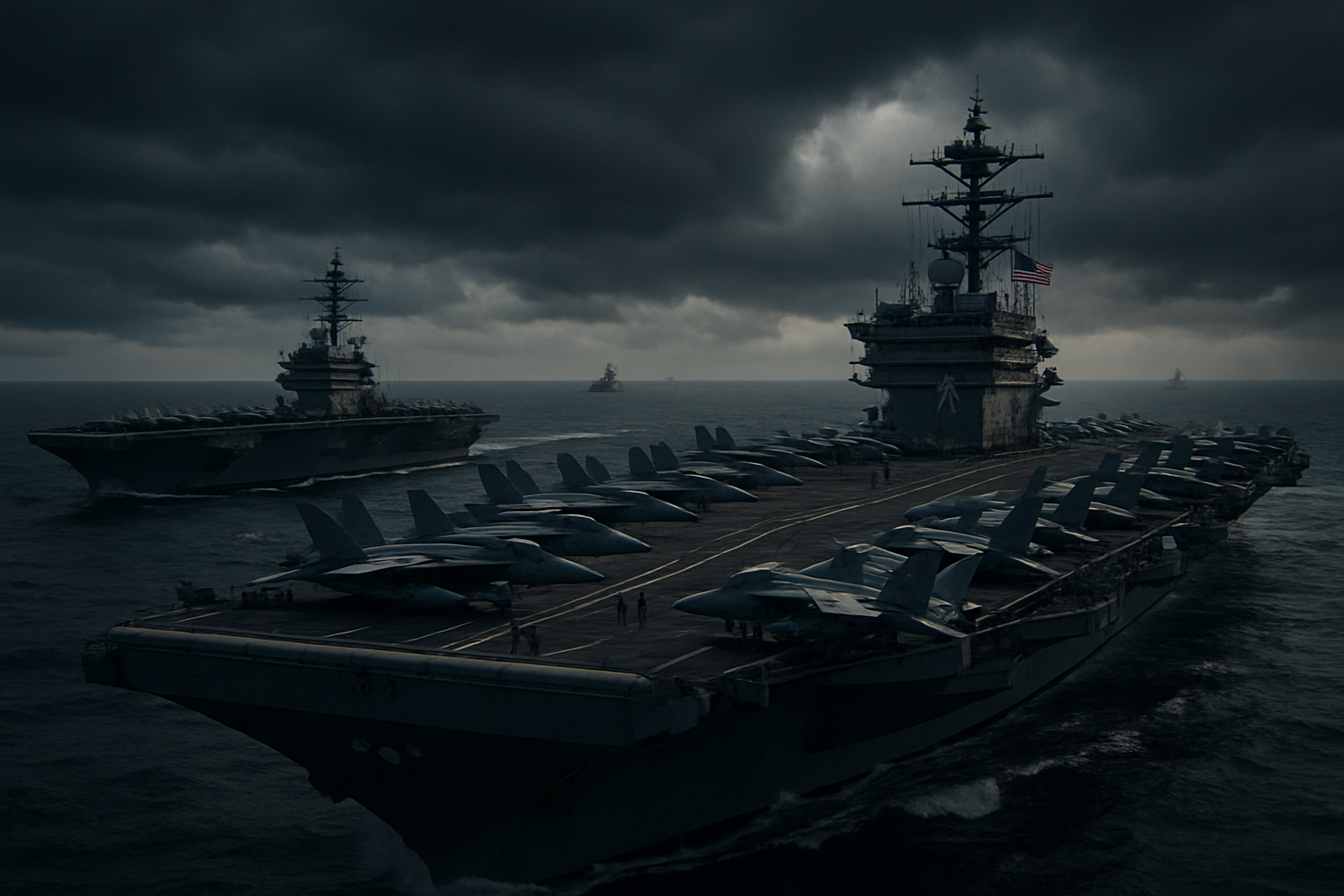
The Middle East teeters on the brink of a major conflict as President Trump issued his most explicit ultimatum yet to Iran, warning that "bad things will happen" if no nuclear agreement is reached within the next 10 days. This historic deadline comes amid the largest U.S. military deployment to the region since the 2003 Iraq invasion and widespread evacuations from American bases across the Middle East.
The escalating crisis has prompted multiple nations to issue immediate evacuation orders for their citizens in Iran. Sweden's Ministry of Foreign Affairs urged its nationals to leave "immediately" due to an "extremely uncertain" security situation, while Serbia advised its citizens to depart "as soon as possible" citing a "deteriorating security situation." These warnings underscore the gravity of tensions as the region braces for potential military confrontation.
Unprecedented Military Buildup
The Pentagon has deployed a dual-carrier strike force to the region, with the USS Gerald R. Ford joining the USS Abraham Lincoln in the Arabian Sea, positioning approximately one-third of the active U.S. Navy fleet just 800 kilometers from Iran's coast. This represents the largest American naval presence in the Middle East since the 2003 Iraq invasion.
In a significant defensive move, hundreds of U.S. troops have been evacuated from Al Udeid Air Base in Qatar, the largest American military installation in the Middle East housing approximately 10,000 personnel. Additional evacuations have been confirmed from Bahrain, where the U.S. Navy's Fifth Fleet is headquartered, as well as bases in Iraq, Syria, Kuwait, Saudi Arabia, Jordan, and the UAE.
"All bases, facilities, and assets of the hostile force in the region would constitute legitimate targets. The United States would bear full and direct responsibility for any unpredictable and uncontrolled consequences."
— Iran's UN Ambassador Amir Saeid Iravani, in letter to UN Secretary-General
The Iranian warning to the United Nations represents the most direct threat against American installations across the region, affecting bases from Qatar to Kuwait that house thousands of U.S. personnel.
Geneva Talks Achieve Framework Breakthrough
Despite the military tensions, diplomatic efforts have produced their most significant breakthrough since the collapse of the Joint Comprehensive Plan of Action (JCPOA) in 2018. Iranian Foreign Minister Abbas Araghchi announced achieving "broad agreement on guiding principles" during talks in Geneva, facilitated by Switzerland and Oman.
The venue evolution from Muscat to Geneva represents growing international momentum for a diplomatic solution. However, fundamental disagreements persist over the scope of any potential agreement. Iran maintains that ballistic missiles and regional proxy activities are "red lines" excluded from nuclear-only talks, while U.S. Secretary of State Marco Rubio insists on a comprehensive agreement including missiles, armed groups, and human rights issues.
Iran continues enriching uranium at 60% purity, far above the 3.67% limit specified in the JCPOA and dangerously close to the 90% weapons-grade threshold. Intelligence assessments confirm Iran possesses sufficient enriched uranium for multiple nuclear weapons if weaponized.
Regional Coalition Backs Diplomacy
In an unprecedented display of Middle Eastern unity, Saudi Arabia, the UAE, Qatar, and Egypt have all endorsed the diplomatic process. This remarkable regional consensus reflects shared concerns about the potential for military conflict in a region that handles 40% of global oil transit through the Strait of Hormuz.
Recent military incidents have demonstrated the volatile nature of the current standoff. A U.S. F-35C fighter jet shot down an Iranian Shahed-139 drone that approached the USS Abraham Lincoln, while Iranian Revolutionary Guard Corps vessels have repeatedly harassed American tankers in the Strait of Hormuz. These incidents have contributed to a $1 per barrel increase in oil prices.
Trump's Escalating Rhetoric
President Trump has made increasingly explicit statements about Iran, declaring that a "change in power in Iran would be the best thing that could happen." This represents the most direct regime change advocacy since taking office, signaling a potential policy evolution from nuclear-focused negotiations to broader political transformation objectives.
The 10-day ultimatum, issued during the inaugural Board of Peace meeting, creates the most specific timeline yet for potential military action. Pentagon officials have briefed the White House that forces could be ready for strikes as early as this weekend, with scenarios ranging from targeted nuclear facilities to broader Revolutionary Guard infrastructure campaigns expecting "weeks-long operations" with Iranian retaliation cycles.
Domestic Pressures on All Sides
The crisis unfolds against a backdrop of severe domestic pressures. Iran faces more than 42,000 protest arrests since 2022, with the regime prioritizing nuclear capabilities over economic relief despite crushing sanctions. During the diplomatic talks, Nobel Peace Prize laureate Narges Mohammadi was sentenced to an additional 7.5 years in prison, demonstrating the regime's continued crackdown on dissent.
The Trump administration faces pressure from Republican hawks viewing engagement as appeasement, while also seeking a foreign policy victory. Israeli Prime Minister Netanyahu has conducted extensive coordination with Trump, emphasizing that any comprehensive agreement must include "limiting ballistic missiles and ending Iranian axis support."
International Stakes and Nuclear Governance Crisis
The Iran crisis occurs within a broader nuclear governance crisis. The New START treaty expired on February 5, 2026, marking the first time in over 50 years without U.S.-Russia nuclear constraints. Combined with China's nuclear expansion, UN Secretary-General António Guterres has warned that nuclear risks are at their "highest in decades."
Success in the Iran negotiations could provide a template for 21st-century nuclear crisis resolution. Failure, however, may accelerate military solutions that could reshape Middle Eastern geopolitics for decades, encourage nuclear proliferation elsewhere, and undermine diplomatic credibility for resolving territorial and security disputes worldwide.
Verification Challenges Unprecedented
Any potential agreement faces unprecedented technical challenges. Iran's nuclear infrastructure has significantly expanded since 2018, featuring advanced centrifuge technology, sophisticated facilities, and dispersed capabilities that require monitoring mechanisms far exceeding the original JCPOA complexity.
Intelligence reports suggest Iran might consider a three-year uranium enrichment halt and stockpile transfer to Russia as potential concessions. However, Foreign Minister Araghchi's declaration that Iran will "never abandon enrichment even if war is imposed" casts doubt on the feasibility of meaningful compromises.
Economic and Energy Security Implications
The economic stakes extend far beyond the Middle East. Oil prices have already risen on tensions, with the potential closure of the Strait of Hormuz threatening 40% of global oil transit. Regional conflict could disrupt supply chains worldwide, affecting energy markets from Europe to Asia.
Iran has positioned potential agreements as offering "trillion-dollar opportunities" in energy and mining access for U.S. firms, framing commercial propositions alongside security arrangements. However, the Trump administration continues its maximum pressure campaign, threatening 25% tariffs on countries trading with Iran.
The Weekend Decision Point
As the situation reaches a critical juncture, all eyes turn to President Trump's authorization decision. Military capabilities exist for immediate strikes, but the political decision remains fluid as the White House weighs escalation risks against the potential for diplomatic breakthrough.
The stakes could not be higher: regional war prevention, global energy stability, nuclear governance credibility, Middle East architectural evolution, and international law enforcement all depend on the coming days. The template-setting implications extend decades beyond the current administration, affecting how the international community approaches nuclear crises in the multipolar era.
With the 10-day deadline creating unprecedented urgency, the world watches to see whether innovative diplomatic solutions can bridge decade-old challenges or whether the gravitational pull toward military confrontation proves irresistible. The outcome will likely define Middle Eastern geopolitics and global nuclear governance for years to come.