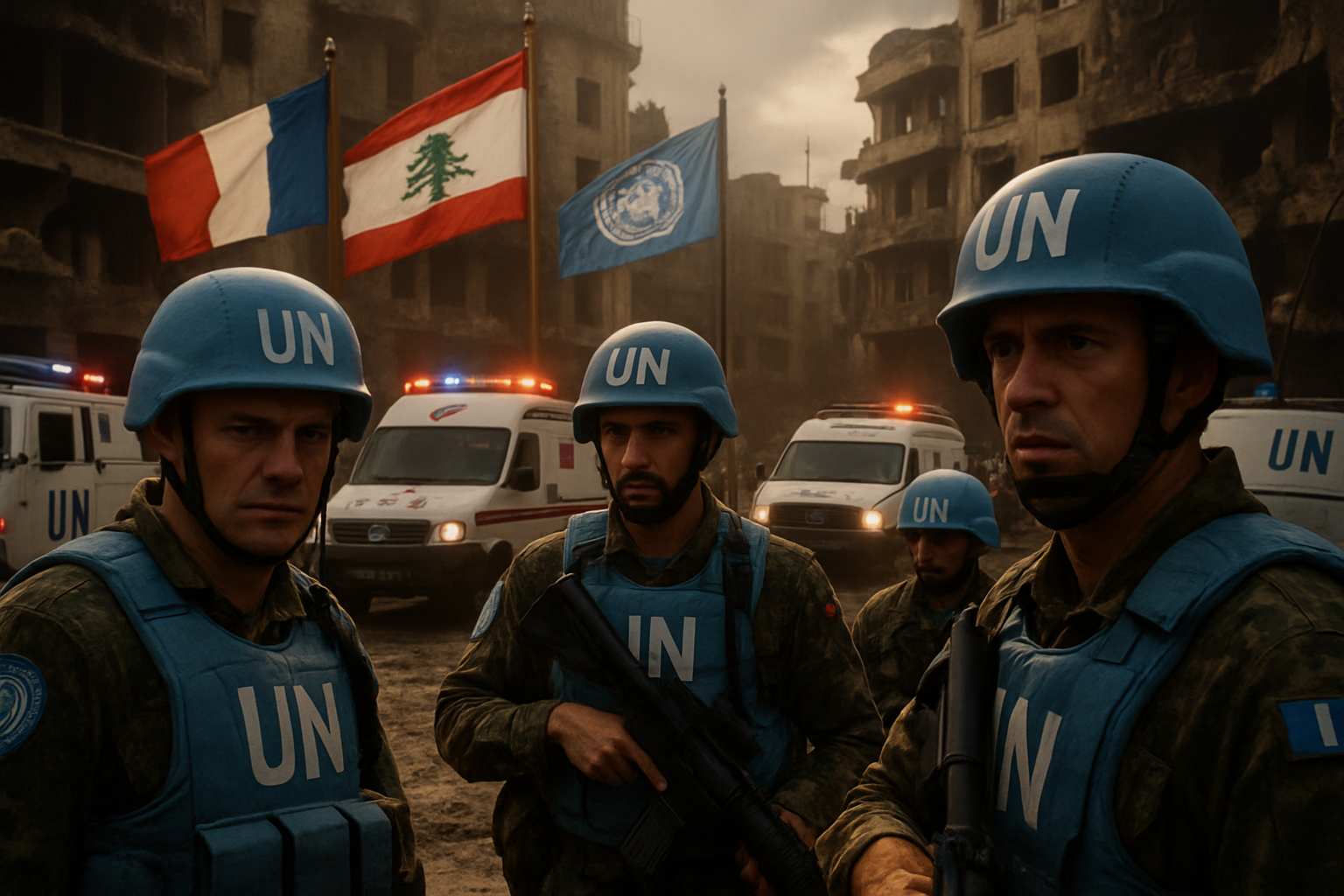
A French UN peacekeeper was killed in Lebanon amid a devastating weekend of violence that included a deadly shooting in Kiev, an Iran-linked attack on a London synagogue, and continued Israeli operations across multiple fronts, highlighting the expanding regional security crisis that threatens international stability.
The death of Staff Sergeant Florian Montorio from the French paratrooper engineering regiment in Montauban represents the most serious incident involving international peacekeepers since the complete collapse of the November 2024 ceasefire in March 2026. French President Emmanuel Macron directly blamed Hezbollah for the attack, stating "Everything suggests that the responsibility for this attack lies with Hezbollah," though the Iran-backed group categorically denied involvement.
International Peacekeeping Forces Under Attack
The attack on UN peacekeeping forces in southern Lebanon occurred during road clearance operations, described by UNIFIL spokesperson Kandice Ardiel as a "deliberate attack" rather than accidental engagement. The incident follows a pattern of systematic attacks on international peacekeepers, including the previous killing of an Indonesian UNIFIL personnel in separate incidents during March 2026.
French authorities demanded an urgent UN Security Council meeting in response to what represents the most dangerous escalation in targeting international forces since the broader regional crisis began following the death of Iranian Supreme Leader Ali Khamenei on March 1, 2026.
"The situation remains precarious and volatile, affecting both peacekeepers and civilians forced to evacuate southern Lebanon areas."
— Kandice Ardiel, UNIFIL Spokesperson
Violence Spreads Beyond Middle East
The security crisis has extended far beyond traditional Middle Eastern boundaries. In Kiev, a deadly shooting at a supermarket left six people dead and more than a dozen wounded, with Ukrainian authorities launching investigations not only into the gunman but also into police conduct after two officers allegedly fled the scene, leaving victims unprotected.
Meanwhile, London experienced what UK Chief Rabbi Mirvis described as part of "a sustained campaign of violence and intimidation against the Jewish community" following an arson attempt on a synagogue. An Iran-linked group claimed responsibility for attacks on Jewish-tied buildings, though no injuries were reported in either incident.
Humanitarian Catastrophe in Lebanon
The killing of the French peacekeeper occurs against the backdrop of an unprecedented humanitarian crisis in Lebanon, where over 1.2 million people—25% of the population—have been displaced since March 2026. Emergency shelters are overwhelmed, forcing thousands to sleep on the streets of Beirut.
Particularly concerning is the systematic targeting of medical personnel, with 26 paramedics killed and 51 wounded since March 2. The deadliest attack occurred at the Burj Qalaouiyah healthcare center, where 12 medical workers were killed in what constitutes potential Geneva Conventions violations.
The World Health Organization has issued a $30.3 million emergency appeal, warning that healthcare systems across five Middle Eastern countries are "under severe strain" due to the escalating violence.
Ceasefire Framework Collapse
The current crisis stems from the complete breakdown of the November 2024 US-French brokered ceasefire between Israel and Hezbollah, which had held for over a year until March 2026. Hezbollah faced what sources describe as an "impossible choice" between maintaining the ceasefire versus responding to Iranian pressure for retaliation following Khamenei's death.
The organization chose "Iranian solidarity over Lebanese sovereignty," declaring "resistance only option" and pulling Lebanon into the broader Iran-Israel confrontation that has consumed the region since March 1.
Regional Military Operations Expand
Israeli Defense Forces have significantly expanded operations beyond the November 2024 ceasefire positions, now controlling an estimated 10% of Lebanese territory between the border and the Litani River. Operations have included the destruction of the strategic Qasmiyeh Bridge and civilian home demolitions, representing a shift from military to civilian infrastructure targeting.
Hezbollah, with an estimated 20,000 fighters, has conducted over 40 operations targeting northern Israeli military sites reaching as far as Haifa, declaring "direct confrontations" with Israeli forces in southern Lebanon—marking a significant operational escalation from previous restraint strategies.
Gaza Operations Continue
Simultaneously, Israeli forces continue operations in Gaza despite supposed ceasefire arrangements. A young Palestinian was killed by Israeli gunfire in northern Gaza, while Israeli forces maintain artillery bombardment in the region, with over 1,600 documented ceasefire violations since October 2025 resulting in more than 680 Palestinian deaths during what should have been a peace period.
Palestinian sources report deteriorating conditions in prison facilities, with the Palestinian Authority for Prisoners' and Ex-Prisoners' Affairs describing unprecedented deterioration in conditions at Etzion prison, calling current circumstances the worst since the war on Gaza began.
West Bank Settler Violence Escalates
In the West Bank, Israeli settlers have escalated attacks on Palestinian communities, burning homes and uprooting olive trees while seizing property. Local sources report that settler groups attacked the village of Turmus Ayya northeast of Ramallah, setting fire to a Palestinian home and continuing a pattern of violence that has intensified during the regional crisis.
Global Crisis Impact
The regional conflict has created unprecedented global disruptions, with over 18,000 flights cancelled worldwide—representing a COVID-scale aviation crisis. Oil prices have surged past $100 per barrel for the first time since 2014, while Iran's closure of the Strait of Hormuz affects 40% of global oil transit.
The International Energy Agency has implemented its largest strategic reserve release in 50-year history, releasing 400 million barrels to stabilize markets. Natural gas prices have increased 24% in Europe and 78% in the United States, threatening household energy costs globally.
Diplomatic Efforts Stalled
Despite the escalating violence, diplomatic efforts remain stalled. A critical "Lebanon loophole" has emerged in the Pakistan-mediated "Islamabad Accord" ceasefire between the US and Iran, with Israeli Prime Minister Netanyahu explicitly excluding Lebanon from the agreement, creating what Vice President JD Vance acknowledged as a "legitimate misunderstanding" on Iran's part.
Iran has threatened to withdraw from regional talks unless comprehensive enforcement covers all fronts, while French President Macron has offered to host direct Israel-Lebanon talks in Paris—the first such negotiations since the ceasefire collapse.
International Response
The international community has responded with unified condemnation. The UK described the situation as "deeply troubled," France called civilian targeting "unacceptable," and Italy condemned attacks on civilian infrastructure. Eight Arab nations, including countries with normalized relations with Israel such as Saudi Arabia and the UAE, have issued joint condemnations.
UN Secretary-General António Guterres has called the crisis the "greatest test of multilateral cooperation in the modern era," emphasizing the template-setting implications for 21st-century conflict resolution mechanisms.
"This represents the most serious international crisis since the end of the Cold War, affecting regional war prevention, energy security, nuclear governance credibility, and international law enforcement with implications that will extend decades beyond current events."
— UN Secretary-General António Guterres
Looking Ahead
The killing of the French peacekeeper, combined with the spreading violence from Kiev to London to Gaza and the West Bank, underscores the global security implications of the Middle Eastern crisis. The systematic targeting of international peacekeepers challenges the fundamental framework of international peacekeeping operations and tests whether diplomatic solutions can prevail over military escalation.
With over 2,020 civilian deaths in Lebanon since March, systematic violations of international humanitarian law, and the complete breakdown of ceasefire mechanisms, the crisis represents a critical juncture for global governance credibility. The success or failure of diplomatic intervention efforts will establish precedents for conflict resolution approaches affecting millions of civilians and determining whether the international community can effectively manage territorial disputes, proxy relationships, and great power competition in an increasingly multipolar world.
As emergency evacuations continue across the region and international mediation efforts struggle to gain traction, the weekend's violence serves as a stark reminder that regional conflicts in an interconnected world quickly become global security challenges requiring sustained international engagement and innovative diplomatic approaches to prevent further escalation.