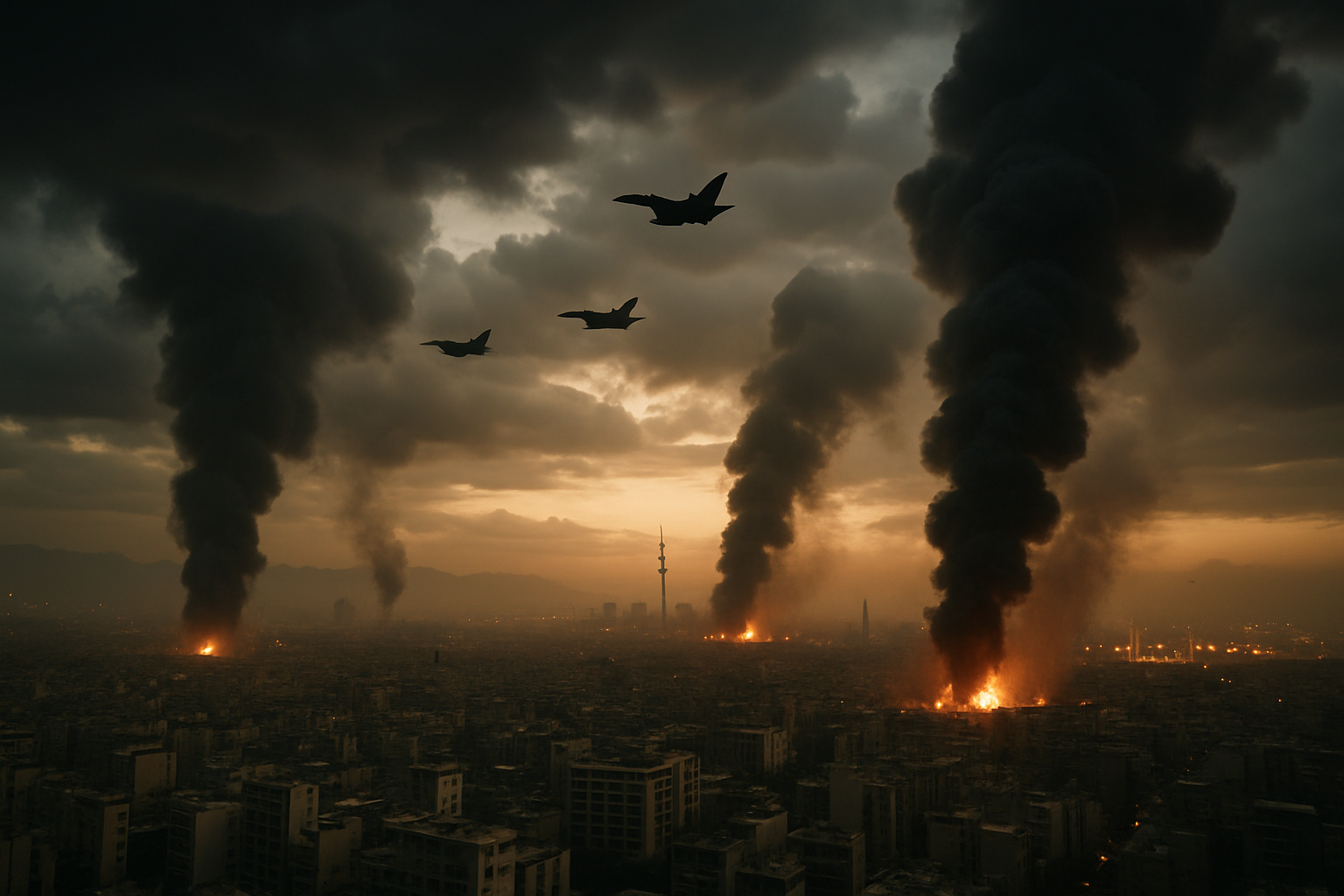
Iran has dramatically escalated its regional military campaign, launching coordinated missile and drone strikes against multiple Gulf states including Bahrain, Kuwait, Qatar, and Cyprus, marking the most dangerous expansion of Middle Eastern conflict since the Cold War ended.
The attacks, conducted under Iran's "Operation True Promise 4," have caused at least 32 casualties in Bahrain alone, including children, according to the Bahrain News Agency. The strikes represent a fundamental shift in Iran's military strategy following the death of Supreme Leader Ali Khamenei on March 1 and the subsequent appointment of his son, Mojtaba Khamenei, as his successor.
New Leadership, Escalated Warfare
The ascension of Mojtaba Khamenei to Supreme Leader marks the first hereditary succession in the Islamic Republic's 47-year history, consolidating hardline military influence within Iran's power structure. CIA assessments suggest the Revolutionary Guards have gained unprecedented control over Iranian decision-making during this succession crisis.
"Iran has shifted toward a direct threat against vital infrastructure and global energy routes," according to Iranian military sources, abandoning their previous policy of "strategic patience." The Islamic Revolutionary Guard Corps (IRGC) has declared "no red lines remain" in their targeting of US and allied assets across the region.
"The armed forces have moved past the policy of 'strategic patience,' warning of reciprocal attacks on vital infrastructure and global energy routes."
— Khatam al-Anbiya Central Headquarters Statement
Regional Casualties Mount
The coordinated Iranian strikes have caused significant casualties across multiple nations:
- Bahrain: At least 32 injured, including children and a two-month-old infant, in drone attacks near the capital
- Kuwait: Airport facilities struck by drones, with Kuwait's National Oil Company announcing production cuts
- Qatar: Strong explosions heard in Doha following missile interceptions by Patriot defense systems
- Cyprus: RAF Akrotiri base attacked, marking the first European territory struck since World War II
The attacks have prompted an unprecedented naval coalition response, with HMS Dragon and Spanish frigates deploying to protect Cyprus, joined by Italian, French, Dutch, and Greek vessels in the largest European military mobilization in the Mediterranean since the Yugoslav conflicts.
Global Energy Crisis Deepens
Iran's targeting of Gulf energy infrastructure has created a cascading global crisis. The Islamic Republic has effectively closed the Strait of Hormuz, through which 40% of the world's seaborne oil transits, declaring the waterway "unsafe" for commercial shipping.
Oil prices have surged more than 10% past $80 per barrel, while natural gas prices have increased 24% in Europe and 78% in the United States. More than 150 tankers remain stranded in the Persian Gulf, worth billions in cargo, as major shipping companies Maersk and MSC have suspended operations in the region.

The energy disruption has forced Qatar to halt its liquefied natural gas production, threatening European energy supplies and potentially adding £160 to UK household energy bills. Iraq's oil production has collapsed by 70%, falling from 4.3 million barrels per day to just 1.3 million.
Aviation Industry in Crisis
The conflict has created the most extensive aviation disruption since the COVID-19 pandemic, with over 18,000 flights cancelled worldwide. Eight Middle Eastern countries have simultaneously closed their airspace, including Iran, Iraq, Israel, UAE, Qatar, Syria, Kuwait, and Bahrain.
Dubai International Airport, the world's busiest with over 86 million passengers annually, remains completely shut down after sustaining missile damage. Major carriers including Emirates, Air France-KLM, and Wizz Air have suspended operations indefinitely, stranding hundreds of thousands of passengers globally.
Unprecedented Military Escalation
The current crisis represents the largest coordinated US-Israeli military operation since the 2003 Iraq invasion, designated "Operation Epic Fury." The campaign has involved dual-carrier deployment of the USS Gerald Ford and Abraham Lincoln, representing approximately one-third of the active US Navy fleet.
President Trump has taken an increasingly hardline stance, demanding Iran's "unconditional surrender" and claiming the right to personally choose Iran's next leadership. In exclusive comments to media outlets, Trump rejected Mojtaba Khamenei as "lightweight" and encouraged Iranian Kurdish forces to launch an offensive.
"We've destroyed a country that would have destroyed Israel. It'll be a mutual decision with Netanyahu regarding when Iran war ends."
— President Donald Trump, in phone interview
International Response and Evacuations
The crisis has prompted the largest international evacuation effort since the Arab Spring in 2011. Australia alone has 115,000 nationals trapped in the region, while Germany is coordinating the evacuation of 30,000 stranded tourists. The European Union has activated its ESTIA evacuation plan for Cyprus for the first time.
Multiple countries have issued urgent travel warnings and ordered immediate evacuations. Sweden and Serbia have ordered all citizens to leave Iran immediately, citing "extremely uncertain" security conditions.
Nuclear Diplomacy Collapses
The military escalation follows the complete breakdown of nuclear negotiations that had achieved the most significant progress since the JCPOA collapse in 2018. Despite reaching "broad agreement on guiding principles" in Geneva talks, fundamental disagreements proved insurmountable.
Iran excluded ballistic missiles and regional proxies as "red lines," insisting on nuclear-only discussions, while the US demanded comprehensive agreements including missiles, armed groups, and human rights issues. Iran continues enriching uranium to 60% purity with over 400 kilograms of material, approaching weapons-grade levels.
Humanitarian Crisis
The conflict has taken a devastating toll on civilian populations. Iran's Red Crescent reports over 787 civilian casualties from US-Israeli strikes, including a tragic attack on a girls' school in Minab that killed between 53-85 students and staff.
The targeting of civilian infrastructure, including hospitals, schools, and water treatment facilities, has drawn international condemnation and calls for war crimes investigations under the Geneva Conventions.
Global Economic Impact
The conflict has triggered widespread economic disruption beyond energy markets. Stock markets have crashed globally, with Pakistan's KSE-100 index suffering its largest single-day decline in history at -8.97%. The Dow Jones futures fell 400-570 points, and major IPOs have been postponed.
Supply chains dependent on Gulf networks, particularly in automotive, electronics, and textiles manufacturing, face severe disruption. The Persian Gulf's role as a critical Asia-Europe trade hub has been compromised, demonstrating the vulnerability of globalized economic systems to regional conflicts.
Nuclear Governance Crisis
The breakdown occurs against a broader nuclear governance crisis. The New START treaty between the US and Russia expired on February 5, marking the first time in over 50 years without bilateral nuclear constraints between the superpowers. Combined with China's nuclear expansion, UN Secretary-General António Guterres has warned that nuclear risks are at their "highest in decades."
Looking Ahead
As the conflict enters its second week, the stakes continue to escalate. Congressional scrutiny in Washington is intensifying, with bipartisan lawmakers demanding answers about strategy, costs, and the potential deployment of ground troops. Senator Richard Blumenthal expressed being "more concerned than ever" about the prospect of American boots on the ground.
The crisis represents what UN Secretary-General Guterres has called "the greatest test of multilateral cooperation and crisis management in the modern era." The decisions made in the coming days and weeks will reverberate through international relations for decades, potentially setting precedents for whether diplomatic or military solutions take preference in future territorial and nuclear disputes globally.
With Iran's new hardline military leadership under Mojtaba Khamenei, Trump's demands for unconditional surrender, and the expanding circle of affected nations, the trajectory appears set for prolonged conflict with global implications extending far beyond the Middle East's traditional boundaries.