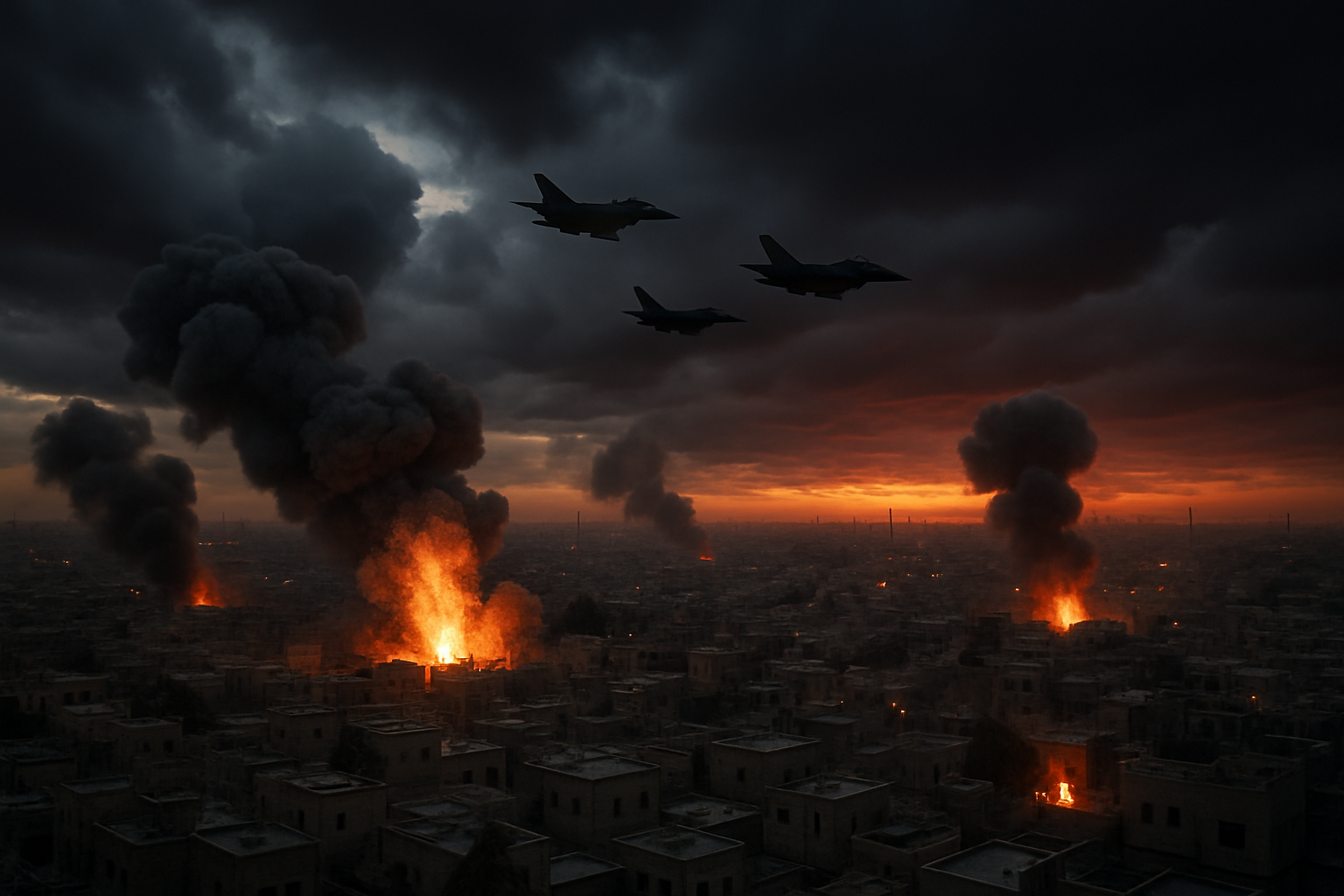
The Middle East has erupted into the most dangerous international crisis since the Cold War as the US-Israel alliance's military campaign against Iran enters its sixth day, triggering massive global disruptions and raising fears of World War III.
What began as failed diplomatic negotiations has exploded into "Operation Epic Fury" - the largest coordinated US-Israeli military operation since the 2003 Iraq invasion. The conflict has already claimed over 1,500 lives and sparked the most extensive global aviation crisis since COVID-19, with over 18,000 flights cancelled worldwide.
Supreme Leader Khamenei Killed, Succession Crisis Unfolds
The crisis reached a historic turning point on March 1 when Iranian state media officially confirmed the death of 86-year-old Supreme Leader Ali Khamenei during coordinated strikes on Tehran leadership compounds. The death ends Khamenei's 37-year rule and creates an unprecedented succession crisis at the heart of the Islamic Republic.
"This is the single greatest chance for the Iranian people to take back their country," President Trump declared via Truth Social, confirming Khamenei's death hours before Iranian media acknowledgment.
"We are witnessing the most dangerous moment since the Cold War ended. The stakes couldn't be higher."
— UN Secretary-General António Guterres
A three-member transitional council led by President Masoud Pezeshkian now governs Iran, while the Assembly of Experts scrambles to select a permanent successor. CIA assessments suggest a Revolutionary Guards member is likely to assume power, indicating a potential hardline military shift that could further destabilize the region.
Global Aviation in Chaos
The conflict has triggered unprecedented disruption to global aviation, with eight Middle Eastern countries simultaneously closing their airspace - Iran, Iraq, Israel, UAE, Qatar, Syria, Kuwait, and Bahrain. Over 18,000 flights have been cancelled worldwide, affecting hundreds of thousands of passengers in what aviation experts describe as the most extensive regional disruption since the COVID-19 pandemic.
Dubai International Airport, the world's busiest with over 86 million annual passengers, remains completely shut down after suffering missile damage. Major carriers including Emirates, Air France-KLM, Wizz Air, and Bulgaria Air have suspended all Middle East operations indefinitely.
"The Middle East serves as a critical hub connecting Europe and Asia. This disruption is reverberating globally," explained aviation analyst Sarah Chen.
Energy Security Under Threat
Iran's Revolutionary Guard has declared the Strait of Hormuz - through which 40% of global seaborne oil transit flows - "unsafe," effectively closing one of the world's most critical energy chokepoints. Oil prices have surged over 10% past $80 per barrel, while natural gas prices have jumped 24% in Europe and 78% in the United States.
Major shipping companies Maersk and MSC have suspended operations, leaving over 150 oil and LNG tankers stranded in the Persian Gulf with billions of dollars in cargo. Qatar has halted LNG production at its facilities, which supply approximately 20% of global LNG exports.
The Saudi Defense Ministry reported intercepting and destroying three ballistic missiles targeting Prince Sultan Air Base, while Iran's Revolutionary Guard claimed successful drone strikes against the USS Abraham Lincoln carrier group.
Operation True Promise 4: Iran's Massive Retaliation
Iran's response, dubbed "Operation True Promise 4," has been swift and devastating. The Islamic Revolutionary Guard Corps declared "no red lines remain," systematically targeting US and Israeli assets across the region.
The casualties are mounting across Gulf allies:
- UAE: 1 civilian killed in Abu Dhabi from missile debris, Dubai International Airport shut down
- Kuwait: 32 foreign nationals injured in airport drone strikes
- Qatar: 8 injured from missile fragments despite intercepting 65 missiles and 12 drones
- Israel: 9 killed and 28 wounded in residential strikes in Beit Shemesh
- Cyprus: RAF Akrotiri base struck - first attack on European soil since WWII
The conflict has expanded beyond the Middle East when Iran launched ballistic missiles targeting Turkey, forcing NATO to intervene for the first time. The alliance successfully intercepted the missiles using Eastern Mediterranean defense systems.
Diplomatic Collapse After Historic Breakthrough
The military escalation is particularly tragic given that US-Iran nuclear negotiations had achieved their biggest breakthrough in years. Geneva talks in February produced what Iranian Foreign Minister Abbas Araghchi called "broad agreement on guiding principles" - the most significant diplomatic progress since the JCPOA collapse in 2018.
However, fundamental disagreements proved insurmountable. Iran excluded ballistic missiles and regional proxies as "red lines" from nuclear-only talks, while the US demanded comprehensive agreements addressing missiles, armed groups, and human rights issues.
"Iran will never abandon uranium enrichment even if war is imposed," Araghchi had declared during the negotiations, while continuing to enrich uranium at 60% purity - approaching the 90% weapons-grade threshold.
Nuclear Governance Crisis Deepens
The crisis unfolds against the backdrop of broader nuclear governance breakdown. The New START treaty between the US and Russia expired February 5 - marking the first time in over 50 years without strategic nuclear constraints between the superpowers. China's rapid nuclear expansion and Iran's weapons-grade uranium stockpile of over 400 kilograms have created what UN officials describe as the highest nuclear risks in decades.
Unprecedented Military Deployment
The US has deployed an enormous military force to the region, including dual-carrier strike groups USS Gerald R. Ford and USS Abraham Lincoln - representing approximately one-third of the active US Navy fleet positioned just 800 kilometers from Iran's coast. This represents the largest American naval presence in the Middle East since the 2003 Iraq invasion.
The conflict reached a new milestone when the US submarine USS Charlotte torpedoed and sank the Iranian frigate IRIS Dena off Sri Lanka, killing over 80 crew members. Defense Secretary Pete Hegseth called it a "quiet death," marking the first enemy vessel sunk by a US submarine since World War II.
Regional Coalition Under Strain
The war has severely strained the unprecedented regional coalition of Saudi Arabia, UAE, Qatar, and Egypt that had backed diplomatic efforts. Iranian retaliatory strikes have directly targeted coalition member territories, forcing these nations to choose between their US alliance and Iranian pressure.
Egyptian President Abdel Fattah el-Sisi condemned the attacks on "sisterly Arab countries," warning of "comprehensive chaos" across the region. The coalition's fracturing represents a significant blow to Middle Eastern stability.
Massive International Evacuations
The deteriorating security situation has triggered the largest coordinated international evacuation since the Arab Spring in 2011. Australia has 115,000 nationals trapped in the region, while Germany reports 30,000 stranded tourists. Multiple European countries including Sweden and Serbia have ordered immediate evacuations, citing "extremely uncertain" security conditions.
The European Union has activated its ESTIA evacuation plan for Cyprus for the first time in its history, as Iran's strikes on RAF Akrotiri marked the first attack on European territory since World War II.
Congressional Scrutiny Intensifies
Back in Washington, bipartisan lawmakers are demanding answers about the administration's strategy, costs, and potential ground troop deployment. Democratic Senator Richard Blumenthal expressed being "more concerned than ever" about the possibility of "boots on the ground."
The conflict's unpopularity is described as "almost unprecedented" this early in military operations, with financial markets emerging as a potential "ultimate constraint" on further escalation as global stock markets crash.
Global Economic Disruption
The conflict's economic impact extends far beyond energy markets. Pakistan's KSE-100 index suffered its largest single-day decline in history at -8.97%, while Dow futures dropped 400-570 points. The PayPal subsidiary PayPay postponed its $1.1 billion IPO due to market instability.
Supply chain vulnerabilities have been exposed as manufacturing dependent on Gulf networks faces severe disruption. The crisis affects everything from automotive to electronics to textiles industries globally.
International Response and Condemnation
The United Nations Security Council has held multiple emergency sessions as international condemnation grows. Russia has condemned what it calls "reckless actions by Washington and West Jerusalem," while China issued its strongest condemnation in years, calling the operations a "serious violation of sovereignty."
Pope Leo XIV expressed "deep concern about the spiral of violence," while European leaders remain split on supporting the operations. Spanish Prime Minister Pedro Sanchez condemned the offensive as a "breach of international law," prompting Trump to threaten cutting all trade with Spain.
Historical Significance and Global Implications
Military analysts and historians describe March 2026 as a watershed moment in Middle Eastern geopolitics with implications extending decades beyond the current crisis. The rapid transition from diplomatic breakthrough to military confrontation demonstrates the fragility of modern crisis management in the multipolar era.
"This is a template-setting moment for 21st-century conflict resolution," explained international relations expert Dr. Michael Patterson. "Success in containing this crisis could provide a framework for future nuclear disputes. Failure may accelerate military solutions and undermine diplomatic credibility worldwide."
The stakes include regional war prevention, global energy security, nuclear governance credibility, and international law enforcement of post-World War II principles - all being tested simultaneously in what experts call the greatest test of multilateral cooperation in the modern era.
The Path Forward
As the conflict enters its critical phase, the coming days will determine whether this remains a contained regional confrontation or escalates into a broader Middle Eastern war with worldwide implications. The crisis has already reshaped international approaches to conflict resolution, energy architecture, and diplomatic versus military solutions.
With nuclear risks at their highest level in decades and critical global infrastructure under threat, the world watches anxiously as this historic confrontation unfolds, potentially determining the template for international relations for decades to come.