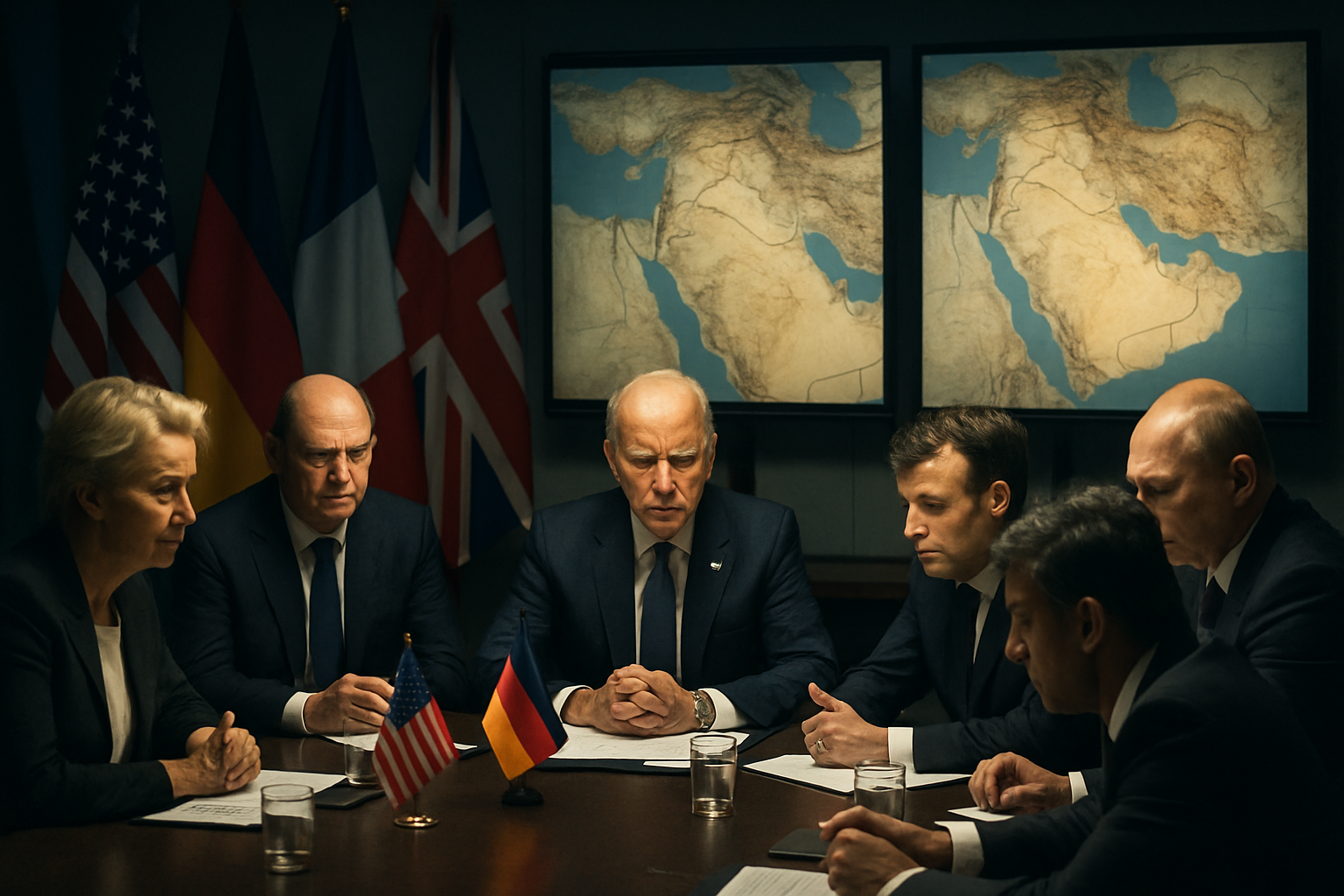
President Donald Trump indicated Saturday that the United States might be "winding down" its military operation against Iran as the Middle East conflict enters its fourth week, while Iranian media reported attacks on the nuclear enrichment facility in Natanz amid continuing global aviation and energy disruptions.
In a social media post, Trump declared the U.S. was close to meeting its objectives but emphasized that other countries should take the lead in policing the vital Strait of Hormuz shipping lane, whose near-closure threatens a global energy shock. The statement comes as the most dangerous international crisis since the Cold War enters a critical phase with unprecedented global implications.
Mixed Signals from Washington
Trump and his administration have sent contradictory messages about U.S. goals throughout the war, now entering its fourth week, leaving traditional allies struggling to respond to the rapidly evolving situation.
In less than 24 hours, Trump suggested the war could wind down as the Iranian threat was being eliminated, while simultaneously U.S. Marines and heavy landing craft were headed to the region on missions whose goals were not immediately clear. The U.S. military has also reportedly been considering an occupation of Kharg Island, a strategically important location in the Persian Gulf that could provide greater control over the Strait of Hormuz.
"We are getting very close to meeting our objective of ending Iran's nuclear program and dismantling their terror network"
— Donald Trump, President of the United States
Nuclear Facility Under Attack
Iranian media confirmed Saturday that the nuclear enrichment facility in Natanz had been attacked as part of the ongoing "Operation Epic Fury" - the largest coordinated U.S.-Israeli military campaign since the 2003 Iraq invasion. The facility has been central to Iran's uranium enrichment program, which intelligence sources indicate has reached 60% purity approaching weapons-grade material.
The strikes on Natanz represent a significant escalation in targeting Iranian nuclear infrastructure, marking a shift from the initial objectives announced when the military operation began on February 28, 2026.
Global Crisis Reaches Peak
The conflict has triggered the most severe international crisis since the end of the Cold War, with cascading effects across multiple sectors:
Aviation Industry Paralyzed
Over 18,000 flights have been cancelled worldwide - the most extensive disruption since COVID-19. Eight Middle Eastern countries have simultaneously closed their airspace, including Iran, Iraq, Israel, UAE, Qatar, Syria, Kuwait, and Bahrain. Dubai International Airport, the world's busiest with 86 million passengers annually, remains completely shut down due to missile damage.
Major carriers including Emirates, Air France-KLM, and Wizz Air have suspended operations indefinitely, affecting hundreds of thousands of passengers globally and severing critical Europe-Asia flight corridors.
Energy Security Crisis
Oil prices have surged 10% past $80 per barrel as Iran declared the Strait of Hormuz "unsafe," effectively closing the waterway that carries 40% of global seaborne oil transit. Over 150 tankers worth billions in cargo remain stranded in the Persian Gulf, with major shipping companies Maersk and MSC suspending operations.
Natural gas prices have increased 24% in Europe and 78% in the United States. Qatar has halted LNG production, threatening European energy supplies and raising concerns about £160 annual household energy increases in the UK.
Iranian Retaliation and Regional Impact
Iran's massive retaliation campaign, dubbed "Operation True Promise 4," has seen the Islamic Revolutionary Guard Corps declare "no red lines remain" as they systematically target U.S. and Israeli assets across the region.
Regional casualties from Iranian strikes include one civilian killed in Abu Dhabi, 32 injured in drone strikes on Kuwait's airport, and eight injured in Qatar despite successful Patriot missile interceptions of 65 missiles and 12 drones. Most significantly, Iranian drones struck RAF Akrotiri in Cyprus - the first attack on European territory since World War II.
European Security Response
The attack on Cyprus has prompted an unprecedented naval coalition response, with HMS Dragon, Spanish frigates, and vessels from Italy, France, the Netherlands, and Greece deploying to protect European territory. The European Union has activated its ESTIA evacuation plan for Cyprus for the first time in the bloc's history.
"This marks the first time European soil has come under attack since World War II, fundamentally altering the scope and implications of this conflict"
— EU Security Analysis, March 2026
Leadership Changes and Nuclear Diplomacy Collapse
The conflict erupted following the confirmed death of Iran's Supreme Leader Ali Khamenei on March 1, ending his 37-year rule. In an unprecedented development, his son Mojtaba Khamenei has emerged as the favored successor, marking the first hereditary succession in the Islamic Republic's 47-year history.
The military escalation followed the complete breakdown of nuclear negotiations in Geneva, despite achieving what diplomats called "broad agreement on guiding principles" - the most significant progress since the JCPOA collapse in 2018. However, fundamental scope disagreements proved insurmountable, with Iran excluding ballistic missiles and proxies as "red lines" while the U.S. demanded comprehensive agreements including missiles, armed groups, and human rights.
Congressional Scrutiny and Domestic Politics
Bipartisan lawmakers in Congress are demanding answers about the administration's strategy, costs, and potential ground troop deployment. Senator Richard Blumenthal expressed being "more concerned than ever" about the possibility of "boots on the ground."
The conflict faces "almost unprecedented" unpopularity for an early-stage military operation, with only 25% of Americans supporting the strikes. Financial markets have emerged as a potential "ultimate constraint" on further escalation, with Pakistan's KSE-100 experiencing its largest single-day decline in history at -8.97%.
International Evacuations and Humanitarian Crisis
The largest coordinated international evacuation since the Arab Spring in 2011 is underway, with Australia reporting 115,000 nationals trapped in the region and Germany seeking to evacuate 30,000 stranded tourists. Multiple countries have ordered immediate evacuations from Iran, citing "extremely uncertain" security conditions.
Iran's Red Crescent reports over 787 civilian casualties from U.S.-Israeli strikes, including a devastating attack on Minab elementary school that killed between 53-85 students and staff, drawing international condemnation and Geneva Conventions investigations.
Nuclear Governance Crisis Context
The current crisis unfolds against a broader nuclear governance breakdown, with the New START treaty between the U.S. and Russia having expired on February 5 - the first time in over 50 years without nuclear constraints between the superpowers. Combined with China's nuclear expansion, UN Secretary-General António Guterres has warned that nuclear risks are at their "highest in decades."
Regional Coalition Under Strain
An unprecedented coalition of Saudi Arabia, UAE, Qatar, and Egypt that had backed diplomatic solutions now faces severe strain as Iranian retaliation has directly targeted their territories. Egyptian President Sisi condemned attacks on "sisterly Arab countries," warning of "comprehensive chaos" spreading across the region.
Historical Significance and Global Implications
UN Secretary-General Guterres has called this the "greatest test of multilateral cooperation in crisis management in the modern era." The rapid transition from diplomatic breakthrough to military confrontation demonstrates the fragility of crisis management mechanisms in the multipolar era.
The events of March 2026 represent a template-setting moment for 21st-century international relations, determining whether diplomatic or military solutions will become the precedent for future territorial and nuclear disputes globally. Stakes include regional war prevention, global energy security, nuclear governance credibility, and international law enforcement of post-WWII order principles.
As Trump considers "winding down" operations while expanding U.S. military presence in the region, the coming days and weeks will prove critical in determining whether this crisis can be contained or will escalate into a broader Middle Eastern war with implications extending decades beyond current events.
The most consequential international crisis since the Cold War continues to test energy architecture evolution, aviation networks, nuclear proliferation mechanisms, and diplomatic credibility worldwide, with the outcome likely to reshape international approaches to conflict resolution for the 21st century.