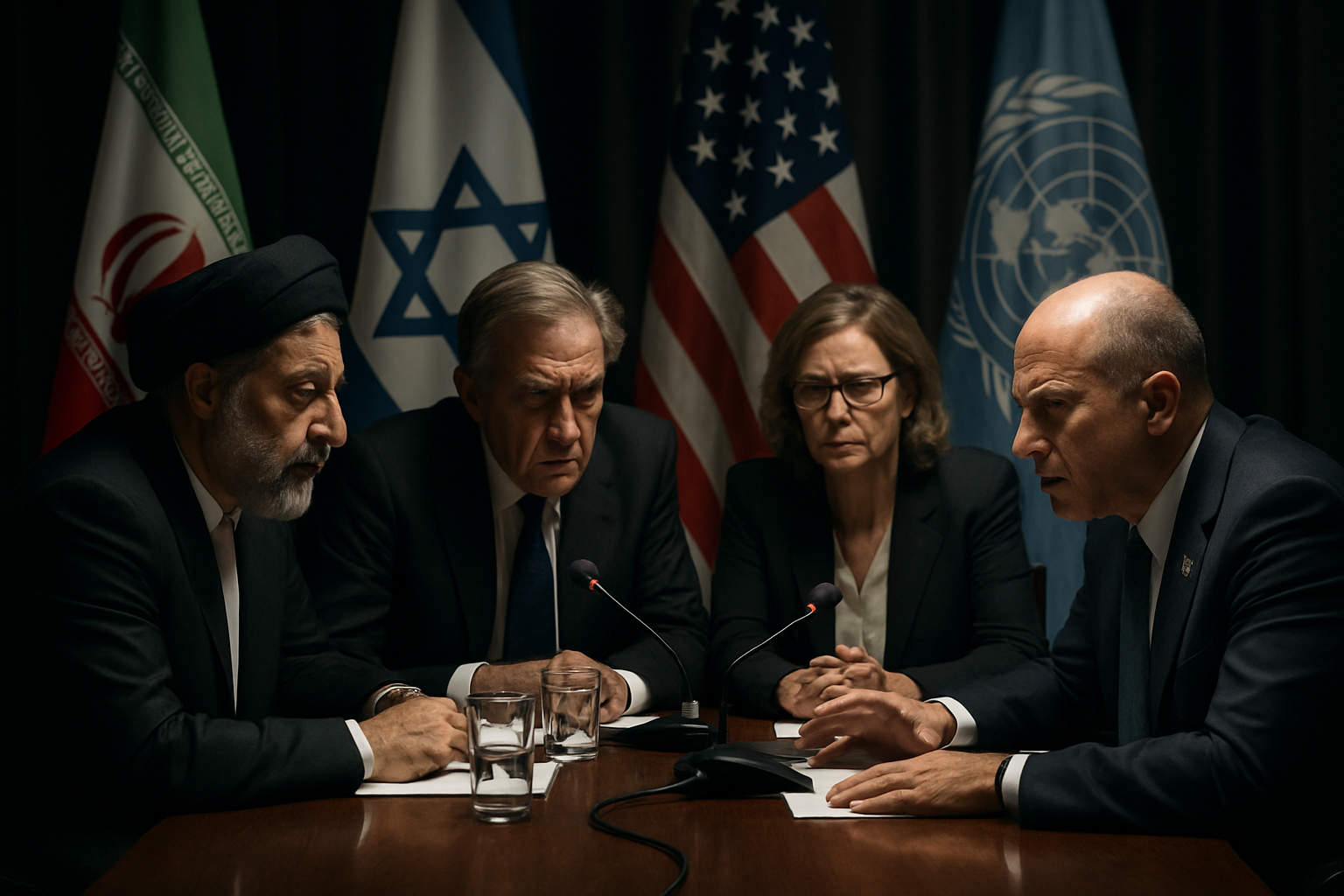
Iran launched fresh missile strikes against Israeli cities while categorically denying President Trump's claims of "productive conversations" with Tehran, deepening contradictions about potential diplomatic efforts to end the 25-day Middle East war that has killed over 1,000 people and disrupted global energy markets.
Iranian missiles struck multiple targets across Israel on Tuesday, including central Tel Aviv, injuring at least six people according to Israeli health officials. The attacks came just hours after Trump announced a temporary pause in planned strikes on Iranian energy infrastructure, citing what he called "good and productive conversations" with Iranian officials.
However, Iran's Parliamentary Speaker Mohammad Bagher Ghalibaf swiftly rejected Trump's assertions, stating that "no negotiations have been held with the US, and fake news is used to manipulate the financial and oil markets and escape the quagmire in which the US and Israel are trapped."
Escalating Military Operations
The latest round of Iranian strikes represents the continued intensity of "Operation True Promise 4," with Iran's Revolutionary Guards declaring "no red lines remain" in targeting US and Israeli assets across the region. The attacks targeted both military installations and civilian areas, including a building strike in northern Israel and explosions in Jerusalem.
Israel responded with what Prime Minister Benjamin Netanyahu described as systematic strikes against Iranian military targets in Tehran, marking some of the most intensive bombardment since the conflict began on March 1 with the death of Iranian Supreme Leader Ali Khamenei.
The conflict has now reached unprecedented global proportions, with over 18,000 flights cancelled worldwide - the most extensive aviation disruption since COVID-19. Eight Middle Eastern countries maintain simultaneous airspace closures, while Dubai International Airport, the world's busiest, remains shuttered from missile damage.
Energy Markets in Crisis
Oil prices have surged past $100 per barrel as Iran continues to mine the Strait of Hormuz, effectively blocking 40% of global oil transit. The International Energy Agency has released a record 400 million barrels from strategic reserves - the largest intervention in the agency's 50-year history.
Natural gas prices have spiked 24% in Europe and 78% in the US, while Qatar has halted LNG production affecting approximately 20% of global exports. Major shipping companies Maersk and MSC have suspended operations in the Persian Gulf, leaving over 150 oil tankers stranded worth billions in cargo.
EU President Ursula von der Leyen warned that rising oil and gas prices highlight "the urgent need to resume negotiations with Iran to reduce tensions in the Middle East," speaking at a joint press conference in Canberra.
Diplomatic Confusion and Mixed Signals
The diplomatic picture remains deeply confused. While Trump suggested progress in talks and ordered a five-day delay to attacks on Iranian power plants, Iran's Foreign Minister Abbas Araghchi categorically ruled out negotiations with the Trump administration.
Adding to the complexity, reports emerged that Iranian Foreign Minister Abbas Araghchi told US Special Envoy Steve Witkoff that new Supreme Leader Mojtaba Khamenei had given his "consent and blessing" to agree to a deal with Washington if Tehran's conditions on its nuclear status are met.
However, this was immediately contradicted by other Iranian officials who accused the US of spreading "fake news" to manipulate markets during heightened volatility.
Regional Coalition Under Strain
The unprecedented coalition of Saudi Arabia, UAE, Qatar, and Egypt that had supported diplomatic solutions is facing severe strain as Iranian retaliation has directly targeted member territories. Egyptian President Abdel Fattah el-Sisi condemned attacks on "sisterly Arab countries," warning of "comprehensive chaos" spreading across the region.
Key US allies in the Middle East are moving closer to direct involvement in the conflict, with both Saudi Arabia and the United Arab Emirates reportedly weighing deeper coordination with the United States and Israel, according to a Wall Street Journal report.
European Territory Attacked
In an unprecedented escalation, Iranian drones struck RAF Akrotiri in Cyprus - the first attack on European territory since World War II. This prompted an extraordinary naval coalition response, with HMS Dragon, Spanish frigates, and vessels from Italy, France, Netherlands, and Greece deploying to protect Europe.
The European Union activated its ESTIA evacuation plan for Cyprus for the first time in the bloc's history, demonstrating how the conflict has expanded beyond traditional Middle Eastern boundaries.
US Military Costs and Casualties
Operation Epic Fury, the largest US military operation in the Middle East since 2003, has cost $11.3 billion in its first week alone. The Pentagon has confirmed 150 US troops wounded, with 8 in critical condition and 3 confirmed deaths.
In a historic first since World War II, the US submarine USS Charlotte sank the Iranian frigate IRIS Dena off Sri Lanka, killing over 80 crew members. The attack expanded the conflict beyond the Middle East into the Indian Ocean, demonstrating the global reach of military operations.
Congressional Pressure Mounts
Bipartisan pressure is mounting in Congress for answers on strategy, costs, and potential ground troop deployment. Senator Richard Blumenthal expressed being "more concerned than ever" about the possibility of "boots on the ground," while the Pentagon reportedly has operations planned through September, well beyond the initial 4-6 week timeline.
The conflict's unpopularity is "almost unprecedented" for early-stage military operations, with only 25% of Americans supporting the strikes according to recent polling.
Humanitarian Crisis Deepens
The Iran Red Crescent reports over 787 civilian casualties from US-Israeli strikes, including the devastating Minab school attack that killed 53-85 students and staff, drawing international condemnation and Geneva Conventions investigations.
International evacuations are taking place on the largest scale since the Arab Spring in 2011, with Australia reporting 115,000 nationals trapped and Germany struggling to evacuate 30,000 stranded tourists.
Nuclear Diplomacy Breakdown
The current military confrontation emerged from the complete breakdown of nuclear negotiations in Geneva, despite achieving what diplomats called "broad agreement on guiding principles" - the most promising diplomatic opening in years since the 2018 JCPOA collapse.
Iran continues uranium enrichment at 60% purity with over 400kg of material, approaching the 90% weapons-grade threshold. The fundamental scope disagreement that doomed negotiations remains: Iran excluded ballistic missiles and regional proxies as "red lines," demanding nuclear-only talks, while the US insisted on comprehensive agreements covering missiles, armed groups, and human rights.
Succession Crisis and Leadership Changes
Following the confirmed death of Supreme Leader Ali Khamenei on March 1, Iran has undergone its first hereditary succession in the Islamic Republic's 47-year history, with his son Mojtaba Khamenei taking power. CIA assessments suggest Revolutionary Guards have unprecedented control, marking a shift from clerical to military governance.
Trump has explicitly rejected the new Iranian leadership, calling Mojtaba Khamenei a "lightweight" and claiming the right to personally choose Iran's next Supreme Leader - the most direct assertion of American control over Iranian affairs since 1979.
Global Supply Chain Disruption
The conflict has exposed fundamental vulnerabilities in global supply chains, with manufacturing in automotive, electronics, and textiles severely impacted by dependence on Gulf logistics networks. The Persian Gulf's role as a critical Asia-Europe trade hub has been completely compromised.
Stock markets have crashed worldwide, with Pakistan's KSE-100 recording its largest single-day decline in history at -8.97%. Companies like PayPal have postponed major IPOs due to market volatility.
Template-Setting Crisis
UN Secretary-General António Guterres has called the crisis "the greatest test of multilateral cooperation in crisis management of the modern era." The rapid transition from diplomacy to military escalation demonstrates the fragility of crisis management mechanisms in the multipolar era.
This crisis is occurring amid broader nuclear governance breakdown, with the New START treaty having expired on February 5 - the first time in over 50 years without US-Russia nuclear constraints. Combined with China's nuclear expansion, experts warn nuclear risks are at their "highest in decades."
Looking Ahead
As the conflict enters its fourth week, the stakes could not be higher. Success in containing the crisis could provide a framework for future nuclear crisis resolution, while failure may accelerate military solutions for decades, encouraging proliferation globally and undermining diplomatic credibility worldwide.
The contradictory signals on diplomacy - with Trump claiming progress while Iran categorically denies any talks - suggest the path forward remains deeply uncertain. With energy markets in crisis, European territory under attack for the first time since World War II, and nuclear governance mechanisms in breakdown, March 2026 may be remembered as a watershed moment that reshaped 21st-century international relations.
The coming days will determine whether this remains a contained regional confrontation or expands into a broader Middle Eastern war with implications extending decades beyond the current crisis, affecting everything from energy architecture evolution to the fundamental principles of the post-WWII international order.