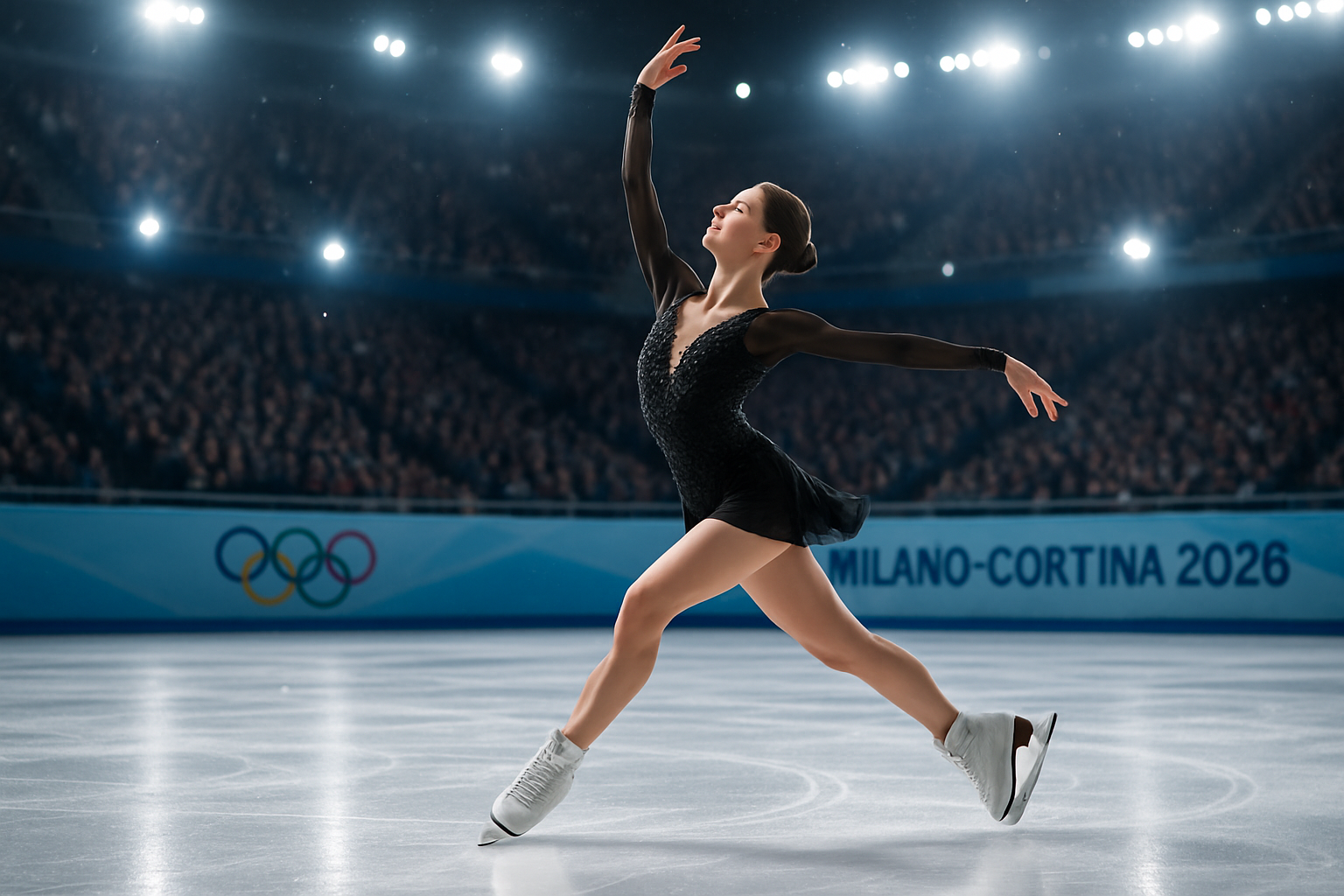
Day 12 at the Milan-Cortina 2026 Winter Olympics delivered spectacular athletic performances across multiple disciplines, with Japan's Ami Nakai landing a breathtaking triple axel to lead women's figure skating, Germany achieving a historic bobsled sweep, and Norway's Tormod Frostad claiming freeski big air gold in what continues to be the most geographically dispersed Winter Games in Olympic history.
The day's action unfolded across seven venues spanning over 400 kilometers from Milan to Cortina d'Ampezzo, showcasing the revolutionary dual-city hosting model that has defined these Games while maintaining the highest levels of competitive excellence.
Japan's Figure Skating Excellence Takes Center Stage
In the most anticipated event of the day, Japan's Ami Nakai delivered a masterful short program performance that included a perfectly executed triple axel, scoring 78.71 points to take the lead in women's figure skating. The 20-year-old's technical brilliance was complemented by teammate Kaori Sakamoto, who secured second place, giving Japan a commanding 1-2 position heading into the free skate.
"I'm not here for medals, but to skate my best and enjoy the Olympic experience,"
— Ami Nakai, Japan Figure Skater
American Alysa Liu, part of the highly touted U.S. "Blade Angels" team, found herself in third place after a solid but not spectacular routine. The American team's struggles continued what has been a challenging individual competition for the defending team event champions, despite their earlier success.
The performances took place at the state-of-the-art Milan Ice Arena, where OMEGA's revolutionary AI-powered figure skating analysis provided unprecedented insights into the technical elements and artistic components of each routine. The technology, making its Olympic debut at these Games, has enhanced both judging accuracy and spectator understanding.
Germany's Bobsled Domination Reaches Historic Heights
Germany's bobsled prowess reached extraordinary levels on Day 12, as they completed a stunning sweep of the two-man bobsled event. Johannes Lochner led the German charge to gold, followed by his compatriots claiming silver and bronze positions in a display of depth that has rarely been seen in Olympic competition.
The German dominance has been nothing short of remarkable throughout the Milano-Cortina Games. When including World Cup results from this winter season, Germany has now won an astounding 23 of 24 available medals in two-man bobsledding, demonstrating a level of superiority that speaks to their systematic approach to the sport.
Frank Del Duca of the United States finished fourth, representing the best American result in an event that has been thoroughly controlled by the German program. The performance highlighted both the excellence of German bobsledding and the challenges facing other nations in competing with their technical and training advantages.
Latvia's two-man bobsled team, piloted by experienced slider Emils Streņģis, finished in eighth place despite high hopes from their record 68-athlete delegation at these Games. The result, while disappointing for medal hopes, still represents solid performance for the Baltic nation's winter sports program.
Norway's Freeski Breakthrough and Hockey Drama
The day's surprises continued with Norway's Tormod Frostad capturing gold in men's freeski big air, defeating American favorite Mac Forehand in a dramatic final jump showdown. The 23-year-old from Bærum delivered when it mattered most, executing a technically superior final attempt to claim Norway's latest gold medal.
"I'm already rich when I can ski every day. This gold medal is just the cherry on top of living my dreams,"
— Tormod Frostad, Norway Freeski Champion
Frostad's victory added to Norway's impressive medal tally as they continue to lead the overall standings at these Games. His technical mastery and fearless approach to the massive jumps at Livigno Snow Park demonstrated why Norway remains a powerhouse across multiple winter sports disciplines.
In hockey eliminations, Sweden decisively defeated Latvia 5-1 in their quarterfinal matchup, with Filip Forsberg among the goal scorers. The result sets up Sweden for a challenging quarterfinal match against the United States, promising another thrilling chapter in Olympic hockey competition.
Sweden's dominant performance showcased the depth and skill that has made them perennial contenders in Olympic hockey. Their systematic breakdown of Latvia's defensive structure and clinical finishing demonstrated the level required to compete for Olympic medals in the sport.
Canada's Olympic Hockey Preparations
Looking ahead to Day 13, Canada's men's hockey team prepares for their first playoff game after a successful preliminary round that included a commanding victory over Switzerland. Nathan MacKinnon's five-goal performance in that match, celebrating alongside Connor McDavid and Macklin Celebrini, highlighted the offensive firepower available to the Canadian squad.
The Canadian team's preparation has been notable for the veteran leadership provided by NHL stars who have embraced the Olympic opportunity after missing recent Games due to scheduling conflicts. Their combination of experience and skill makes them one of the favorites as the tournament enters its elimination phase.
Revolutionary Games Continue to Impress
Day 12 continued to demonstrate the success of Milano-Cortina 2026's groundbreaking approach to Olympic hosting. The dual-city model, spanning seven venues across northern Italy, has maintained competitive excellence while setting new standards for sustainability and environmental responsibility.
The technological innovations have been equally impressive, with Alibaba Cloud's Qwen AI system providing the first Olympic LLM (Large Language Model) integration for enhanced broadcasting and spectator services. This technology, combined with OMEGA's AI-powered analysis systems, has created unprecedented levels of insight and engagement for both in-person and television audiences.
Cultural authenticity has remained a cornerstone of these Games, from the bilingual place names in Alto Adige/South Tyrol that accommodate the German-speaking population, to the sustainable Olympic villages featuring greenhouse spaces that demonstrate environmental consciousness. The Gen Z mascots Milo and Tina have resonated globally, connecting with younger audiences while maintaining Olympic traditions.
Medal Standings and Global Competition
As Day 12 concluded, Norway maintained its position atop the medal standings, but faced increasing pressure from a globally competitive field. The unprecedented depth of competition across all disciplines has made these Games among the most democratically contested Winter Olympics in recent memory.
Japan's strong showing in figure skating, combined with earlier successes across multiple sports, positions them for potentially their best-ever Winter Olympic performance. Their systematic approach to winter sports development, following their successful hosting of previous Olympic Games, continues to pay dividends on the international stage.
Germany's bobsled excellence adds to their impressive medal haul across various disciplines, while Australia's breakthrough performances in moguls and snowboarding have challenged traditional winter sports hierarchies. The global expansion of winter sports excellence has been one of the defining narratives of Milano-Cortina 2026.
Looking Forward: Competition Intensifies
With Day 13 approaching, the focus shifts to hockey playoffs, speed skating finals, and continued figure skating competition. The women's figure skating free program will determine whether Japan can convert their short program advantage into Olympic medals, while Canada's hockey team begins their quest for gold in earnest.
The revolutionary hosting model continues to prove its viability, even as Europe's harsh winter conditions create both ideal natural snow and logistical challenges across the vast venue network. The success of these Games in balancing athletic excellence with environmental sustainability may well influence future Olympic hosting concepts.
As competition continues through February 22, Milano-Cortina 2026 has already established itself as a watershed moment for Olympic hosting, winter sports globalization, and the integration of technology with traditional Olympic values. Day 12's compelling action across multiple sports reinforced why these Games will be remembered as among the most innovative and competitive in Winter Olympic history.