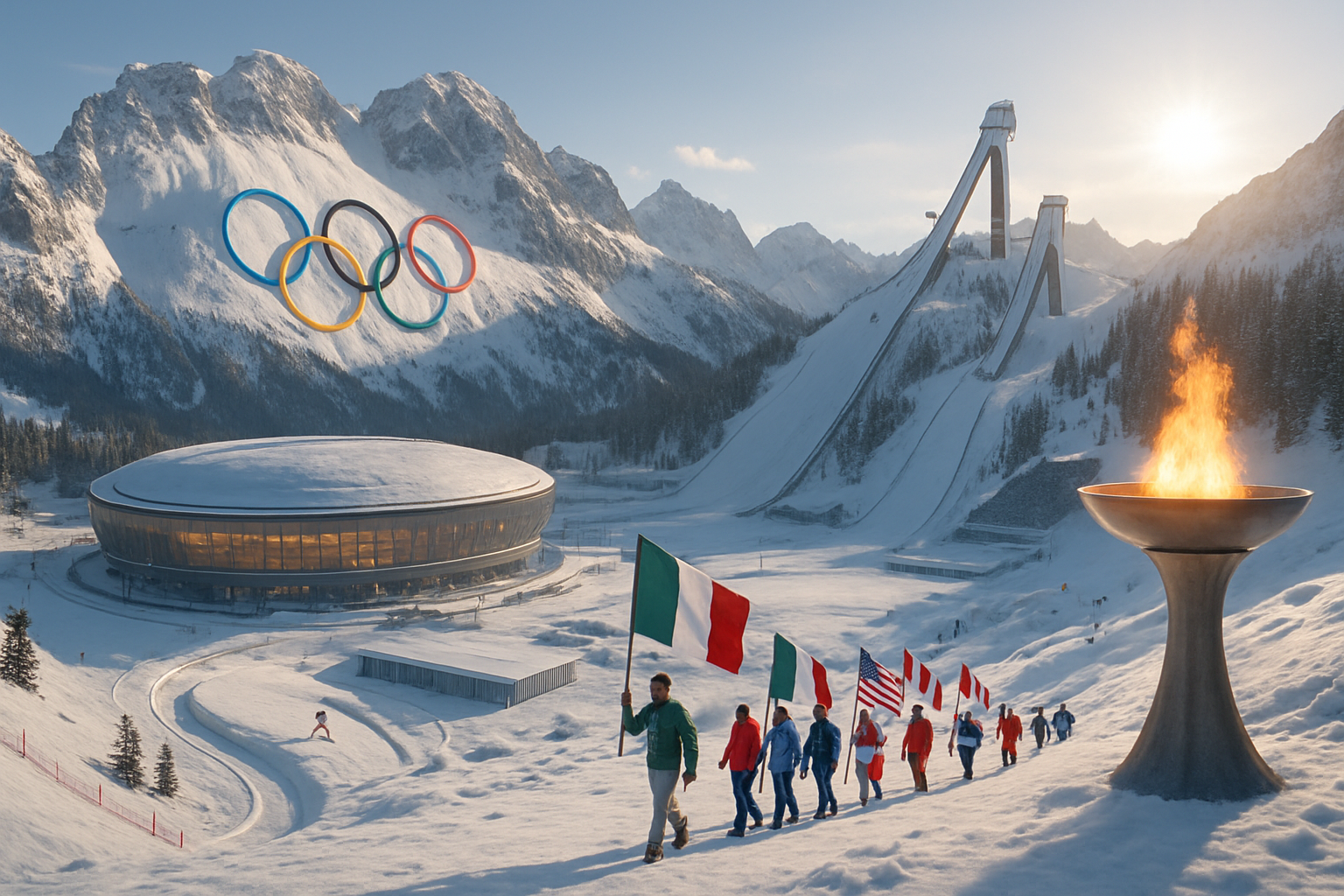
The Milano-Cortina 2026 Winter Olympics continues to deliver unprecedented global breakthroughs as traditional winter sports powerhouses face increasing challenges from emerging nations, with Australia's remarkable rise and shocking upsets from Kazakhstan and Brazil highlighting the most competitively diverse Winter Games in Olympic history.
Historic Breakthrough Performances
Australia's winter sports revolution reached new heights on February 14, with Jakara Anthony securing her second gold medal in dual moguls freestyle skiing, cementing Australia's position as one of the Games' biggest success stories. Anthony's victory followed an "emotional rollercoaster" preparation period that teammate Scotty James described as showcasing her "incredible character."
"This feels surreal. To come back after everything and win again shows that believing in yourself is everything,"
— Jakara Anthony, Australia's dual moguls champion
The Australian success story extends far beyond individual achievements. Cooper Woods captured the nation's first moguls gold earlier in the Games, while Josie Baff dominated snowboard cross competition. This represents Australia's most successful Winter Olympics performance in history, with the nation positioned to surpass traditional winter sports powers in the medal count.
Kazakhstan's Figure Skating Earthquake
Perhaps the most stunning upset of Milano-Cortina 2026 came in men's figure skating, where 21-year-old Mikhail Shaidorov delivered Kazakhstan's first-ever Olympic figure skating medal with a commanding gold medal performance scoring 291.58 points.
The victory represented one of the biggest upsets in Olympic figure skating history, as overwhelming favorite Ilia Malinin of the United States suffered a devastating collapse, falling twice during his free skate program and finishing eighth despite entering as the reigning world champion who had been undefeated since 2023.
Japan's Yuma Kagiyama claimed silver with 280.06 points, while compatriot Shun Sato secured bronze, demonstrating the sport's increasing global competitiveness beyond traditional powerhouses.
Brazil's Historic Winter Gold
Lucas Pinheiro Braathen, the Norwegian-born skier now competing for Brazil, delivered South America's first-ever Winter Olympic gold medal in men's giant slalom at the Stelvio course in Bormio. Despite challenging conditions with heavy snowfall and reduced visibility, Pinheiro Braathen overcame a 40th-place position after the first run to claim a commanding victory.
"If you believe in your dreams, you can achieve them. This gold medal belongs to all of Brazil,"
— Lucas Pinheiro Braathen, Brazil's historic gold medalist
The Brazilian's triumph represents a watershed moment for global winter sports expansion, proving that geographic boundaries no longer limit Olympic excellence. Switzerland's Marco Odermatt took silver, while compatriot Loïc Meillard secured bronze.
Biathlon Excellence and European Dominance
European nations continued their biathlon dominance on February 14, with Norway's Maren Kirkeeide claiming women's sprint gold in a thrilling finish. The Norwegian delivered what experts called a "tactical masterstroke," demonstrating the precision and mental fortitude that defines elite biathlon competition.
France's Oceane Michelon captured silver with flawless shooting, while compatriot Lou Jeanmonnot claimed bronze, highlighting France's strong biathlon program development. Bulgaria's Milena Todorova delivered another breakthrough performance, finishing fourth just 16.3 seconds from the podium in her career-best Olympic result.
Speed Skating and Nordic Supremacy
American speed skating sensation Jordan Stolz continued his record-breaking campaign with victory in the men's 500-meter race, setting yet another Olympic record. The 21-year-old phenomenon has emerged as the face of modern speed skating, combining technical perfection with unprecedented power.
Netherlands' Jenning de Boo claimed silver for the second time at these Games, consistently finishing behind Stolz but establishing himself as the American's primary challenger. Canadian Laurent Dubreuil rounded out the podium with bronze, giving Canada its eighth medal at Milano-Cortina 2026.
Revolutionary Olympic Format
The Milano-Cortina 2026 Games continue to demonstrate the viability of the most geographically dispersed Winter Olympics in history, with competitions successfully conducted across seven venues spanning more than 400 kilometers. This revolutionary dual-city hosting model emphasizes sustainability and existing venue utilization while maintaining the highest competitive standards.
Cultural innovations have enhanced the Olympic experience, including bilingual place names in the German-speaking Alto Adige/South Tyrol region, while the "Gen Z" mascots Milo and Tina have connected with younger audiences globally. Technology integration, featuring Alibaba's Qwen AI system as the first Olympic LLM deployment and OMEGA's AI-powered figure skating analysis, has set new standards for Olympic broadcasting and spectator services.
Curling Controversy and Competition Drama
Olympic drama extended beyond medal competitions as Canada's men's curling team faced allegations of cheating from Swedish opponents, leading to heated exchanges that required intervention from World Curling officials. Canadian Marc Kennedy's confrontation with Sweden's Oskar Eriksson over alleged "double-touching" violations highlighted the intense competitive pressure at the highest levels of Olympic sport.
Despite the controversy, Canada's curling teams continue to perform at elite levels, with the women's squad defeating Denmark 10-4 in convincing fashion.
Hockey Excellence and National Pride
Canada's women's ice hockey team advanced to the semifinals with dominant performances, though captain Marie-Philip Poulin's injury status remains uncertain ahead of crucial matches. The team's depth and resilience have been tested throughout the tournament, but they continue to demonstrate the championship character that has defined Canadian women's hockey excellence.
Men's hockey competition has delivered surprising results, with Latvia stunning Germany 4-3 in one of the tournament's biggest upsets. Finland demolished Italy 11-0, showcasing the gulf in talent levels between hockey powerhouses and emerging programs.
Global Winter Sports Democratization
The Milano-Cortina 2026 Games have become a showcase for winter sports democratization, with nations from six continents achieving breakthrough performances. Israel's historic participation includes the country's first-ever bobsled team, featuring AJ Edelman as the first Orthodox Jewish winter Olympian.
Saudi Arabia's Winter Olympic debut with alpine skier Fayik Abdi and cross-country specialist Rakan Aliriza demonstrates the global reach of Olympic competition. Caribbean nations Jamaica and Trinidad & Tobago made their bobsled Olympic debuts, continuing the sport's expansion beyond traditional geographic boundaries.
Infrastructure Triumphs Amid Challenges
Despite early concerns about venue readiness and infrastructure completion, the Games have proceeded successfully across the dispersed venue network. While the Apollonio-Socrepes cable car remains incomplete, forcing some school closures, competition venues have operated at the highest standards.
Europe's harshest winter in decades, with temperatures reaching -30°C, has created ideal natural snow conditions while presenting logistical challenges. Enhanced security measures have successfully countered pro-Russian cyberattacks and managed various operational challenges.
Medal Race Dynamics
Norway maintains its traditional position atop the medal standings with systematic Nordic sports excellence, but faces unprecedented challenges from a more globally competitive field. Italy has leveraged home advantage effectively, while emerging nations continue to claim breakthrough medals that reshape winter sports demographics.
The United States has delivered strong performances across multiple disciplines, though some expected victories, like Malinin's figure skating dominance, have not materialized. Germany has shown impressive depth across alpine and Nordic events, while France continues its biathlon excellence.
Legacy and Future Implications
Milano-Cortina 2026 is establishing new paradigms for Olympic hosting, demonstrating that geographically dispersed Games can maintain competitive excellence while emphasizing environmental sustainability and cultural authenticity. The success of dual-city hosting may influence future Olympic bidding processes and venue selection criteria.
The Games have proven that winter sports excellence transcends traditional geographic and cultural boundaries. Australia's emergence as a winter sports power, Kazakhstan's figure skating breakthrough, and Brazil's alpine skiing triumph signal a fundamental shift in global winter sports participation and success.
"These Games have shown that dreams have no geographic limits. Winter sports are truly global now,"
— IOC President Kirsty Coventry
As competition continues through February 22, Milano-Cortina 2026 has already secured its place in Olympic history as the Games that redefined winter sports possibilities. With 3,000 athletes from 92 countries competing across 116 medal events, these Olympics represent both a celebration of traditional winter sports excellence and a blueprint for the future of global Olympic competition.
The revolutionary hosting model, breakthrough performances from unexpected nations, and successful integration of technology and sustainability measures have created an Olympic experience that honors tradition while embracing innovation. Milano-Cortina 2026 stands as proof that the Olympic movement continues to evolve, inspire, and unite the world through the power of sport.