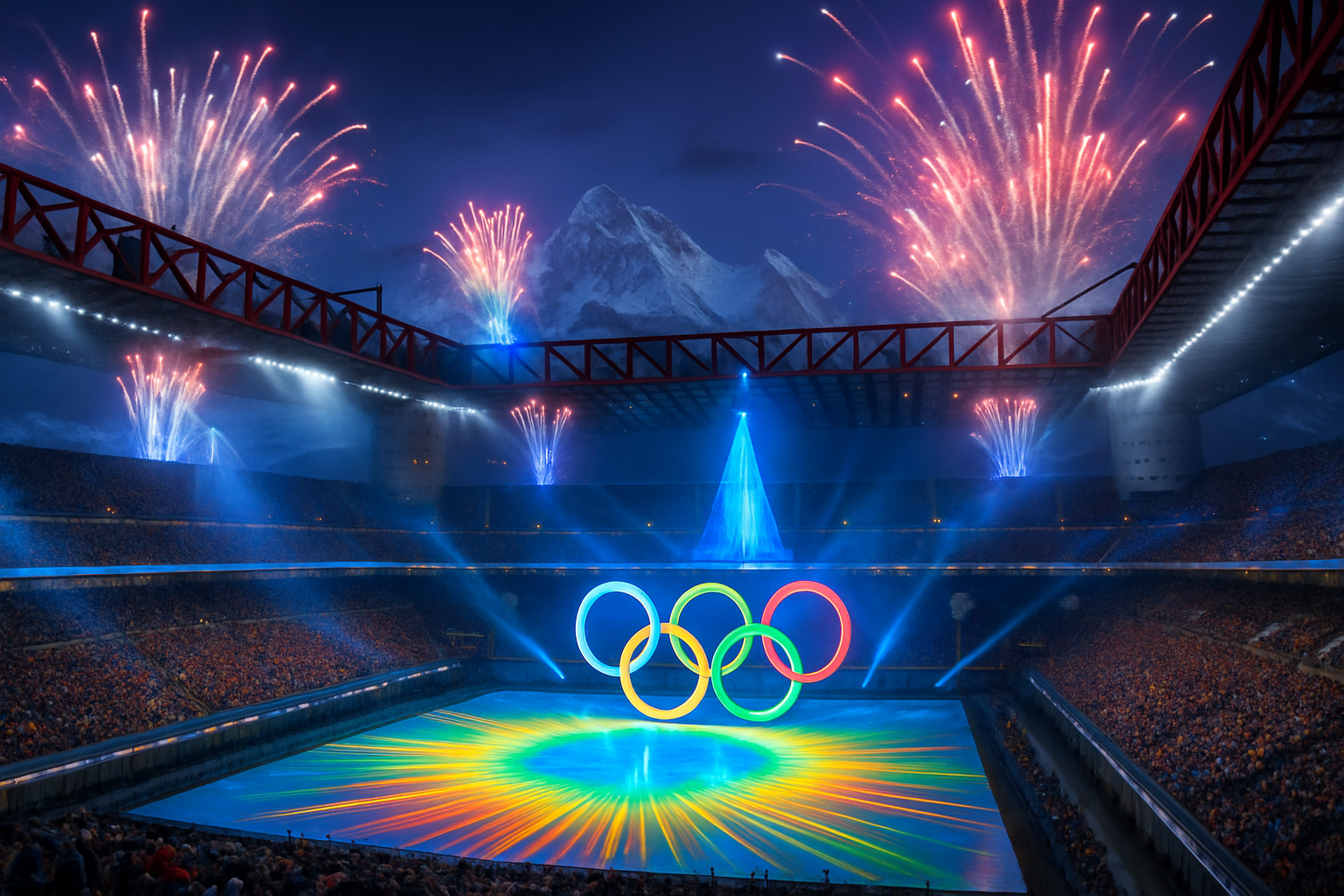
The 2026 Winter Olympics officially commenced on February 6, 2026, with a spectacular opening ceremony at Milan's iconic San Siro stadium, launching the most geographically dispersed Winter Games in Olympic history as nearly 3,000 athletes from 92 countries prepare to compete across seven venues spanning northern Italy.
The ceremony, broadcast live at 8:45 p.m. local time, marked a historic return to the Alps after a 20-year absence and showcased Italy's revolutionary dual-city hosting model stretching over 400 kilometers from Milan to Cortina d'Ampezzo. The Games, running through February 22, feature 116 medal events across 16 sports, including the Olympic debut of ski mountaineering.
Opening Ceremony Highlights Harmony Amid Challenges
The opening ceremony was designed to celebrate "harmony" and unity, presenting a more consensual approach compared to the controversial Paris 2024 Games. The Olympic torch completed its final journey through Milan toward the Arco della Pace, where it arrived as the elaborate show began at San Siro, featuring numerous guests and attended by Italian President Sergio Mattarella.
Star power was evident at the ceremony, with football legend Zlatan Ibrahimović among the notable attendees. The event was held simultaneously across four sites to unify the scattered Olympic venues, representing one of the rare global events capable of attracting hundreds of millions of television viewers worldwide.
Historic Participations and Notable Athletes
The 2026 Games mark several historic firsts for international participation. Saudi Arabia made its Winter Olympic debut with alpine skier Fayik Abdi and cross-country skier Rakan Aliriza, while Caribbean nations Jamaica and Trinidad & Tobago compete in four-man bobsleigh for the first time in Olympic history. Latvia sent its largest-ever Winter Olympics delegation with 68 athletes.
Perhaps the most dramatic storyline belongs to American alpine skiing legend Lindsey Vonn, who at 41 is attempting an unprecedented comeback after completely rupturing her ACL in a January 30 crash at Crans-Montana, Switzerland. Despite the devastating injury occurring just days before the Games, Vonn declared her intention to compete in the downhill event on February 8, presenting one of the most remarkable athletic challenges in Olympic history.
"This is a historic moment that brings together athletes from around the world in the spirit of Olympic unity and competition."
— IOC President Kirsty Coventry
Infrastructure Challenges and Last-Minute Preparations
The Games faced significant logistical hurdles in the final preparations. The main ice hockey venue required "frantic" last-minute construction work, though Canadian ice masters Don Moffatt and Mark Messer assured NHL-quality playing surfaces would be ready for competition.
Transportation issues persisted with the incomplete Apollonio-Socrepes cable car in Cortina forcing local school closures to ease transport management. The geographic dispersion across seven venues has created unprecedented logistical challenges, though organizers expressed confidence in their coordination systems.
Competition had already begun on February 5 with mixed doubles curling, despite power outages at the Cortina venue that disrupted early matches and left competition temporarily in darkness. Italian curlers Stefania Constantini and Amos Mosaner defeated South Korea 8-4 in the opening matches.
Security Concerns and Geopolitical Tensions
The Games opened under heightened security following pro-Russian cyberattacks on Olympic venues and Italian diplomatic facilities just hours before the opening ceremony. Italian Foreign Minister Antonio Tajani confirmed that security services had detected coordinated attacks targeting hotel websites in Cortina d'Ampezzo and Italian embassies in Washington, Sydney, Toronto, and Paris.
Diplomatic tensions also emerged over the presence of U.S. Vice President J.D. Vance and Secretary of State Marco Rubio, who were accompanied by ICE agents, sparking criticism from Italian politicians and raising IOC concerns about potential anti-American demonstrations during the Games.
Technology and Sustainability Innovations
The Milan-Cortina Games represent a technological milestone with the first Olympic integration of AI through Alibaba Cloud's Qwen LLM system, providing artificial intelligence-enabled broadcasting and spectator services. This revolutionary technology aims to enhance the viewing experience for global audiences and streamline information delivery.
Sustainability remains a central theme, with the Games utilizing primarily existing venues to reduce environmental impact. The Olympic villages feature innovative sustainable design with greenhouse spaces and wood materials, housing up to 3,500 athletes in Milan. This approach aims to avoid the waste and environmental destruction often associated with previous Olympic constructions.
Cultural Innovations and Local Integration
The Games showcase significant cultural innovations, including the implementation of bilingual place names in Alto Adige/South Tyrol to accommodate the region's German-speaking population, which comprises two-thirds of residents. The official mascots Milo and Tina, designed as stoats, have been dubbed the "first Gen Z" Olympic mascots.
A Florence-born love song serves as the Games' soundtrack, emphasizing the cultural celebration aspect of the Olympics alongside sporting competition. The dual-city hosting model itself represents a new approach to Olympic organization that could influence future Games.
Athletic Competitions and Medal Expectations
Norway is expected to lead the medal count, with cross-country skier Johannes Høsflot Klæbo anticipated to capture multiple medals. The Netherlands speed skating team is preparing for what they describe as a potential "gold rush" in their traditional strength events.
Figure skating competition began with team events, featuring Italian star Daniel Grassl as a home medal hope. The 23-year-old, who has trained in Boston and Moscow and gained popularity in Japan, is preparing a tango performance that has been dramatically described as "entering like a cardinal, emerging as a Pope."
Weather and Environmental Conditions
The Games are taking place during one of Europe's harshest winters in decades, with temperatures reaching -30°C across northern Italy and the entire continent. While creating challenging conditions for athletes and spectators, the extreme cold has produced ideal natural snow conditions, reducing concerns about artificial snow production that had generated environmental controversy.
Looking Ahead
Despite what IOC President Kirsty Coventry acknowledged as "bumpy" preparations, she promised "unforgettable" Games that would demonstrate the viability of the dual-city hosting model. The Milan-Cortina 2026 Olympics represent a potential new paradigm for sustainable Olympic hosting, emphasizing the use of existing infrastructure and geographic distribution over centralized mega-venues.
As competition intensifies over the coming two weeks, the success of this innovative approach will be measured not only in athletic achievements but also in the effective coordination of the most geographically dispersed Winter Olympics in history, setting precedents for future Olympic organization and international sporting event management.