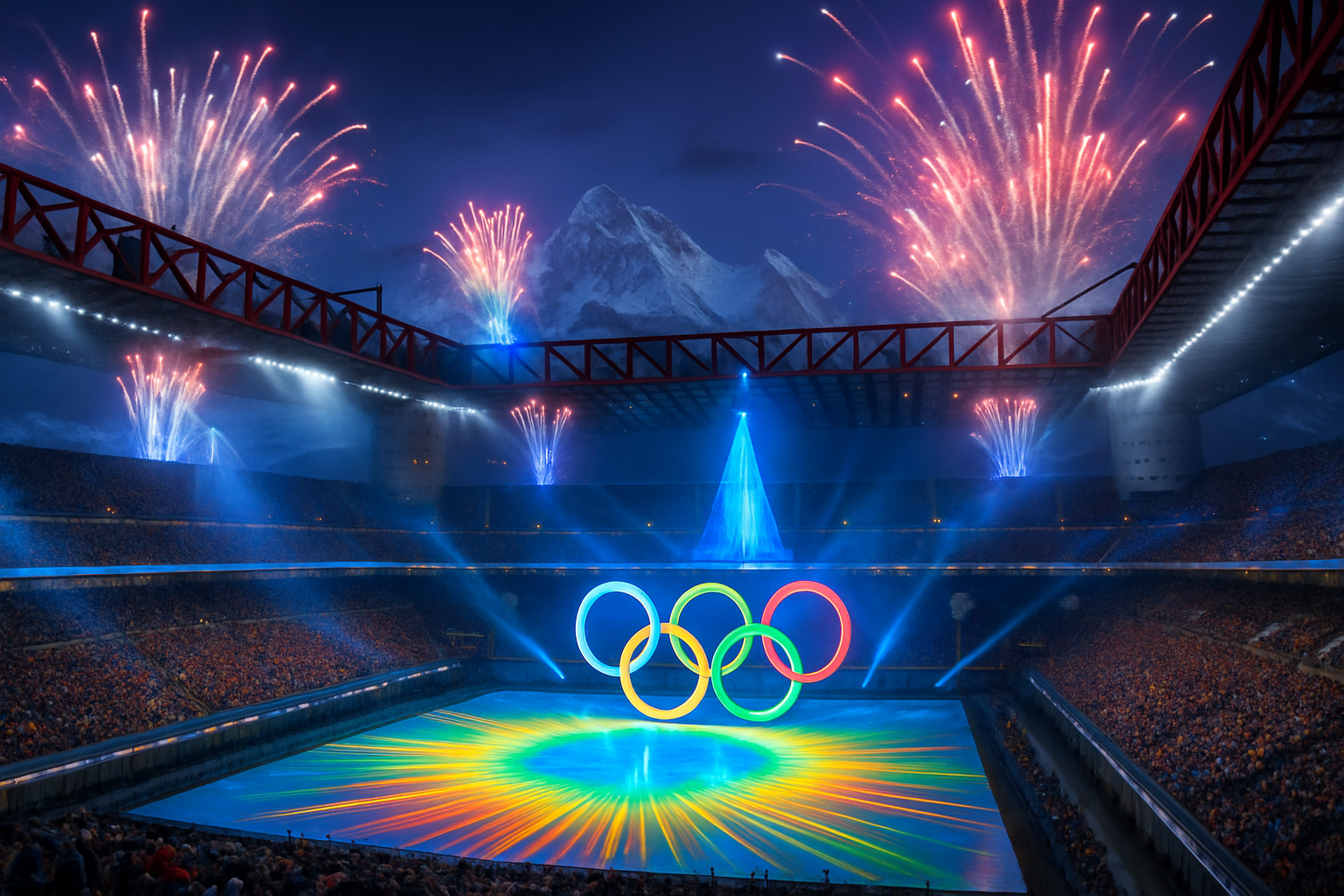
The Milan-Cortina 2026 Winter Olympics officially opened Friday evening with a spectacular three-hour ceremony at San Siro stadium in Milan, marking the beginning of the most geographically dispersed Olympic Games in history as nearly 3,000 athletes from 92 countries prepare to compete across seven venues spanning more than 400 kilometers of northern Italy.
The ceremony, broadcast at 8:45 p.m. local time under the theme "Harmony," officially launched 16 days of competition featuring 116 medal events across 16 sports disciplines. The Games represent a historic return to the Alps after a 20-year absence and showcase an innovative dual-city hosting model that organizers hope will influence future Olympic paradigms.
Presidential Surprise and Star-Studded Opening
In a delightful surprise that captured global attention, Italian President Sergio Mattarella arrived at the ceremony aboard a Milan tram driven by motorcycle racing legend Valentino Rossi, creating an iconic moment that embodied the Games' emphasis on blending tradition with innovation. The unusual arrival delighted spectators and demonstrated Italy's commitment to showcasing both its cultural heritage and sporting legacy.
Football icon Zlatan Ibrahimović was among the star guests attending the ceremony, while the event also drew high-profile international dignitaries including U.S. Vice President J.D. Vance and Secretary of State Marco Rubio, though their presence alongside ICE agents sparked some diplomatic tensions in the lead-up to the Games.
Revolutionary Geographic Distribution
The Milan-Cortina 2026 Olympics represent a groundbreaking approach to Olympic hosting, with events spread across seven venues from Milan in the south to Cortina d'Ampezzo in the north. This geographic dispersion of over 400 kilometers makes these Games the most spatially distributed in Olympic history, driven by sustainability concerns and the desire to utilize existing venues rather than construct new facilities.
"These Games represent a revolutionary model for sustainable Olympic hosting that we believe will influence future bids by emphasizing environmental responsibility and existing infrastructure utilization over centralized venue construction."
— IOC President Kirsty Coventry
The innovative approach includes bilingual place names in Alto Adige/South Tyrol to accommodate the region's German-speaking population, representing two-thirds of the area's residents. This cultural sensitivity demonstrates the organizers' commitment to inclusive hosting that respects local linguistic diversity.
Historic Torch Journey Concludes
The Olympic torch completed its remarkable 12,000-kilometer journey through more than 300 Italian municipalities, with its final passage through central Milan just hours before the ceremony. Renowned ballerina Nicoletta Manni had the honor of lighting the Olympic cauldron at Milan's iconic Piazza Duomo, capping a torch relay that had captured the imagination of millions across Italy.
The relay featured participation from Olympic shooting champion Abhinav Bindra, who described the torch as "a symbol of unity, perseverance, and shared human aspiration" during the emotional final stages of the journey.
Groundbreaking Technology Integration
The Milan-Cortina Games mark several technological firsts in Olympic history. Alibaba Cloud's deployment of the Qwen AI system represents the first integration of Large Language Model (LLM) technology into Olympic infrastructure, providing enhanced broadcasting capabilities and interactive spectator services throughout the competition venues.
Additionally, OMEGA has introduced AI-powered figure skating analysis systems designed to assist judges and provide viewers with unprecedented technical insights into the sport's most complex elements. These innovations represent a significant step forward in sports technology integration.
Sustainability and Cultural Innovation
The Games emphasize environmental consciousness through their sustainable Olympic villages, which feature greenhouse spaces and wood materials with capacity for 3,500 athletes in Milan. This approach reflects growing global awareness of Olympic environmental impact and represents a shift toward more responsible hosting practices.
Cultural innovation extends beyond infrastructure to the Games' mascots, Milo and Tina, dubbed the "first Gen Z" Olympic mascots. These stoat characters represent a modern approach to Olympic branding designed to engage younger audiences while maintaining connection to Alpine wildlife.
Historic Participations and Comeback Stories
The Games feature several historic firsts, including Saudi Arabia's Winter Olympic debut with alpine skier Fayik Abdi and cross-country competitor Rakan Aliriza. Caribbean nations Jamaica and Trinidad & Tobago are making their first appearances in Olympic bobsleigh competition, while Latvia has sent its largest-ever Winter Olympic delegation with 68 athletes.
Perhaps the most compelling individual story belongs to American alpine skiing legend Lindsey Vonn, who at 41 is attempting an unprecedented comeback after suffering a complete ACL rupture in her left knee just days before the Games during a World Cup event in Crans-Montana, Switzerland. Vonn's determination to compete in the downhill event on February 8 despite the devastating injury has captured global attention as the ultimate test of Olympic spirit.
Competition Begins Amid Challenges
Competition officially began February 5 with mixed doubles curling, though early events were disrupted by power outages at the Cortina venue that briefly plunged matches into darkness. Despite technical difficulties, Italy defeated South Korea 8-4 while Sweden overcame the Czech Republic 7-4 in opening results.
The Games have faced various logistical challenges, including incomplete construction of the Apollonio-Socrepes cable car in Cortina, which forced local school closures to manage transportation demand. However, organizers expressed confidence that all venues would be ready for their respective competitions.
Security Measures and Diplomatic Tensions
Security preparations have been extensive across the dispersed venues, with thousands of officers, robotic surveillance systems, and drone monitoring ensuring athlete and spectator safety. These measures were intensified following pro-Russian cyberattacks on Olympic venues and Italian diplomatic facilities just hours before the opening ceremony, targeting hotel websites in Cortina d'Ampezzo and Italian embassies in Washington, Sydney, Toronto, and Paris.
Foreign Minister Antonio Tajani confirmed that Italian security services successfully detected and countered the coordinated attacks, ensuring they did not disrupt the ceremony or ongoing competition preparations.
Weather Creates Ideal Conditions
The Games are taking place during one of Europe's harshest winters in decades, with temperatures dropping to -30°C across the northern Italian venues. While creating logistical challenges, these extreme conditions have provided ideal natural snow coverage, reducing concerns about artificial snow production that had been raised by environmental groups during the planning phase.
Medal Expectations and Competition Outlook
Norway enters as the overwhelming favorite to top the medal table, led by cross-country skiing sensation Johannes Høsflot Klæbo, while the Netherlands is expected to dominate speed skating with what analysts are calling a potential "gold rush." Host nation Italy harbors hopes for figure skating success through Daniel Grassl, whose tango-themed performance has generated significant anticipation among home fans.
The Games will also feature the Olympic debut of ski mountaineering, adding a new dimension to the Winter Olympic program and reflecting the growing popularity of adventure sports among global audiences.
Looking Toward Future Olympic Models
IOC President Kirsty Coventry acknowledged the "bumpy" preparation period but expressed confidence that the Milan-Cortina Games would prove "unforgettable" and potentially transformative for future Olympic hosting. The dual-city model, emphasis on existing venue utilization, and focus on environmental sustainability represent a significant departure from traditional Olympic approaches.
"These Games showcase how the Olympics can adapt to 21st-century realities while maintaining the spirit of international cooperation and athletic excellence that defines our movement."
— IOC President Kirsty Coventry
As competition continues through February 22, the Milan-Cortina Games promise to deliver not only thrilling athletic performances but also valuable lessons about sustainable mega-event hosting that could reshape how future Olympics are conceived and executed. The success of this innovative approach will likely influence Olympic hosting strategies for years to come, particularly as climate change continues to impact traditional winter sports venues worldwide.