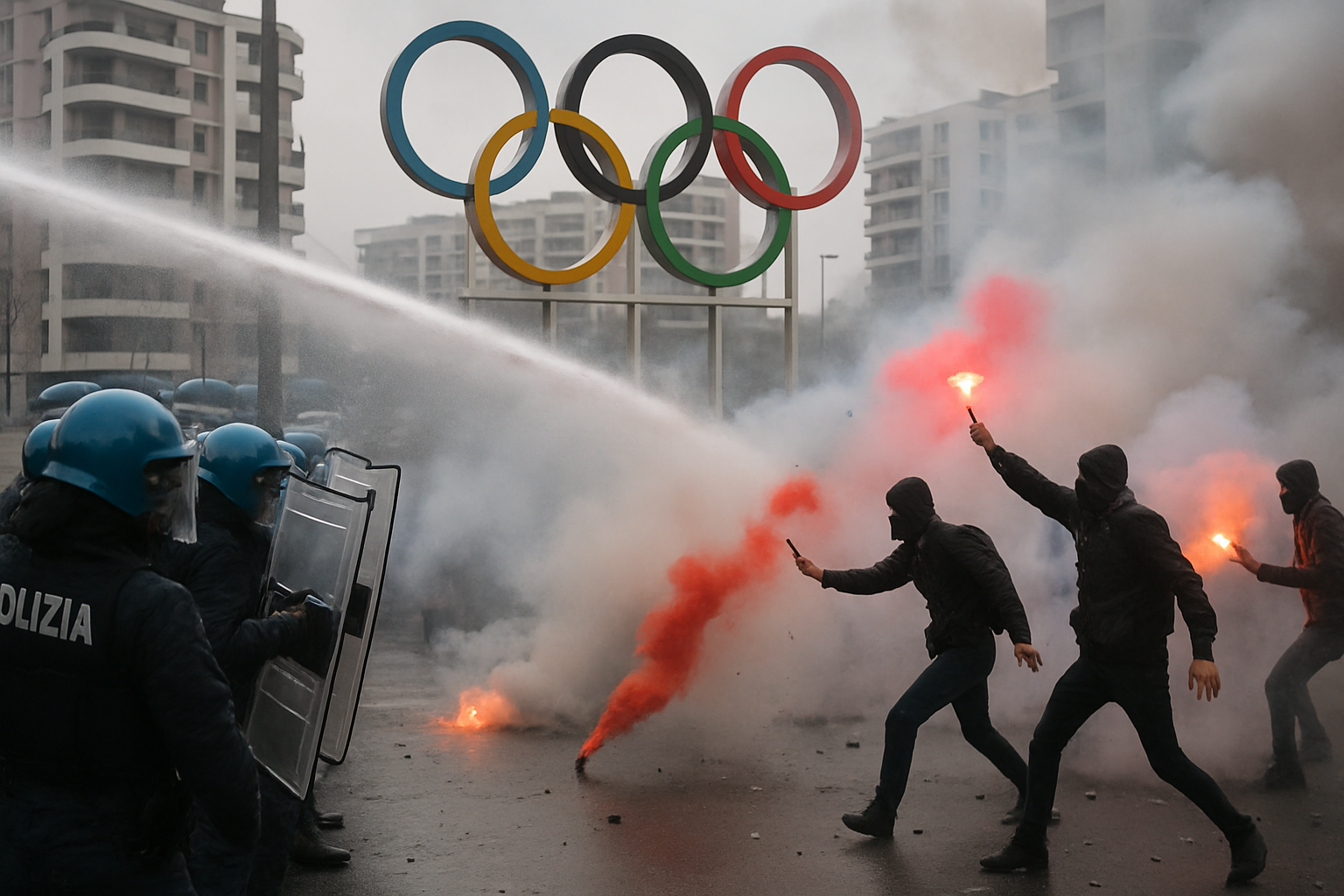
Approximately 10,000 protesters took to the streets of Milan on February 8, 2026, in massive demonstrations against the Milano-Cortina Winter Olympics, leading to violent confrontations with Italian police near the Olympic Village that marked the most significant civil unrest since the Games began.
The protests, which began as peaceful marches denouncing what organizers called the "unsustainable" Olympics, deteriorated into clashes as dozens of rioters threw stones, smoke bombs, and fireworks at police lines. Italian authorities responded with tear gas and water cannons to disperse the crowds in scenes reminiscent of major European protests.
Environmental and Economic Grievances Drive Demonstrations
Demonstrators cited multiple concerns driving their opposition to the Games, with environmental impact and housing affordability topping the list of grievances. The protests occurred against the backdrop of what activists describe as the Olympics' environmental toll on the Italian Alps and concerns over gentrification in Milan and surrounding areas.
The demonstrations coincided with reports of railway sabotage near Bologna that disrupted high-speed and conventional train services across northern Italy. Officials said cables were damaged on sections of the Bologna-Venice line, with authorities investigating what Transport Minister Matteo Salvini called "serious sabotage" potentially linked to the Olympics.
"Environmental damage, housing shortages, and multiple other reasons led thousands of people in Milan to protest against the Olympic Games in Italy."
— German News Report, Tagesschau
Security Concerns Escalate on Olympic Competition Day
The violent confrontations occurred on what was the first full day of Olympic competition, raising serious security concerns about the safety of the Games. The protests represent the most significant challenge to the Milano-Cortina Olympics since they began, coming after previous disruptions including power outages at venues and infrastructure delays.
Italian police had implemented extensive security measures across the geographically dispersed Olympic venues, but the scale of the Milan demonstrations appeared to catch authorities off guard. The protests occurred just days after the opening ceremony at San Siro stadium, which had been marked by diplomatic tensions and security concerns.
The unrest adds to a growing list of challenges facing what organizers have called the most geographically dispersed Winter Olympics in history, spanning seven venues across 400+ kilometers from Milan to Cortina d'Ampezzo.
Broader Context of Olympic Opposition
The February 8 protests represent the culmination of mounting opposition to the Olympics that has been building since the Games' preparation phase. Critics have pointed to environmental concerns over artificial snow production, the construction of new facilities in sensitive Alpine areas, and the displacement of local residents due to rising accommodation costs.
Previous reports documented that 500 ancient larch trees were felled for the Cortina Sliding Centre bobsleigh track, sparking environmental controversy. Infrastructure challenges have also plagued the Games, including the incomplete Apollonio-Socrepes cable car that forced school closures for transport management.
The protests also reflect broader concerns about the militarization of Olympic security, with thousands of officers, robots, drones, and cyber command centers deployed across the venues. Some demonstrators have specifically opposed the presence of U.S. Immigration and Customs Enforcement (ICE) agents accompanying American officials to the Games.
Railway Sabotage Compounds Olympic Disruptions
The protests occurred alongside what authorities described as coordinated sabotage attacks on Italy's railway infrastructure. The incidents near Bologna disrupted traffic and caused delays to high-speed services connecting major Olympic host cities, stranding thousands of passengers at Milan Central Station during the peak travel period.
Transport Minister Matteo Salvini confirmed that technical causes had been ruled out, with the attacks being treated as deliberate coordinated strikes against critical infrastructure. The timing during the Olympics' opening weekend was seen as intended to maximize disruption during massive passenger movements between venues.
The sabotage exposed vulnerabilities in Italy's transportation network, which serves as the primary backbone connecting the dispersed Olympic venues. Enhanced security has since been implemented across the railway network as authorities investigate potential links to broader opposition to the Games.
International Attention on Olympic Security
The Milan protests have drawn international media attention, with coverage highlighting concerns about public order during major international events. The demonstrations occurred against the backdrop of previous security challenges, including pro-Russian cyberattacks on Olympic venues and Italian diplomatic facilities just hours before the opening ceremony.
The scale of the protests – with an estimated 10,000 participants – represents one of the largest anti-Olympic demonstrations in recent Games history. The events have prompted questions about the sustainability of hosting Olympic Games in densely populated urban areas where local opposition can mobilize significant numbers of protesters.
Olympic organizers have sought to emphasize the Games' sustainability credentials, including the use of existing venues and the dual-city hosting model. However, the protests suggest that messaging about environmental responsibility has not resonated with significant portions of the local population.
Looking Forward: Security and Competition Continuation
Despite the protests and infrastructure disruptions, Olympic competition continues across all venues. The International Olympic Committee and local organizers have expressed confidence in their security arrangements, though the events have highlighted the complex challenges of hosting mega-events in politically sensitive environments.
The Milano-Cortina Olympics are scheduled to run through February 22, with nearly 3,000 athletes from 92 countries competing across 16 sports. The Games represent Italy's return to hosting Winter Olympics after 20 years and the first time a Winter Olympics has been spread across such a vast geographic area.
Authorities have indicated that additional security measures may be implemented in response to the protests and sabotage incidents. The coming days will test whether Olympic organizers can maintain both the security of the Games and their commitment to the open, celebratory atmosphere that has traditionally defined the Olympic movement.