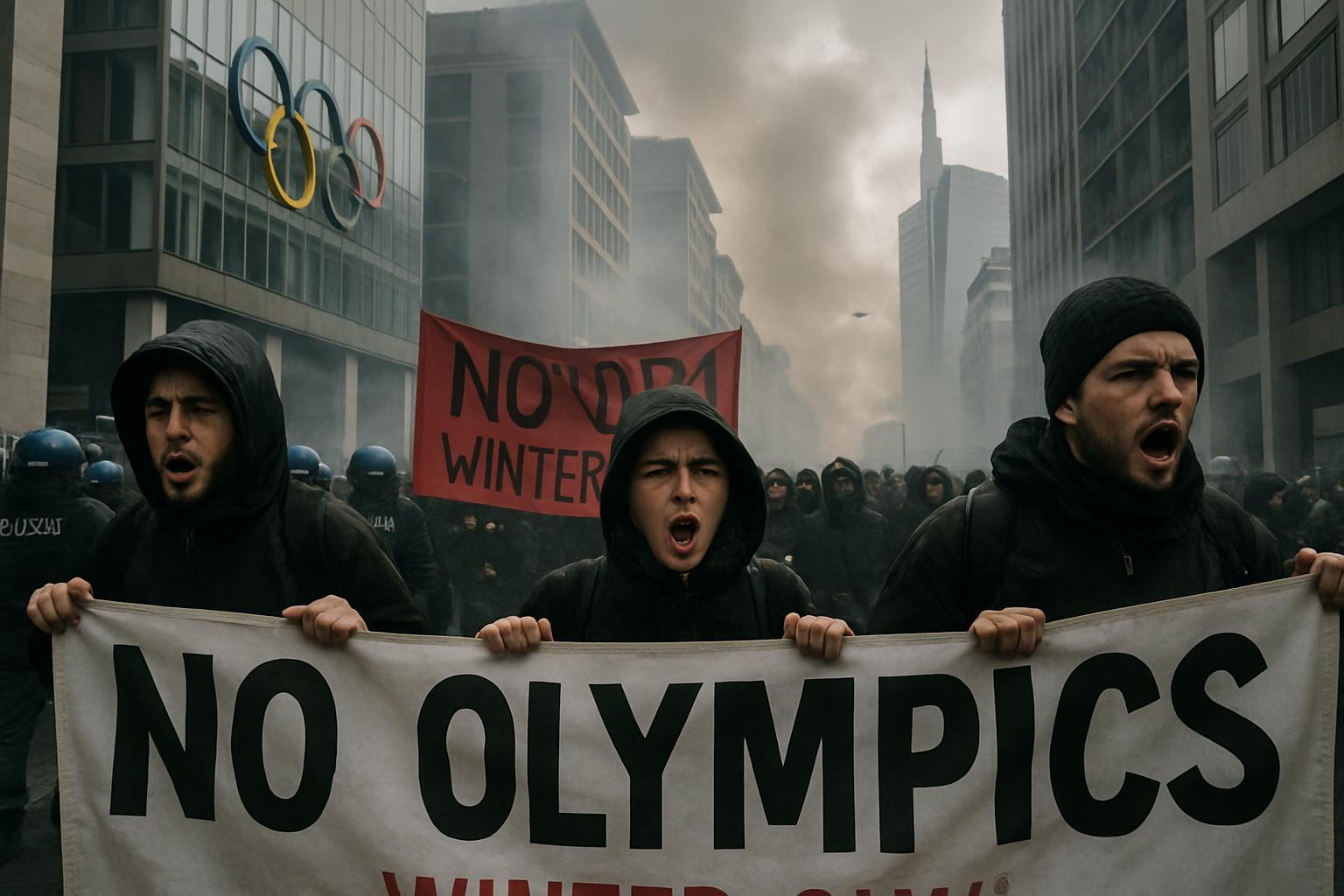
Italian Prime Minister Giorgia Meloni on Sunday condemned demonstrators who protested against the Winter Olympics in Milan as "enemies of Italy," following violent clashes between protesters and police near Olympic venues that ended a peaceful march by thousands concerned about the Games' environmental and economic impact.
Approximately 10,000 protesters marched through Milan on Saturday in opposition to the Milano-Cortina 2026 Winter Olympics, which officially opened on February 6. What began as a peaceful demonstration under the slogan "Free the mountains!" escalated into violence when dozens of participants threw stones, smoke bombs, fireworks, and firecrackers at police officers in riot gear.
Italian authorities responded with tear gas and water cannons when protesters attempted to access a highway near the Winter Olympics venues. The confrontation marked the most significant civil unrest since the Games began, representing a culmination of mounting opposition during the preparation phase of what is being billed as the most geographically dispersed Winter Olympics in history.
Environmental and Economic Grievances
The protests centered on multiple concerns about the Olympics' impact on the Alpine region. Demonstrators denounced what they termed "unsustainable" Olympics, citing environmental damage from artificial snow production, the felling of 500 ancient larch trees for the Cortina Sliding Centre, and Alpine environmental degradation across the seven venues spanning 400+ kilometers from Milan to Cortina d'Ampezzo.
Housing affordability emerged as another key grievance, with protesters arguing that the Games have contributed to gentrification and displaced local residents due to rising accommodation costs. The demonstrations also opposed the presence of U.S. Immigration and Customs Enforcement (ICE) agents accompanying American officials, including Vice President J.D. Vance and Secretary of State Marco Rubio, creating additional diplomatic tensions.
According to multiple European news sources, the protesters specifically targeted what they viewed as excessive public spending on Olympic infrastructure while local communities face housing pressures and environmental concerns.
Government Response and Political Implications
Prime Minister Meloni's harsh condemnation came during a Sunday statement where she declared that anyone manifesting against the Olympic Games was an enemy of the state. Her strong rhetoric reflects the Italian government's commitment to the success of the Games, despite growing criticism of the event's environmental and social costs.
The protests coincided with broader infrastructure challenges facing the Games, including coordinated railway sabotage near Bologna that disrupted high-speed train services across northern Italy. Transport Minister Matteo Salvini called these incidents "serious sabotage" potentially linked to the Olympics, forcing thousands to be stranded at Milan Central Station.
Security measures have been extensive across the dispersed venues, involving thousands of officers, robots, drones, and cyber command centers. The Games have already faced pro-Russian cyberattacks on venues and Italian embassies, which were successfully countered by Foreign Minister Antonio Tajani's security services.
Olympic Context and International Attention
The Milano-Cortina 2026 Winter Olympics represent a return to the Alps after a 20-year absence, featuring 3,000 athletes from 92 countries competing in 116 medal events across 16 sports through February 22. The Games have been marketed as emphasizing sustainability and using existing venues, but critics argue the reality falls short of these promises.
The protests have drawn international media attention to the tensions between hosting mega-sporting events and addressing local environmental and social concerns. European outlets have described the demonstrations using terms like "bloodbath" and "chaos," highlighting the severity of the confrontations between protesters and law enforcement.
The incidents represent a significant challenge for Italy's sports diplomacy efforts, with IOC President Kirsty Coventry having acknowledged "bumpy" preparations while promising "unforgettable" Games. The revolutionary dual-city hosting model, spanning unprecedented geographic distances, has created both logistical challenges and opportunities for local opposition to mobilize.
Broader Infrastructure Concerns
Beyond the protests, the Games continue to face infrastructure challenges that have provided additional fuel for critics. The incomplete Apollonio-Socrepes cable car in Cortina has forced school closures for transport management, while venue construction has continued until the last minute despite years of preparation.
Power outages have affected competition venues, including curling matches at Cortina, demonstrating the technical difficulties of managing events across such a geographically dispersed area. These challenges have reinforced protesters' arguments about the Games' impact on local communities and infrastructure.
The railway sabotage incidents near Bologna, which occurred during the Olympics' opening weekend, exposed vulnerabilities in critical transportation infrastructure during periods of international scrutiny. The coordinated attacks on electrical systems suggested technical knowledge and careful planning, raising concerns about the security of mega-events in politically sensitive environments.
Historical Olympic Protests Context
Olympic protests are not unprecedented, but the Milano-Cortina demonstrations represent a significant escalation in civil unrest directly challenging a host nation's Olympic project. Previous Olympic Games have faced opposition, but the combination of environmental concerns, housing issues, and geopolitical tensions has created a particularly volatile situation.
The protests highlight the growing tension between the Olympic movement's ideals of international cooperation and athletic excellence, and local communities' concerns about the social, economic, and environmental costs of hosting mega-sporting events. This tension has become increasingly prominent as climate change and social justice concerns have gained greater public attention.
Looking Forward
As the Milano-Cortina Games continue through February 22, the Italian government faces the challenge of maintaining security while preserving the Olympic spirit of international cooperation. The strong political rhetoric from Prime Minister Meloni suggests that authorities will take a firm stance against future demonstrations, but this approach may also risk further polarizing public opinion.
The success or failure of managing these tensions could influence how future Olympic host cities approach the balance between celebrating international sport and addressing legitimate community concerns. The Games represent a test case for whether the Olympic movement can adapt to 21st-century realities while maintaining its core values of promoting peace through sport.
The international community will be watching closely to see whether the remainder of the Games can proceed without further major incidents, and whether the Italian authorities can find ways to address the underlying concerns that drove thousands to the streets of Milan in opposition to an event designed to showcase their country to the world.