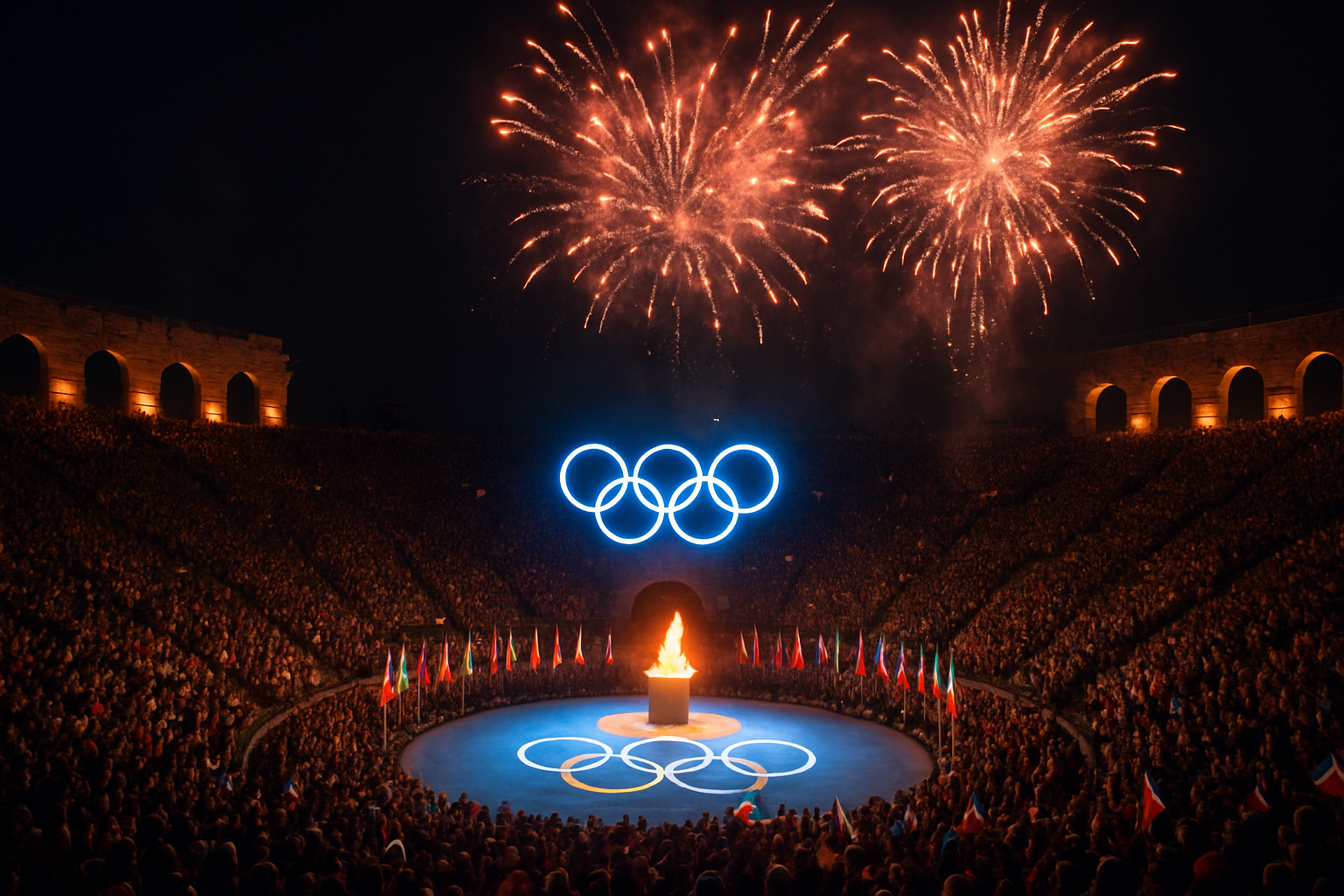
The 2026 Winter Olympics Milano-Cortina concluded with a magnificent closing ceremony at the historic Arena di Verona on February 22, 2026, marking the end of the most geographically dispersed Winter Games in Olympic history and officially transferring the Olympic flag to France for the 2030 French Alps Games.
The spectacular "Beauty in Action" ceremony, held in the 2,000-year-old Roman amphitheater, brought together approximately 1,500 athletes from 92 nations in a celebration of Italian culture, Olympic achievement, and international unity. The event featured performances by renowned ballet dancer Roberto Bolle, opera star Achille Lauro, actress Benedetta Porcaroli, and DJ Gabry Ponte, creating a uniquely Italian farewell to these groundbreaking Games.
Norway Dominates Medal Standings
Norway finished as the undisputed champion of Milano-Cortina 2026, achieving unprecedented Winter Olympic records with 18 gold medals and 41 total medals. The nation's success was anchored by Johannes Høsflot Klæbo, who became the most decorated Winter Olympian in history with 11 career gold medals, including six at these Games – making him the first athlete ever to win all six cross-country skiing events at a single Olympics.
"These have been truly magical Games," declared IOC President Kirsty Coventry as she officially closed the Olympics. "Milano-Cortina has shown us that Olympic excellence can be achieved while embracing sustainability and innovation."
— Kirsty Coventry, IOC President
Italy's performance as host nation was remarkable, capturing 9 gold medals and 26 total medals, with Lisa Vittozzi winning the country's first-ever individual women's biathlon Olympic gold. The United States rounded out the top three with 24 medals, while several nations achieved historic breakthroughs.
Revolutionary Hosting Model Proves Successful
The Milano-Cortina 2026 Games established a new paradigm for Olympic hosting, successfully spanning more than 400 kilometers across northern Italy with seven venues from Milan to Cortina d'Ampezzo. This dual-city hosting model, initially met with skepticism, proved that geographically dispersed Games could maintain the highest competitive standards while promoting environmental sustainability.
The Games featured groundbreaking technological innovations, including the first Olympic deployment of artificial intelligence through Alibaba's Qwen LLM system for broadcasting and spectator services, and OMEGA's AI-powered figure skating analysis. Cultural authenticity was preserved through bilingual place names in Alto Adige/South Tyrol and sustainable Olympic villages featuring greenhouse spaces.
Global Winter Sports Democratization
Milano-Cortina 2026 will be remembered as the Olympics that truly democratized winter sports across six continents. Australia achieved its most successful Winter Games ever with multiple gold medals in moguls and snowboard cross. Brazil's Lucas Pinheiro Braathen won the nation's first Winter Olympic gold, while Kazakhstan's Mikhail Shaidorov delivered one of the biggest upsets in figure skating history.
Historic first-time participations included Saudi Arabia's debut with alpine and cross-country skiers, Caribbean nations Jamaica and Trinidad & Tobago competing in bobsleigh, and Latvia's record-setting 68-athlete delegation. Bulgaria ended a 20-year medal drought, while Estonia achieved multiple breakthrough performances.
The Final Competition Day
The Games' final day featured the men's 50km cross-country mass start classic, with Klæbo completing his unprecedented six-gold achievement. Earlier, the United States defeated Canada 2-1 in overtime to claim ice hockey gold, marking the return of NHL stars to Olympic competition after a 12-year absence.
Speed skating concluded with the Netherlands demonstrating their traditional dominance, while women's 50km cross-country provided the final Nordic event with Norway's Astrid Øyre Slind forced to withdraw due to equipment problems, highlighting the dramatic unpredictability that characterized these Games.
Ceremony Highlights and Olympic Flag Transfer
The closing ceremony, attended by Italian Prime Minister Giorgia Meloni and other dignitaries, celebrated Italy's rich cultural heritage through performances of Giuseppe Verdi's "Rigoletto" and "La Traviata," contemporary music, and spectacular aerial displays. The dual Olympic flames that had burned throughout the Games in both Milan and Cortina were ceremonially extinguished in a moment of profound symbolism.
In the traditional flag transfer ceremony, the Olympic flag was passed from Milano-Cortina organizers to representatives of the 2030 French Alps Games, with the French flag raised alongside those of Italy and Greece in the ancient amphitheater.
Legacy of Innovation and Unity
Milano-Cortina 2026 overcame significant challenges, including infrastructure delays, severe European winter conditions, and geopolitical tensions, to deliver Games that redefined what Olympic hosting could achieve. The successful integration of sustainability measures, technological innovation, and cultural authenticity while maintaining athletic excellence at the highest level created a template for future Olympic hosting in the climate-change era.
The Games demonstrated that winter sports excellence transcends geographic boundaries, with breakthrough performances from every inhabited continent challenging traditional power structures. The revolutionary hosting model proved that Olympic ideals of international cooperation and sporting excellence could adapt to 21st-century realities while preserving the Olympic spirit.
"Milano-Cortina has shown the world that the Olympic Games can evolve while staying true to our core values of excellence, friendship, and respect," reflected organizing committee president Giovanni Malagò during the ceremony.
— Giovanni Malagò, Milano-Cortina 2026 President
Looking Toward 2030
As the Olympic flame was extinguished and attention turned to the 2030 French Alps Games, Milano-Cortina 2026 concluded as potentially the most transformative Winter Olympics in history. The Games established new benchmarks for sustainable hosting, technological integration, global participation, and athletic achievement, creating a legacy that will influence Olympic hosting for decades to come.
The two-week celebration of winter sports at its finest, set against the spectacular backdrop of the Italian Alps and powered by unprecedented global participation, demonstrated that Olympic dreams have no boundaries – geographical, cultural, or otherwise. As the last notes of the ceremony echoed through the ancient stones of Verona's Arena, the Milano-Cortina 2026 Winter Olympics joined the pantheon of truly historic Olympic Games.