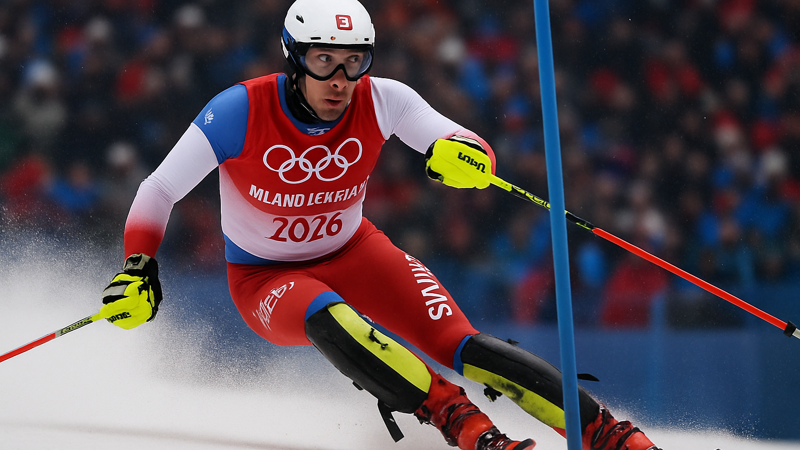
Day 10 of the Milano-Cortina 2026 Winter Olympics delivered more historic achievements and dramatic storylines as Switzerland extended its Alpine dominance, Canada celebrated breakthrough performances, and the revolutionary dual-city Games continued to showcase winter sports at their finest.
Swiss Alpine Excellence Reaches New Heights
Switzerland's remarkable Alpine skiing campaign reached another pinnacle as Loïc Meillard captured men's slalom gold at Bormio, marking the first Swiss men's slalom Olympic victory since Edy Reinalter's triumph at St. Moritz in 1948. This historic achievement represents Switzerland's eighth gold medal of the Games—the nation's best-ever Winter Olympic performance.
Meillard's victory on the challenging Stelvio course came after Switzerland had already established unprecedented Alpine dominance through Franjo von Allmen's triple gold medal performance across downhill, team combination, and Super-G events. The 78-year gap between Swiss men's slalom Olympic champions underscores the magnitude of Meillard's achievement.
"This victory completes our incredible Alpine campaign," stated Swiss Olympic officials. "From von Allmen's historic triple to Meillard's slalom mastery, we're witnessing Swiss skiing at its absolute peak."
— Swiss Olympic Team Statement
Canadian Freestyle Skiing Breakthrough
Canada's freestyle skiing program delivered spectacular results as Megan Oldham captured her second gold medal of the Milano-Cortina Games with a dominant women's big air performance. The Parry Sound, Ontario native scored 180.75 points across her best two runs, defeating Chinese superstar Eileen Gu (179 points) and Italy's Flora Tabanelli in a thrilling final.
Oldham's victory makes her the third Canadian to earn multiple medals at these Games and the first Canadian woman in freestyle skiing to claim two medals at the same Olympics. Her performance in the big air final showcased the technical precision and aerial innovation that has become the hallmark of Canadian freestyle skiing excellence.
The victory was particularly meaningful as it came after Oldham emerged as a medal contender following strong qualifying performances at Livigno Snow Park. Her success adds to Canada's impressive freestyle skiing legacy at Milano-Cortina 2026, continuing the nation's tradition of excellence in aerial disciplines.
Australia's Historic Winter Sports Emergence Continues
Australia's remarkable transformation into a winter sports powerhouse continued with performances that have positioned the nation for its most successful Winter Olympics ever. The "beach nation" has defied expectations with its moguls skiing dominance, earning recognition as the world's premier moguls nation through systematic development and strategic investment.
The Australian moguls team's success represents no accident, built through years of dedicated preparation and technical innovation. Their dominance has challenged traditional winter sports hierarchies and demonstrated that geographic location need not limit Olympic aspirations in winter disciplines.
This breakthrough reflects broader winter sports democratization occurring at Milano-Cortina 2026, where nations from six continents have challenged traditional powerhouses and redefined the competitive landscape.
Athletic Excellence Amid Operational Challenges
Despite ongoing infrastructure challenges, including the incomplete Apollonio-Socrepes cable car that has forced school closures in the Cortina region, the most geographically dispersed Winter Olympics in history continues to deliver world-class competition across its seven venues spanning 400+ kilometers.
The revolutionary dual-city hosting model has proven successful in maintaining Olympic standards while demonstrating sustainable practices. Technology integration, including Alibaba's Qwen AI system and OMEGA's advanced analysis tools, has enhanced both spectator experiences and competitive assessment.
Global Competition Intensifies
Day 10 featured intense competition across multiple disciplines as the Games approach their conclusion. Austria won a chaotic ski jumping super team final that was repeatedly disrupted by heavy snowfall at Predazzo, demonstrating the adaptability required in winter sports competition.
Short track speed skating continued to showcase global competitiveness, while curling competitions have provided dramatic storylines including heated confrontations and cheating accusations that required World Curling Federation intervention.
The medal standings continue to reflect unprecedented global competitiveness, with Norway maintaining its traditional lead but facing significant challenges from emerging winter sports nations across multiple continents.
Revolutionary Olympic Legacy Taking Shape
Milano-Cortina 2026 has established new paradigms for Olympic hosting through its combination of environmental sustainability, geographic distribution, and cultural authenticity. The bilingual place names in Alto Adige/South Tyrol, sustainable Olympic villages featuring greenhouse spaces, and innovative Gen Z mascots Milo and Tina have created a distinctly authentic Italian Olympic experience.
The Games have successfully demonstrated that winter sports excellence transcends traditional boundaries, with breakthrough performances from unexpected nations proving that Olympic dreams recognize no geographic limits. The success of the dual-city model, despite logistical complexities, provides a template for future sustainable Olympic hosting.
Looking Toward the Final Week
As Milano-Cortina 2026 enters its final stages, the competition continues to deliver the human drama, athletic excellence, and international cooperation that define the Olympic movement. With several days of competition remaining through February 22, these Games have already secured their place as a transformative moment in Winter Olympic history.
The success of the geographically dispersed format, combined with technological innovations and cultural celebrations, has created an Olympic experience that honors tradition while embracing 21st-century sustainability and inclusivity. The stage is set for a memorable conclusion to what may prove to be the most democratically competitive Winter Olympics ever held.