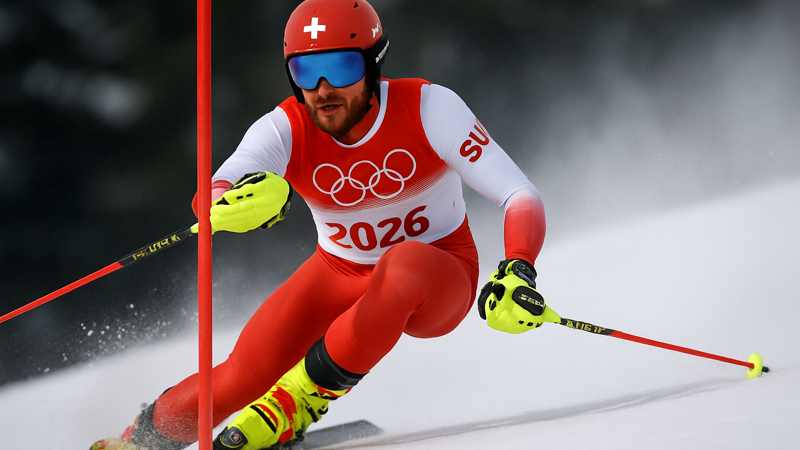
Switzerland's Loïc Meillard etched his name in Olympic history on Monday, becoming the first Swiss man to win Olympic slalom gold since 1948, while the Milano-Cortina 2026 Winter Olympics continued to deliver compelling storylines across multiple venues spanning northern Italy.
Meillard's commanding victory at the challenging Bormio course marked a watershed moment for Swiss alpine skiing, coming 78 years after Edy Reinalter's triumph at the 1948 St. Moritz Olympics. The 28-year-old from Romand demonstrated exceptional technical precision and mental fortitude to claim Switzerland's eighth gold medal of these Games, the nation's best-ever Winter Olympic performance.
"This victory represents everything we've worked for," Meillard said after his historic achievement. "To be the first Swiss man to win this event in nearly eight decades is beyond my dreams."
Canada's Sarault Continues Medal Collection
Canadian short track speed skater Courtney Sarault added another silver medal to her impressive Milano-Cortina haul, finishing second in the women's 1,000-meter event. The 25-year-old from Moncton, New Brunswick, now boasts three medals from these Games, having previously claimed bronze in the 500 meters and silver in the mixed relay.
"It's a dream come true to stand on this podium three times," Sarault said while biting her silver medal. "Each race has been an incredible journey, and to compete at this level across multiple distances shows the depth of our Canadian program."
Sarault's success continues Canada's strong showing in short track, a sport where the nation has historically excelled. Her ability to medal across different distances demonstrates the versatility that has made her one of the world's premier short track athletes.
Austria Claims Ski Jumping Gold Despite Team Event Chaos
Austria's ski jumping team prevailed in a chaotic super team final that was repeatedly disrupted by heavy snowfall. The competition at Predazzo faced multiple delays and format changes as conditions deteriorated, but the Austrian quartet ultimately secured victory with superior technique and consistency.
Fabio Gstrein emerged as a silver medallist in the men's slalom, adding to Austria's impressive alpine skiing medal tally. The performance came as weather conditions across the Italian Alps continued to challenge organizers, though natural snow has provided ideal racing surfaces when competitions can proceed.
Global Competition Reaches Fever Pitch
The revolutionary dual-city hosting model spanning more than 400 kilometers from Milan to Cortina d'Ampezzo continues to function effectively despite the logistical challenges. Monday's competition featured events across multiple venues, from the technical alpine courses of Bormio to the high-speed action at the Milano speed skating oval.
Australia's remarkable Winter Olympic campaign shows no signs of slowing, with the nation positioned to achieve its most successful Winter Games ever. Following breakthrough gold medals from Jakara Anthony in dual moguls, Cooper Woods in men's moguls, and Josie Baff in snowboard cross, Australian athletes continue to challenge traditional winter sports hierarchies.
Infrastructure Resilience Amid Challenges
Despite ongoing concerns about incomplete infrastructure, including the Apollonio-Socrepes cable car system that has forced school closures in the Cortina region, competition venues have maintained their operational standards. The Games have successfully demonstrated that geographically dispersed hosting can work while maintaining competitive integrity.
"The conditions are challenging, but that's what makes Olympic competition so special. Every athlete is facing the same difficulties, and it's about who can adapt and perform when it matters most."
— International Olympic Committee spokesperson
Technology Integration Enhances Experience
The integration of Alibaba's Qwen AI system and OMEGA's advanced timing technology continues to provide enhanced experiences for both spectators and broadcast audiences. The AI-powered analysis has offered unprecedented insights into athletic performance, particularly in complex disciplines like figure skating and freestyle skiing.
Cultural innovations, including the bilingual place names in Alto Adige/South Tyrol and the popular Gen Z mascots Milo and Tina, have resonated with international audiences and demonstrated how Olympic hosting can celebrate regional identity while maintaining global appeal.
Medal Standings Reflect Global Competition
Norway continues to lead the overall medal count, but the margin has narrowed as nations like Switzerland, Italy, and unexpected contenders from across six continents challenge traditional winter sports powerhouses. The democratization of winter sports has been a defining characteristic of Milano-Cortina 2026.
The Games have featured breakthrough performances from athletes representing nations with limited winter sports traditions, including historic participations from Saudi Arabia, Caribbean bobsled teams from Jamaica and Trinidad & Tobago, and Latvia's record delegation of 68 athletes.
Looking Ahead
As Milano-Cortina 2026 approaches its final week, the competition intensity continues to escalate. Upcoming events include crucial ice hockey matches, the conclusion of several alpine skiing disciplines, and the highly anticipated figure skating individual events that have already produced stunning upsets.
The Games have successfully established a new paradigm for Olympic hosting, combining environmental sustainability with athletic excellence across a geographically dispersed format. Despite early infrastructure concerns and the challenges posed by Europe's harshest winter in decades, Milano-Cortina 2026 has delivered memorable competition and demonstrated the enduring power of the Olympic spirit.
With competition continuing through February 22, these Olympics have already secured their place in history as a successful demonstration that winter sports excellence transcends traditional boundaries while embracing innovation, sustainability, and cultural authenticity.