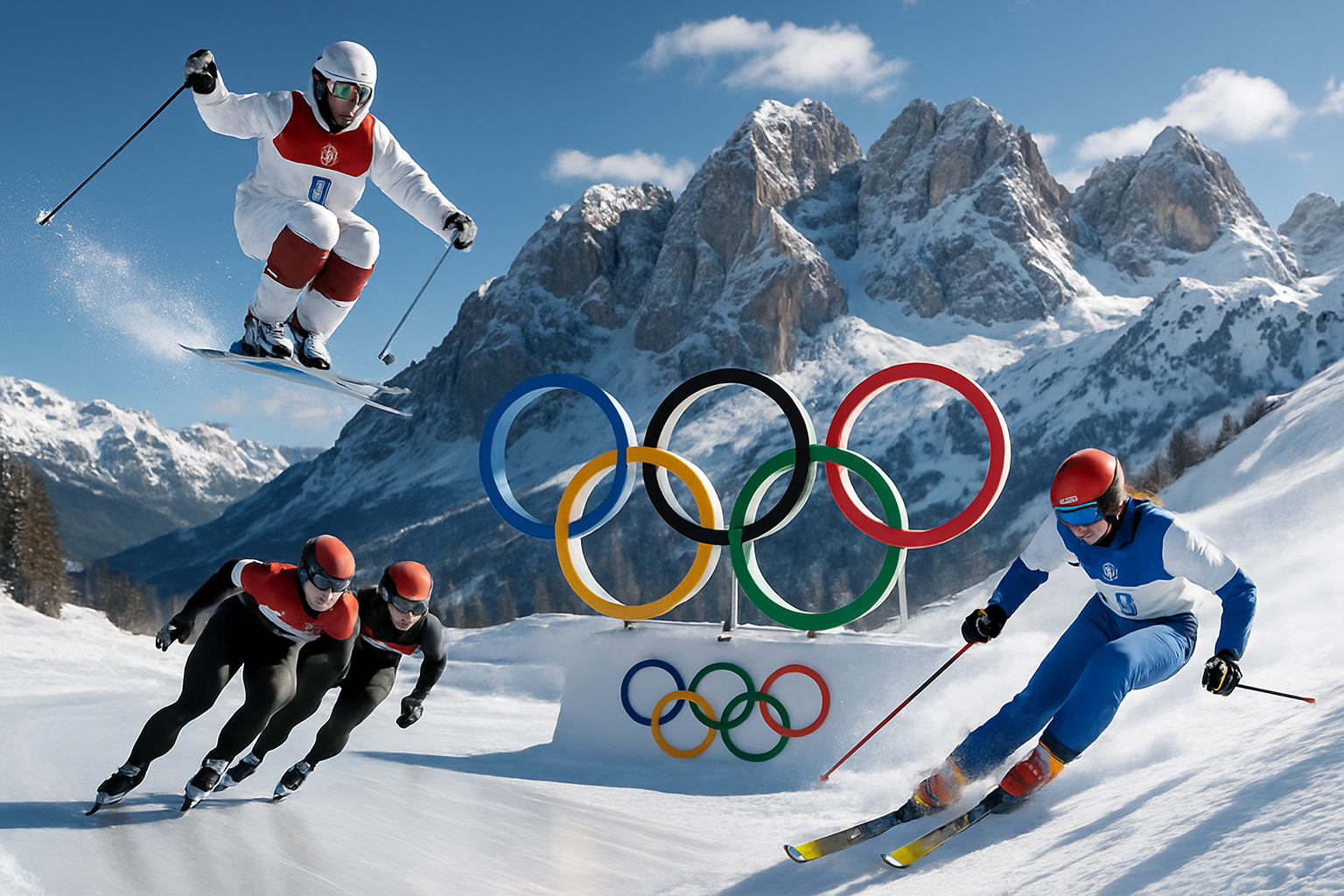
Day 6 of the Milano-Cortina 2026 Winter Olympics delivered extraordinary drama across the Italian Alps, with Australia's Cooper Woods stunning the moguls field for gold, Italy's Federica Brignone achieving an emotional Super-G victory just 10 months after a devastating injury, and Sweden's Frida Karlsson continuing her cross-country dominance in what experts called a "demonstration of power."
The most geographically dispersed Winter Olympics in history continued to showcase athletic excellence across its 400+ kilometer venue network, with Thursday's competition producing career-defining moments and historic achievements that will be remembered long after the Games conclude on February 22.
Australia's Golden Breakthrough in Men's Moguls
In the day's most surprising result, Australia's Cooper Woods delivered a stunning performance to claim gold in the men's moguls at Livigno, defeating two-time Olympic champion Mikaël Kingsbury of Canada and Japan's Ikuma Horishima in an epic final that had spectators on their feet.
Woods, who entered the competition as an outsider, produced a flawless run in the super final to secure Australia's first gold medal of Milano-Cortina 2026. The 24-year-old's victory marked a breakthrough moment for Australian freestyle skiing, with his technical precision and aerial mastery overwhelming more established competitors.
"Cooper has etched his name into Australian Olympic history," declared team officials, as Woods' triumph provided an emotional highlight in what has been a challenging campaign for the Australian delegation. The victory was particularly sweet given the recent injury concerns that had plagued several Australian athletes.
Canada's Kingsbury, seeking his third consecutive Olympic gold, had to settle for silver in what may have been his final Olympic appearance. The 31-year-old champion graciously acknowledged Woods' superior performance, while Japan's Horishima claimed bronze for the second consecutive Olympics, maintaining his reputation as one of the sport's most consistent performers.
Brignone's Remarkable Super-G Triumph
Perhaps no victory carried more emotional weight than that of Italy's Federica Brignone, who won Super-G gold at Cortina d'Ampezzo just 10 months after suffering a horrific leg fracture that many believed would end her career. The 35-year-old became the oldest alpine skiing champion in Winter Olympic history, fulfilling a dream in front of Italian President Sergio Mattarella and passionate home crowds.
Brignone's victory came on the same Tofana course where American legend Lindsey Vonn suffered her tragic crash earlier in the Games, adding poignancy to an already emotional competition. The Italian's triumphant return from injury represented one of the most remarkable comebacks in Olympic history.
"The emotions are incredible," Brignone said through tears after her victory. "To think that 10 months ago I broke my leg completely, and now I'm here winning Olympic gold at home – it's something I never dared to dream."
France's Romane Miradoli claimed silver, while Austria's Cornelia Hütter completed the podium with bronze in what was described as her final Olympic competition. The race saw several favorites crash out, including Germany's Emma Aicher and several other medal contenders, highlighting the treacherous nature of the Cortina course.
Swedish Cross-Country Dominance Continues
Sweden's Frida Karlsson delivered another commanding performance in women's cross-country skiing, winning the 10-kilometer event with what Norwegian expert Anna J. Haag described as a "complete demonstration of power." The 26-year-old continued her Milano-Cortina dominance, adding to her growing medal collection with a performance that left competitors far behind.
Karlsson's victory reinforced Sweden's emergence as a major force in Nordic skiing, with the nation challenging Norway's traditional supremacy. Her technical excellence and tactical intelligence have made her one of the most feared competitors in the sport, and her latest triumph further cement her status as a generational talent.
"It's completely amazing," said Swedish commentators as Karlsson crossed the finish line with a commanding margin. Her performance provided another highlight for Swedish skiing, which has enjoyed remarkable success throughout the Milano-Cortina Games.
Other Notable Performances
Denmark's Rasmus Vestergaard Johansen made history as the first Danish skeleton athlete to compete at the Olympics, showing promising form in his debut despite finishing outside the medal positions. The 28-year-old's participation highlighted the continuing global expansion of winter sports beyond traditional powerhouses.
In speed skating, Estonia's Marten Liiv placed 14th in the men's 1000m event, representing a solid performance for the Baltic nation in one of winter sport's most competitive disciplines. While disappointed not to reach the podium, Liiv's showing demonstrated the growing competitiveness of smaller nations in Olympic competition.
South Korea's Jung Dae-yoon finished 19th in men's freestyle moguls, maintaining his nation's presence in the discipline despite the challenging field. His performance, while not medal-worthy, showed the global reach of freestyle skiing in the modern era.
Infrastructure and Operational Excellence
Despite early concerns about the logistical challenges of hosting the most geographically dispersed Winter Olympics in history, the Milano-Cortina organizing committee has successfully managed competition across seven venues spanning more than 400 kilometers. The revolutionary dual-city hosting model has proven viable while maintaining the highest standards of Olympic competition.
The Games continue to showcase technological innovations, including the first Olympic integration of Alibaba's Qwen AI system for broadcasting and spectator services, along with OMEGA's AI-powered figure skating analysis. These advances are setting new standards for future Olympic competitions.
Cultural elements have also enhanced the Olympic experience, with bilingual place names in the Alto Adige/South Tyrol region acknowledging the area's German-speaking population, while the Milo and Tina "Gen Z" mascots have connected with younger audiences worldwide.
Medal Standings and Competition Outlook
Norway continues to lead the overall medal standings with its traditional Nordic sports dominance, while nations like Italy, Germany, and Sweden are mounting strong challenges across multiple disciplines. The global nature of winter sports success has been on full display, with breakthrough performances from athletes representing all continents.
As competition moves into its second week, the Milano-Cortina Games are establishing themselves as a landmark Olympics that successfully balances athletic excellence with environmental responsibility and cultural authenticity. The sustainable hosting model, emphasizing existing venues and geographic distribution, is providing a template for future Olympic Games in an era of climate consciousness.
Looking Ahead
With competition continuing through February 22, the Milano-Cortina 2026 Winter Olympics are delivering on their promise of "unforgettable" Games. The combination of spectacular Alpine venues, world-class competition, and innovative hosting approaches is creating an Olympic experience that honors tradition while embracing 21st-century sustainability principles.
The human stories emerging from these Games – from Woods' breakthrough triumph to Brignone's emotional comeback – exemplify the Olympic spirit that transcends national boundaries and inspires athletes and spectators alike. As the most geographically dispersed Winter Olympics in history, Milano-Cortina 2026 is proving that innovation and tradition can successfully coexist on sport's biggest stage.
The Games continue to demonstrate the power of international cooperation and athletic excellence, even as they navigate the complex challenges of modern Olympic hosting in an increasingly interconnected and environmentally conscious world.