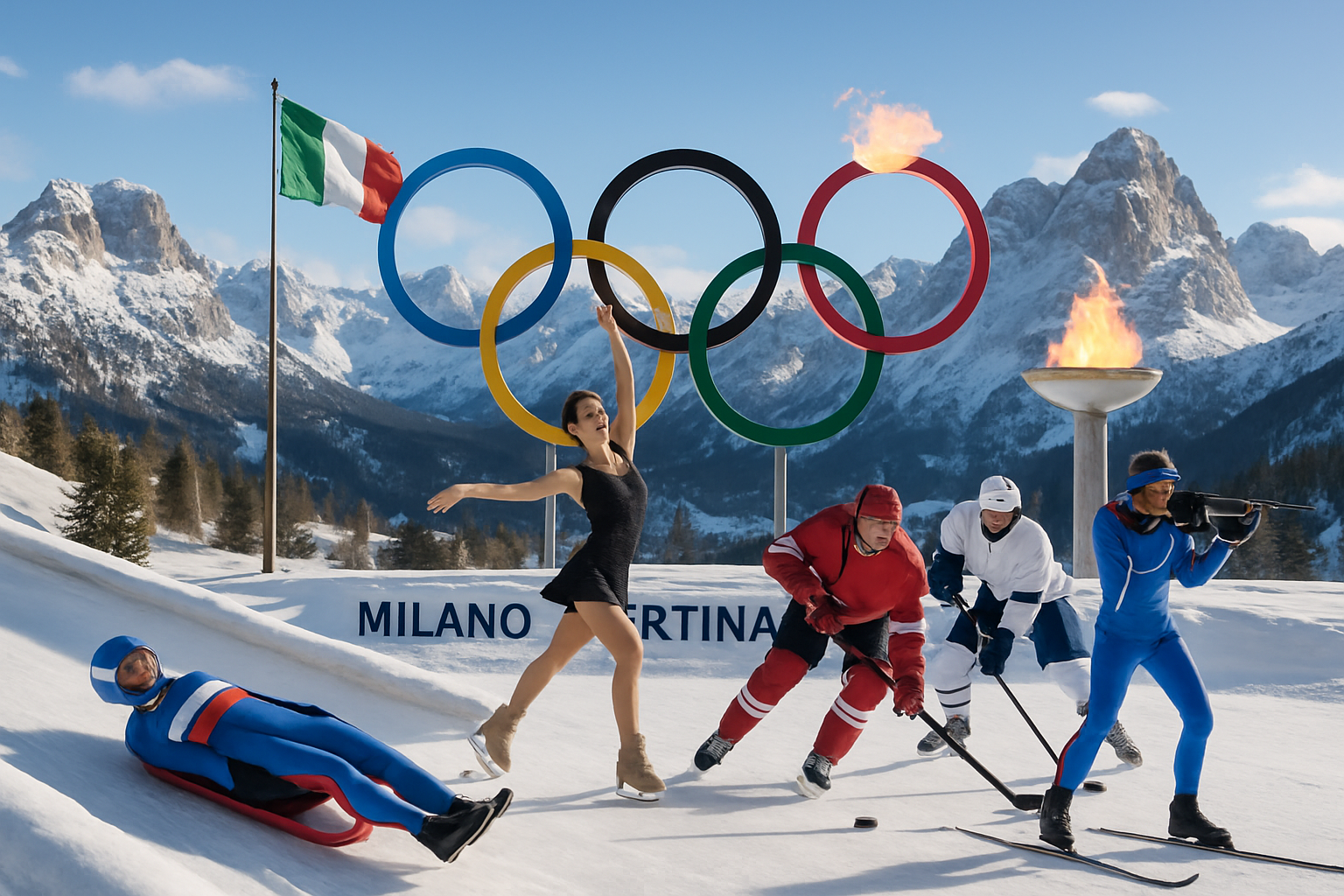
February 11, 2026 marked another historic day at the Milano-Cortina Winter Olympics as Italy captured both men's and women's luge doubles gold medals at home, while France's Guillaume Cizeron and Laurence Fournier Beaudry triumphed in ice dance and Julia Simon dominated women's biathlon individual competition.
Italy's Luge Domination on Home Ice
The Cesana Pariol sliding center erupted in celebration as Italy achieved unprecedented success in luge doubles competition. In the men's event, Emanuel Rieder and Simon Kainzwaldner recovered from third place after the first run to claim gold, overtaking the United States and Austria in a thrilling comeback performance that showcased their technical mastery on the challenging Cortina track.
The women's doubles competition saw an equally impressive Italian performance, with the home team capitalizing on their intimate knowledge of the venue. Austria's Selina Egle and Lara Kipp claimed bronze in what marked a breakthrough for the sport's relatively new Olympic discipline, trailing by just 0.069 seconds after the first run before securing their podium position.
"After the women's achievement, here comes the men's field: third after the first run, the Azzurri recovered against USA and Austria."
— Italian Olympic Committee Statement
Figure Skating Excellence and Controversy
The ice dance competition delivered one of the Games' most captivating performances as France's Guillaume Cizeron and Laurence Fournier Beaudry captured Olympic gold with a mesmerizing routine that left judges and spectators spellbound. The duo's victory represented France's continued strength in figure skating, adding to their growing medal tally at Milano-Cortina 2026.
The United States secured silver through Madison Chock and Evan Bates, while Canada's Piper Gilles and Paul Poirier earned bronze after what Gilles described as an uncertain period where she questioned whether she would ever return to Olympic competition.
Meanwhile, Ukrainian skeleton athlete Vladyslav Heraskevych became the center of a significant controversy as the International Olympic Committee urged him not to compete wearing a customized helmet displaying the faces of more than 20 Ukrainian athletes and coaches killed since Russia's 2022 invasion. The IOC's request highlighted ongoing tensions between Olympic neutrality policies and athletes' desires to honor fallen compatriots.
Biathlon and Speed Skating Breakthroughs
Julia Simon of France dominated the women's 15km biathlon individual event, overcoming shooting penalties to claim gold and continue France's impressive biathlon campaign at these Games. Her victory demonstrated the technical precision and mental fortitude required at the highest level of winter sports competition.
In speed skating, American Jordan Stolz set a new Olympic record in the men's 1000-meter distance, showcasing the depth of talent emerging from the United States winter sports program. The 21-year-old's performance highlighted the growing competitiveness of speed skating beyond traditional powerhouses.
Ice Hockey and Emerging Storylines
The men's Olympic ice hockey tournament opened with a stunning upset as Slovakia defeated defending Olympic champion Finland 4-1 in Group B play in Milan. Juraj Slafkovsky led the Slovakian charge with two goals, including an early opener that set the tone for their comprehensive victory.
Finland, the 2022 Olympic gold medalists, struggled to match Slovakia's intensity and precision. After Slafkovsky's eighth-minute goal gave Slovakia the lead, Finland managed only a single response through Eeli Tolvanen in the 25th minute. Slovakia's dominance became apparent in the final period with goals from Dalibor Dvorsky, Slafkovsky's second on the power play, and Adam Ruzicka sealing the impressive victory.
Injury Concerns and Comebacks
The Games continued to be marked by both triumph and tragedy as several athletes faced significant challenges. Australian snowboarder Cam Bolton suffered a devastating neck fracture during training for the snowboard cross competition, requiring helicopter evacuation and ending his Olympic dreams. The 35-year-old athlete, who was scheduled to compete on Thursday, is in stable condition but faces a long recovery process.
In contrast, defending Olympic halfpipe champion Ayumu Hirano of Japan successfully qualified for the men's final despite competing less than a month after injuring his face and pelvis in a training accident. The Japanese rider's determination to compete at the highest level exemplified the Olympic spirit of perseverance.
Lindsey Vonn's recovery continued following her third surgery after the devastating downhill crash that ended her comeback attempt. The American skiing legend posted on Instagram about making progress, stating that while success has taken on a different meaning, she remains optimistic about her recovery.
Medal Standings and Global Competition
After eleven days of competition, Norway maintained its position atop the medal standings with seven gold medals among thirteen total medals. The Scandinavian nation's traditional winter sports dominance continued across Nordic disciplines, though other nations demonstrated the increasingly global nature of winter sports competition.
Latvia's luge teams delivered strong performances, with Marta Robežniece and Kitija Bogdanova finishing fourth in women's doubles, just missing the podium, while the men's duo of Mārtiņš Bots and Roberts Plūme placed fifth. These results reflected the growing depth of competition across traditionally non-winter sports nations.
Ongoing Challenges and Innovations
The most geographically dispersed Winter Olympics in history continued to face operational challenges while demonstrating remarkable innovation. Despite ongoing infrastructure concerns, including the incomplete Apollonio-Socrepes cable car system that has forced school closures in the Cortina region, competition has proceeded smoothly across the 400-kilometer venue network.
The Games' revolutionary dual-city hosting model, spanning from Milan to Cortina d'Ampezzo, has proven viable despite logistical complexities. The integration of artificial intelligence through Alibaba's Qwen system and OMEGA's figure skating analysis has enhanced both broadcasting quality and competitive fairness, setting new standards for future Olympic Games.
Looking Ahead
As the Milano-Cortina Olympics enter their final phase, the competition intensity continues to escalate. Monaco's Arnaud Alessandria achieved a personal milestone by finishing 30th in the men's Super-G, representing significant achievement given his recovery from major back surgery just six months prior. His participation, with Prince Albert II in attendance, exemplified the Olympic movement's inclusive spirit.
The Games have successfully demonstrated that sustainable, geographically distributed hosting can maintain competitive excellence while addressing 21st-century environmental and logistical realities. With eleven days of competition remaining, Milano-Cortina 2026 continues to rewrite the template for future Olympic hosting while delivering unforgettable moments of athletic achievement and human drama.
"The International Olympic Committee is not an organization that generally begs, but they are begging Ukrainian skeleton athlete Vladyslav Heraskevych not to compete in a customized helmet showing the faces of more than 20 Ukrainian athletes and coaches killed since Russian invaded Ukraine in 2022."
— CBC Sports Report
As these Winter Olympics progress through their second week, they continue to embody the complex intersection of sport, politics, innovation, and human resilience that defines the modern Olympic movement. The Milano-Cortina model may well influence how future Games balance tradition with adaptation to contemporary global realities.