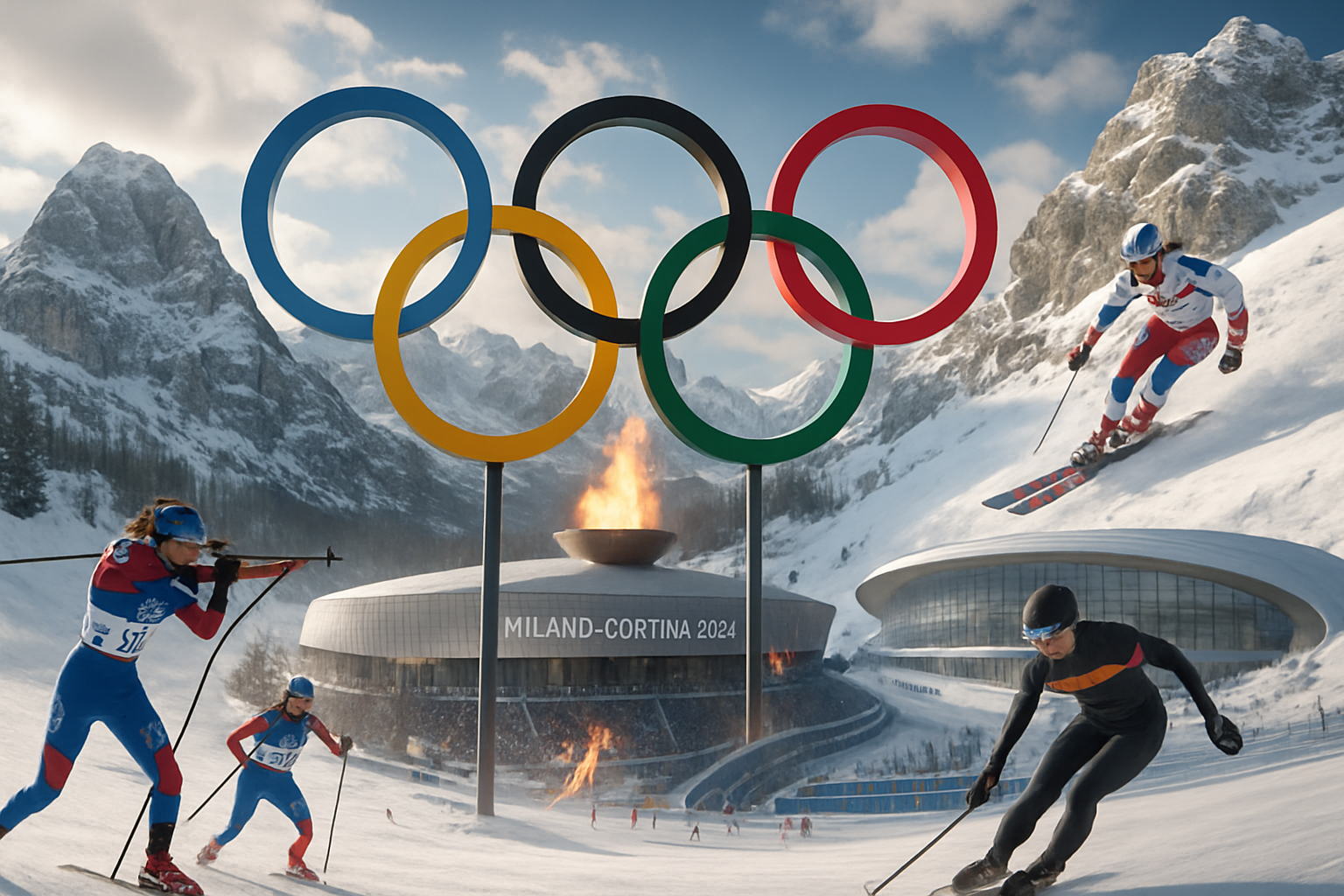
The Milano-Cortina 2026 Winter Olympics have delivered unprecedented drama, breakthrough performances, and major controversies as the most geographically dispersed Games in Olympic history reach their midpoint, showcasing both the triumph and turmoil that define modern Olympic competition.
Historic Breakthrough Performances
The Games have witnessed remarkable individual achievements that are rewriting Olympic history. Cypriot-American figure skater Emilea Zingas, whose grandparents emigrated from Paphos in the 1970s, made Olympic history by finishing fifth in ice dancing alongside partner Vadym Kolesnik. At just 23 years old, they became the only first-time Olympians to break into the top five, despite never having competed at a World Championships before.
"I'm very proud of my Cypriot heritage. I'm happy to make my family proud with my athletic achievements," Zingas told media after their qualifying round at the Ice Skating Arena in Milan.
France's Romane Miradoli captured silver in the women's Super-G at age 31, claiming her first Olympic medal and marking the first Alpine skiing medal for a French woman in 24 years. Her achievement was overshadowed only by Italy's Federica Brignone, who won gold just 10 months after suffering a serious left leg injury, competing in front of home crowds at Cortina d'Ampezzo.
Major Controversy: Ukrainian Memorial Helmet Ban
The most significant controversy of the Games involves Ukrainian skeleton athlete Vladyslav Heraskevych, who was banned by the International Olympic Committee from competing with a memorial helmet honoring Ukrainian athletes killed during Russia's war. The IOC cited Olympic neutrality rules, though they offered a compromise of a black armband that Heraskevych refused.
"Even if the IOC wants to betray the memory of these athletes, I will not betray them. This is the price of our dignity."
— Vladyslav Heraskevych, Ukrainian Skeleton Athlete
President Volodymyr Zelensky condemned the IOC decision and awarded Heraskevych the Order of Freedom for "selfless service to the Ukrainian people." The controversy has sparked international debate about the intersection of politics and sport, with Polish journalists and Olympic champions criticizing what they see as IOC double standards.
Athletic Excellence Across Disciplines
The competition has showcased exceptional depth across winter sports disciplines. Latvia's Roberts Krūzbergs became the first Latvian to reach an A final at the Winter Olympics, finishing fifth in short track speed skating. Meanwhile, Romania's snowboard team, represented by Bartalis Henrietta and Mandel Kata, demonstrated the global expansion of winter sports beyond traditional powerhouses.
Germany has emerged as a breakthrough nation, with Leon Draisaitl scoring after just 23 seconds in ice hockey and multiple athletes reaching finals across disciplines. The German team's success reflects years of investment in winter sports development programs.
Operational Challenges and Innovations
Despite spanning over 400 kilometers across seven venues from Milan to Cortina d'Ampezzo, the Games have largely succeeded in their revolutionary dual-city hosting model. However, infrastructure challenges have persisted, including power outages at venues and incomplete transportation systems that have forced local school closures.
The Games represent a technological milestone with the first Olympic integration of AI systems, including Alibaba's Qwen LLM for broadcasting services and OMEGA's AI-powered figure skating analysis. Cultural innovations include bilingual place names in the German-speaking Alto Adige/South Tyrol region and the "Gen Z" mascots Milo and Tina.
Medal Manufacturing Crisis
A unprecedented quality control scandal emerged when Olympic medals began physically breaking apart during athlete celebrations. Multiple athletes, including American skier Breezy Johnson, reported medals detaching from ribbons and cracking when dropped. Italian organizers have acknowledged the manufacturing defect and promised investigations and repairs, but the crisis threatens to overshadow athletic achievements.
Global Participation and Rising Nations
The Games continue to demonstrate winter sports' global expansion, with breakthrough performances from nations traditionally outside the winter sports mainstream. Bulgaria's success in snowboard events, South Korea's strong showing across multiple disciplines, and historic participations from Middle Eastern and Caribbean nations highlight the democratization of winter Olympic competition.
Lithuanian coverage has focused particularly on the ice dancing achievements of Allison Reed and Saulius Ambrulevičius, who finished sixth, while also highlighting controversies surrounding French Olympic champions Laurence Fournier Beaudry and Guillaume Cizeron, whose success has been shadowed by allegations of misconduct in their training environment.
Weather and Environmental Factors
Europe's harshest winter in decades, with temperatures reaching -30°C, has created ideal natural snow conditions while simultaneously posing logistical challenges. The extreme weather has reduced concerns about artificial snow production but has complicated transportation and athlete safety across the vast venue network.
Looking Ahead
As the Games approach their final week, several storylines continue to develop. Norway maintains its traditional Nordic dominance with Johannes Høsflot Klæbo pursuing additional medals, while surprise contenders from non-traditional winter sports nations continue to challenge established hierarchies.
The Milano-Cortina 2026 Games have established a new paradigm for Olympic hosting, proving that geographically dispersed events can maintain competitive excellence while emphasizing sustainability and existing venue utilization. Despite numerous challenges, from manufacturing defects to political controversies, the Games continue to deliver the human drama and athletic excellence that define Olympic competition.
With competition continuing through February 22, these Olympics have already secured their place in history as a transformative event that balanced tradition with innovation, showcasing both the best and most complex aspects of modern international sport.