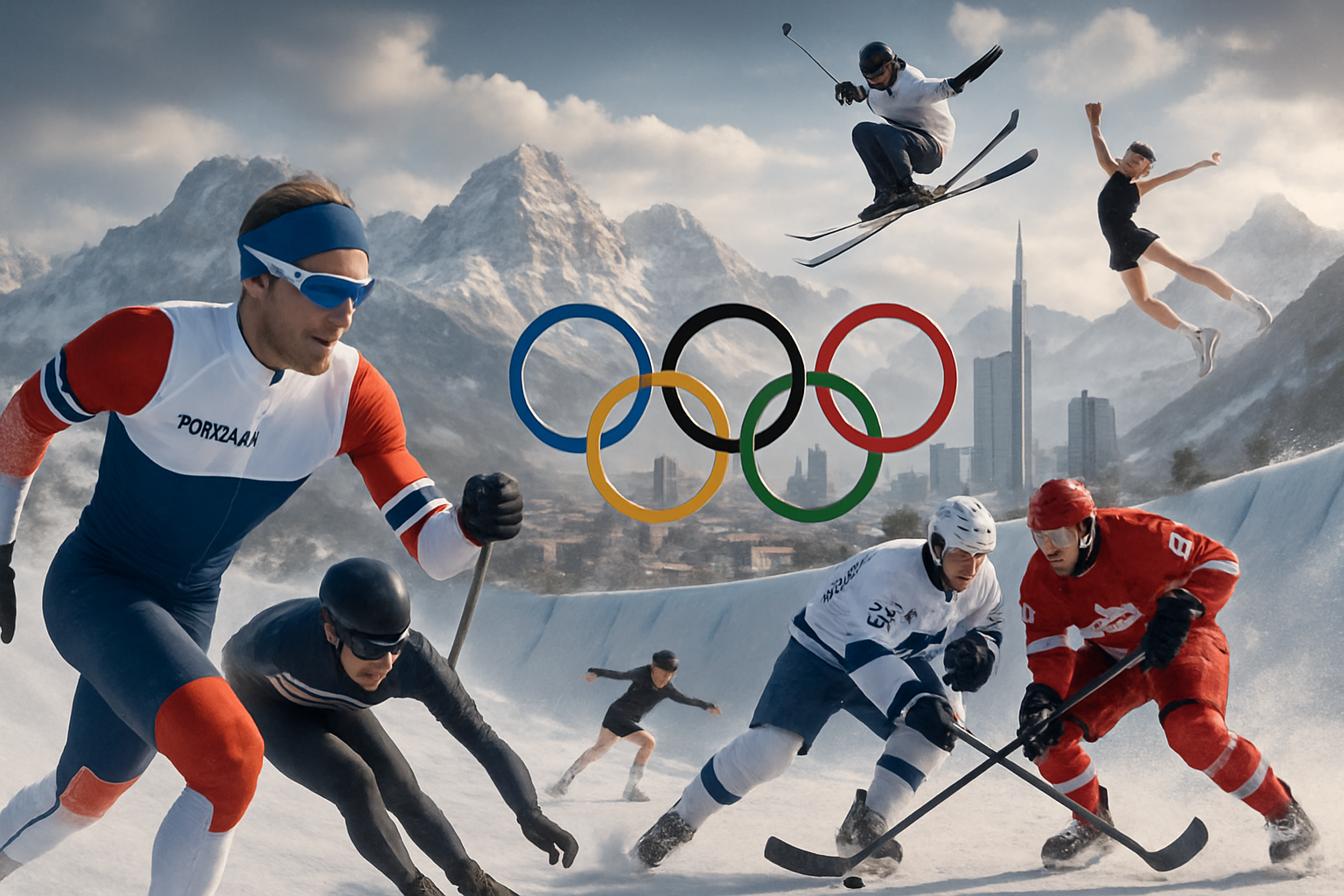
The Milano-Cortina 2026 Winter Olympics delivered their most dramatic moments yet as competition reaches its crescendo, with breakthrough performances, heart-stopping accidents, and historic achievements defining what has become the most geographically dispersed and competitive Winter Games in Olympic history.
Terrifying Short Track Incident Shocks Milano Arena
The Olympic ice arena in Milano fell silent as Polish short-track speed skater Kamila Sellier was immobilized on a stretcher after a competitor's blade sliced above her left eye during the women's 1500m semifinals. The horrific accident occurred when another skater's blade caught Sellier's face during a tight turn, requiring immediate medical evacuation from the venue.
The incident highlighted the inherent dangers of short-track racing, where athletes reach speeds of up to 50 kilometers per hour in tight quarters. Swedish expert Linda Liljedahl, commentating for SVT, described unusual conditions during the race: "There's something wrong with the ice - they're not falling due to their own mistakes," she observed as multiple skaters crashed throughout the semifinals.
Despite the frightening scenes, competition continued with enhanced safety protocols. South Korean skaters dominated the event, with Kim Gil-li and Choi Min-jeong claiming gold and silver respectively, extending South Korea's remarkable short track campaign at these Games.
South Korea's Short Track Supremacy
South Korea's short track speed skating team has delivered one of the most dominant performances in Milano-Cortina 2026 history. The nation collected three medals in a single day, including gold in the women's 1500m and a silver in the men's relay.
"Many athletes consider winning an Olympic gold medal the pinnacle of their career, but beating my mentor makes this victory even more special."
— Kim Gil-li, South Korean short track gold medalist
Veteran Choi Min-jeong became South Korea's most decorated Winter Olympian with her latest medal, while rising star Kim Gil-li won her second gold of these Games. The young Korean's victory was particularly poignant as she defeated her former coach in the final.
The success has positioned South Korea among the top medal-winning nations despite competing in the shadow of Norway's historic dominance across Nordic events.
Jamaica's Bobsled Team Captures Hearts Again
Nearly four decades after their legendary debut in Calgary 1988, Jamaica's four-man bobsled team has once again become the story everyone is talking about at the Winter Olympics. The team, supported by celebrity endorsements from Lewis Hamilton and Snoop Dogg, has brought the same spirit and determination that made them international icons.
The Jamaican team's presence in Milano-Cortina represents a continuation of Caribbean winter sports expansion, alongside Trinidad & Tobago's historic Olympic debut in bobsled. Their participation demonstrates the truly global nature of these Games, with athletes from six continents challenging traditional winter sports hierarchies.
Estonia's Historic Breakthrough
Estonia ended their Milano-Cortina medal drought in spectacular fashion when 19-year-old freestyle skier Henry Sildaru won silver in the men's halfpipe, recovering from a disastrous first run to post a score of 93.00 points.
The victory represents Estonia's emergence as a legitimate force in freestyle skiing, joining sister Kelly Sildaru's previous successes. The result has generated massive celebration across the Baltic nation and signals Estonia's growing winter sports program.
"For many Olympic viewers, Henry Sildaru was a new name. By the end of Friday night in Italy, he was an Olympic medalist – and a clear signal that Estonia's freestyle programme has another genuine top-tier talent."
— Estonian World report
Norway Shatters Winter Olympic Records
Norway has rewritten Olympic history at Milano-Cortina 2026, breaking their own record for the most gold medals won by a single nation at a Winter Olympics. With 17 gold medals and counting, the Scandinavian powerhouse has dominated across traditional Nordic events while expanding into new disciplines.
Cross-country legend Johannes Høsflot Klæbo has been at the center of Norway's success, potentially targeting his sixth consecutive Olympic gold in Sunday's 50km mass start classic - a feat that would further cement his status as the greatest Winter Olympian of all time.
Figure Skating Drama and Teenage Phenomenons
The figure skating competition has provided compelling storylines, with defending champion Eileen Gu praising Australia's teenage sensation Indra Brown as "the real deal." The 16-year-old Brown has emerged as a genuine medal contender in freeski halfpipe while maintaining her mathematics homework schedule between training sessions.
Meanwhile, Swedish curler Oskar Eriksson continued his verbal warfare with Canadian rival Marc Kennedy, delivering what observers called his "most devastating barb yet" in their ongoing rivalry that has become one of the Games' most entertaining storylines.
Ice Hockey Reaches Crescendo
The men's ice hockey tournament has set up a dream final between Canada and the United States after both teams advanced through dramatic semifinals. Canada overcame Finland in a last-minute thriller, while the US dominated Slovakia 6-2 in a comprehensive display.
Despite the absence of injured captain Sidney Crosby, Canada's depth has shone through with superstars Connor McDavid and Nathan MacKinnon leading the charge. The final promises to be a classic North American showdown for hockey gold.
Lindsey Vonn's Recovery Progress
American skiing legend Lindsey Vonn provided an update on her recovery from the devastating crash that ended her comeback attempt, revealing she underwent more than six hours of surgery. The 41-year-old posted on social media that she's now "truly bionic" but remains positive about her recovery process.
Her crash on the opening weekend became one of the defining images of these Games, representing both the courage required to compete at Olympic level and the ever-present danger facing winter sports athletes.
Revolutionary Games Format Proves Successful
Milano-Cortina 2026 has successfully demonstrated that Olympic excellence can be maintained across the most geographically dispersed venues in Winter Olympic history. The dual-city hosting model spanning over 400 kilometers has proven that sustainable, existing venue utilization can deliver world-class competition.
The Games have integrated groundbreaking technology, including the first Olympic deployment of Alibaba's Qwen AI system for broadcasting and spectator services, alongside OMEGA's AI-powered figure skating analysis. Cultural innovations have included bilingual place names in Alto Adige/South Tyrol and the popular "Gen Z" mascots Milo and Tina.
Global Winter Sports Democratization
Perhaps the most significant storyline of Milano-Cortina 2026 has been the unprecedented global competitiveness across all sports. Nations from six continents have challenged traditional winter sports powerhouses, with breakthrough performances from Australia, Kazakhstan, Brazil, Bulgaria, and many others reshaping the Olympic landscape.
The Games have featured historic debuts from Saudi Arabia in alpine skiing and cross-country, while Caribbean nations Jamaica and Trinidad & Tobago made their mark in bobsled. These participations represent the true democratization of winter sports in the 21st century.
Final Day Anticipation
As Milano-Cortina 2026 enters its final day of competition, the Games have already established themselves as a watershed moment for the Olympic movement. The combination of traditional athletic excellence with revolutionary sustainable hosting, technological innovation, and unprecedented global participation has created a new paradigm for future Olympic Games.
With medal races intensifying across multiple disciplines and Norway's record-breaking performance still growing, Sunday's conclusion promises to cap off what many observers are calling the most competitive and democratically representative Winter Olympics in history.
The success of the Milano-Cortina model - combining environmental responsibility with competitive excellence across vast geographic distances - has established a template that may influence Olympic hosting for decades to come, proving that the Olympic spirit of international cooperation and athletic achievement can adapt to 21st-century realities while maintaining its essential character.