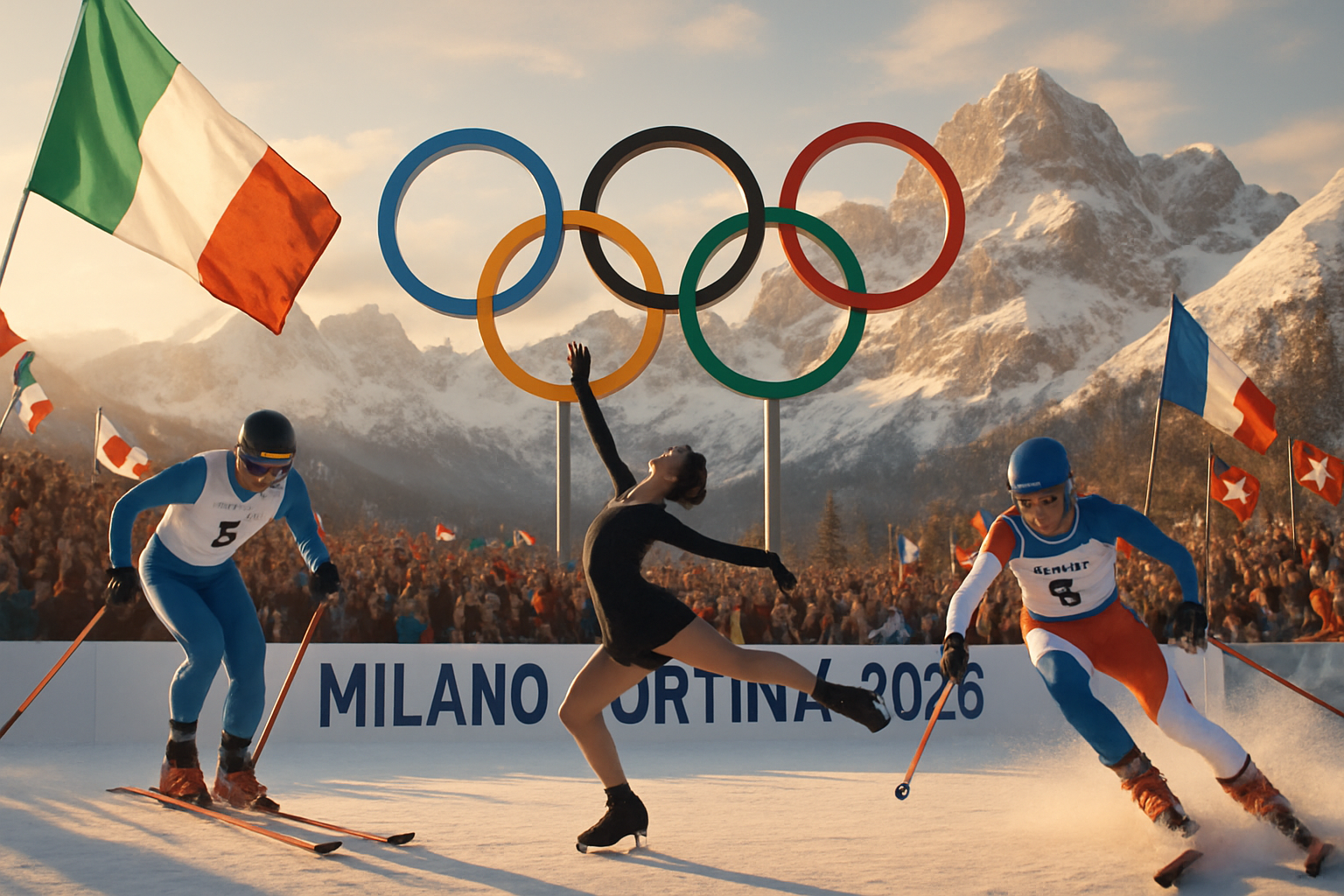
The 2026 Milano-Cortina Winter Olympics delivered their first medal ceremonies on Saturday, February 7, as Switzerland's Franjo von Allmen claimed the inaugural gold in men's alpine skiing downhill, while Norway's Anna Odine Strøm soared to victory in women's ski jumping amid a day marked by athletic triumph, civil unrest, and tragic accidents across northern Italy.
After a spectacular opening ceremony that showcased Italy's cultural heritage across four venues, the most geographically dispersed Winter Olympics in history began finding its competitive rhythm on Day Three, despite significant challenges including infrastructure sabotage, fatal avalanches, and thousands of protesters taking to Milan's streets.
First Gold Medal Glory
Switzerland struck first in the medal race as 24-year-old Franjo von Allmen delivered a flawless run down the Stelvio course in Bormio, clocking 1:51.61 to claim the men's alpine skiing downhill title. The victory marked a breakthrough moment for von Allmen, who had never won a major international title before arriving in Italy.
Italy celebrated a remarkable home double podium finish, with Giovanni Franzoni taking silver just 0.20 seconds behind von Allmen, while veteran Dominik Paris finally captured his elusive Olympic bronze on his fifth Olympic attempt, finishing 0.50 seconds back. The result sent Italian crowds into raptures and provided the host nation with its first medals of the Games.
"This is what I've been dreaming of my entire career," said von Allmen after his victory. "To win Olympic gold is something I can barely comprehend right now."
— Franjo von Allmen, Olympic Champion
Pre-race favorite Marco Odermatt of Switzerland missed the podium entirely, finishing fourth by a mere 0.2 seconds in what proved to be one of the most competitive Olympic downhill races in recent memory.
Norwegian Ski Jumping Triumph
Norway's Anna Odine Strøm delivered a masterclass in nerves and technique to win the women's ski jumping normal hill competition in Predazzo, defeating Slovenia's favored Nika Prevc by just 1.1 points in a thrilling contest that came down to the final jump.
The 27-year-old Strøm, who had struggled with consistency throughout the season, produced two exceptional jumps when it mattered most, using an 80s-inspired playlist during the break between rounds to maintain her focus. Her victory gave Norway its first gold medal of the 2026 Games and continued the nation's traditional dominance in ski jumping.
Prevc, the 20-year-old Slovenian who dominated the World Cup circuit this season with 13 victories, had to settle for silver despite being the overwhelming pre-competition favorite. The result demonstrated the unpredictable nature of Olympic competition, where form guides often prove meaningless under the unique pressures of the Games.
Japanese Snowboarding Dominance
Japan announced its arrival as a snowboarding powerhouse with a stunning one-two finish in men's big air, as Kira Kimura claimed gold ahead of teammate Ryoma Kimata in Livigno. The Japanese pair's technical mastery and aerial innovation left competitors struggling to match their combination of difficulty and execution.
The victories underlined Japan's growing dominance in snowboarding, continuing a trend that began with their breakthrough performances at previous Olympics and has now established them as the sport's leading nation.
Figure Skating Team Event Drama
The figure skating team event provided early drama as American superstar Ilia Malinin struggled in the men's short program, finishing second and failing to deliver the historic quad axel that skating fans had eagerly anticipated. His subdued performance allowed the United States to maintain their lead in the team standings, but by a narrower margin than expected.
Madison Chock and Evan Bates showcased their world championship pedigree with a spectacular ice dance free routine that earned 133.23 points, the highest score of the competition. Their paso doble performance, complete with matching costumes and intricate choreography, captivated audiences and judges alike.
Canada's Stephen Gogolev made a solid Olympic debut with a score of 92.99 in the men's short program, keeping his country in medal contention for the team event while gaining valuable experience ahead of the individual competitions.
Speed Skating Records and Milestones
Italy's Francesca Lollobrigida delivered a home crowd moment for the ages, setting an Olympic record in the women's 3,000m speed skating event. Her victory provided another emotional highlight for Italian spectators and demonstrated the host nation's depth across multiple winter sports disciplines.
France's Violette Braun made history by becoming the first French athlete to compete in Olympic speed skating's 3,000m, marking a significant milestone for her country's winter sports development program.
Norway added to their medal tally through Ragne Wiklund, who claimed an emotional silver medal in speed skating, marking her country's first medal in the discipline for 46 years. The veteran athlete's achievement was made even more special when her young son joined her in the interview area, creating one of the day's most heartwarming moments.
Civil Unrest Mars Competition
The sporting celebrations were overshadowed by significant civil unrest in Milan, where thousands of protesters took to the streets to demonstrate against the Olympics. What began as peaceful marches quickly escalated when approximately 100 demonstrators began throwing fireworks, smoke bombs, and bottles at police lines.
The protesters argued that the Olympics represented a waste of public funds and that sporting investments were harming both the environment and local communities. Their concerns reflected broader debates about the cost and impact of hosting major international sporting events, particularly in times of economic uncertainty.
Italian authorities deployed extensive security forces to contain the unrest, with riot police using tear gas to disperse the most aggressive protesters. The incidents highlighted the ongoing tensions surrounding the Games, which have faced criticism throughout the preparation period.
Infrastructure Sabotage Investigation
In a more sinister development, Italian authorities launched a major investigation into suspected sabotage of railway infrastructure near Bologna. Three separate attacks on electrical cables disrupted high-speed and intercity train services across northern Italy during the Olympics' first full day of competition.
Transport Minister Matteo Salvini characterized the incidents as "serious sabotage" potentially linked to the Olympics, ruling out technical causes and treating them as deliberate, coordinated attacks. The targeting of Italy's transport backbone during the Games raised serious security concerns about the vulnerability of critical infrastructure during major international events.
The attacks followed earlier pro-Russian cyberattacks on Olympic venues and Italian diplomatic facilities, suggesting a pattern of attempts to disrupt the Games through various means. Thousands of passengers were stranded at Milan's central station and other major transport hubs as authorities worked to restore services.
Avalanche Tragedies
The day was marked by tragedy as three off-piste skiers lost their lives in separate avalanche incidents in the Trentino Alto Adige and Lombardy regions—areas hosting several Olympic venues. The deaths served as a stark reminder of the natural dangers present in the alpine environment, even as the region experiences some of the harshest winter conditions in decades.
The avalanches occurred despite extensive safety measures and warnings about unstable snow conditions. Emergency services reported multiple incidents throughout the day, with several other skiers requiring rescue from dangerous situations in the backcountry areas surrounding the Olympic venues.
Health Challenges
The Games continued to grapple with health issues as a norovirus outbreak affected multiple teams. Finland's women's hockey team, which had 13 players quarantined earlier in the week, finally returned to action but suffered a heavy defeat to the United States in their Olympic opener, clearly affected by the disruption to their preparation.
Canada's women's hockey team also dealt with virus concerns, with several players reporting illness symptoms, though they managed to secure a victory over Switzerland in their delayed opening game. The team's slow start was attributed partly to the disruption caused by the illness outbreak.
Curling and Other Competitions
Mixed doubles curling provided steady entertainment despite ongoing infrastructure challenges at the Cortina venue, including power outages that had disrupted play on previous days. Canada's Jocelyn Peterman and Brett Gallant experienced a difficult day, losing both their matches and seeing their playoff hopes diminish significantly.
South Korea provided one of the day's surprises by defeating the United States in mixed doubles curling for their first victory of the Games, demonstrating the unpredictable nature of the sport and the growing global competitiveness in curling.
Looking Ahead
As the Games move into their fourth day, attention turns to the highly anticipated return of NHL players to Olympic ice hockey, with the men's tournament set to begin. Canada's team faces particularly intense scrutiny as they seek to reclaim Olympic gold after missing out on the podium in recent tournaments.
The speed skating program continues with sprint events that could see the Netherlands begin their anticipated "gold rush" in the sport they have dominated for decades. Meanwhile, alpine skiing moves to the women's downhill, where American legend Lindsey Vonn will attempt her remarkable comeback just days after rupturing her ACL.
Figure skating's individual events approach, with particular focus on Italy's Daniel Grassl, who will attempt to deliver a home medal with his much-anticipated tango routine that has been described as entering "like a cardinal, emerging as a Pope."
Despite the challenges of Day Three—from protests and sabotage to tragic accidents—the 2026 Milano-Cortina Olympics demonstrated the resilience that has characterized these Games from their troubled preparation period. With 13 more days of competition across seven venues spanning 400+ kilometers of northern Italy, the most geographically dispersed Winter Olympics in history continues to provide compelling drama both on and off the fields of play.
The events of February 7 established several key narratives that will likely define these Games: Switzerland's unexpected alpine success, Norway's continued jumping excellence, Japan's snowboarding emergence, Italy's emotional home victories, and the ongoing security and infrastructure challenges that organizers must navigate while maintaining the Olympic spirit of international cooperation and athletic excellence.