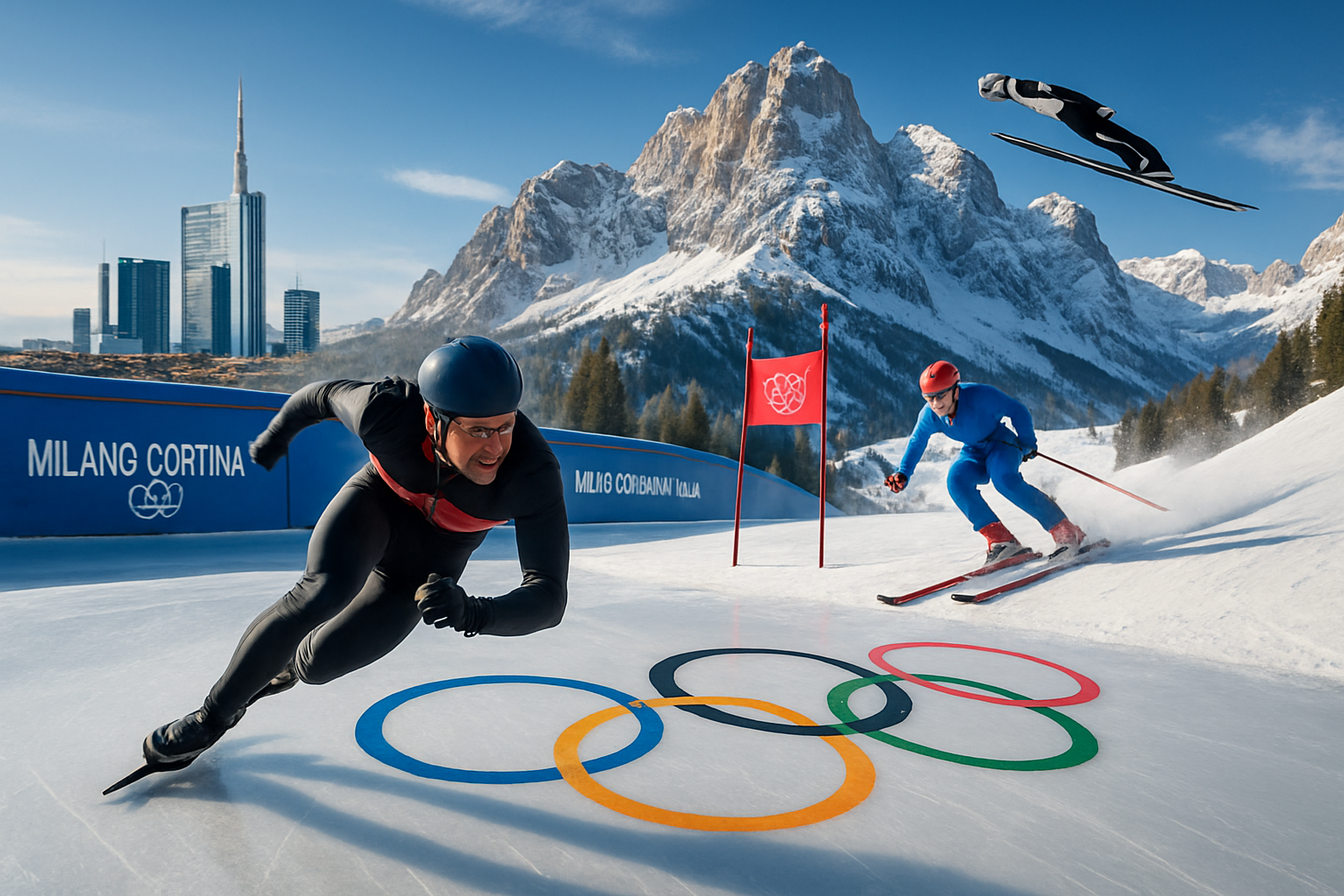
The Milano-Cortina 2026 Winter Olympics have delivered a stunning combination of athletic triumph and heartbreak as the most geographically dispersed Winter Games in Olympic history unfold across seven venues spanning 400+ kilometers of northern Italy's alpine landscape.
Lindsey Vonn's Tragic End to Remarkable Comeback
The most shocking moment came on February 9th when American skiing legend Lindsey Vonn's extraordinary comeback attempt ended in devastating fashion. Racing with start number 13 just nine days after completely rupturing her ACL at Crans-Montana, the 41-year-old champion crashed 13 seconds into the women's downhill on Cortina's treacherous Tofana course.
Vonn clipped a gate with her right shoulder and tumbled spectacularly down the mountainside, lying motionless in the snow before being evacuated by helicopter. Medical reports confirmed a broken left tibia, torn MCL, severely damaged meniscus, and shoulder injuries, though emergency surgery was successful and her condition remains stable.
"Jag ångrar ingenting" (I regret nothing)
— Lindsey Vonn, Instagram statement
Her teammate Breezy Johnson captured gold in the same event, though celebrations were muted out of concern for Vonn. The crash overshadowed what many considered one of the most courageous comeback attempts in Winter Olympics history, with Vonn competing at an unprecedented age with a career-threatening injury.
Record-Breaking Performances and Breakthrough Golds
While tragedy struck on the slopes, the Games have witnessed remarkable athletic achievements across multiple disciplines. Germany's Max Langenhan dominated men's luge singles, setting track records in all four runs to claim Germany's first Milano-Cortina gold medal with a commanding 0.596-second margin.
Speed skating delivered Olympic records as Norway's Sander Eitrem shattered the men's 5000m mark in Milan with an emotional celebration, overcoming a catastrophic start to demolish the field. Meanwhile, Netherlands' Jutta Leerdam set a new Olympic record in women's 1000m, with her fiancé Jake Paul seen in tears celebrating from the stands.
Germany's Philipp Raimund achieved a stunning upset in ski jumping, claiming his first-ever World Cup victory by winning Olympic gold with a magnificent leap in Predazzo. "Ich weiß nicht, wie ich das geschafft habe" (I don't know how I did that), said the bewildered champion.
Global Winter Sports Breakthrough
The Games have showcased the democratization of winter sports with several nations achieving historic milestones. Bulgaria ended a 20-year Olympic medal drought as Tervel Zamfirov claimed bronze in snowboard parallel giant slalom, defeating Slovenia's Tim Mastnak in a dramatic photo finish.
South Korea earned their first Milano-Cortina medal through Kim Sang-kyum's silver in men's snowboarding, while Switzerland's Gregor Deschwanden became only the third Swiss ski jumper ever to win Olympic bronze on the normal hill, following in the footsteps of Walter Steiner and Simon Ammann.
Historic participations have defined these Games, with Saudi Arabia making their Winter Olympic debut through alpine skier Fayik Abdi and cross-country competitor Rakan Aliriza. Caribbean nations Jamaica and Trinidad & Tobago competed in bobsleigh for the first time in Olympic history.
Infrastructure Challenges and Security Concerns
The revolutionary dual-city hosting model spanning from Milan to Cortina d'Ampezzo has faced significant challenges. The incomplete Apollonio-Socrepes cable car in Cortina forced school closures for transport management, while power outages disrupted curling competitions during the Games' opening days.
Security concerns escalated when pro-Russian hackers launched coordinated cyberattacks on Olympic venues and Italian diplomatic facilities hours before the opening ceremony. Foreign Minister Antonio Tajani confirmed successful countermeasures by security services, but the attacks targeted Cortina hotels and Italian embassies in Washington, Sydney, Toronto, and Paris.
Civil unrest erupted in Milan on February 8th when approximately 10,000 protesters demonstrated against the Olympics, citing environmental concerns and housing affordability issues. Prime Minister Giorgia Meloni condemned the protesters as "enemies of Italy" after violent clashes with police involving stones, smoke bombs, and fireworks.
Railway Sabotage Disrupts Transportation
Adding to the challenges, suspected coordinated sabotage targeted railway infrastructure near Bologna during the Games' opening weekend. Transport Minister Matteo Salvini called the incidents "serious sabotage" potentially linked to the Olympics, with electrical cable damage affecting high-speed and intercity train services across northern Italy, stranding thousands at Milan Central Station.
Technology and Cultural Innovation
Despite challenges, Milano-Cortina 2026 has pioneered several technological and cultural innovations. Alibaba Cloud deployed the first Olympic LLM technology with Qwen AI powering broadcasting and spectator services, while OMEGA introduced AI-powered figure skating analysis for judges and viewers.
Cultural innovations include bilingual place names in Alto Adige/South Tyrol for the German-speaking population, sustainable Olympic villages featuring greenhouse spaces and wood materials, and Milo and Tina "Gen Z" mascots connecting with younger audiences.
Nordic Dominance and American Success
Norway continues their Winter Olympics dominance with Johannes Høsflot Klæbo claiming his sixth Olympic gold in the 20km skiathlon, reinforcing their Nordic supremacy. The United States defended their figure skating team title, with 17-year-old Ilia Malinin delivering a decisive free skate performance to secure his first Olympic gold medal.
Italy has provided emotional home celebrations, particularly through biathlete Dorothea Wierer earning her fourth consecutive Olympic medal and Riccardo Lorello's bronze in speed skating with his grandparents watching from the stands.
Harsh Winter Conditions Create Ideal Competition
Europe's harshest winter in decades, with temperatures reaching -30°C, has created ideal natural snow conditions across the venues while presenting logistical challenges. The extreme weather has reduced concerns about artificial snow production but has contributed to dangerous off-piste conditions, resulting in at least four avalanche deaths in the Italian Alps regions during the Games.
Looking Ahead
With competition continuing through February 22nd, the Milano-Cortina 2026 Winter Olympics have already established themselves as one of the most dramatic in Olympic history. The Games feature 3,000 athletes from 92 countries competing across 116 medal events in 16 sports, including the Olympic debut of ski mountaineering.
The revolutionary dual-city hosting model represents a potential new paradigm for Olympic hosting, emphasizing sustainability and geographic distribution over centralized venues. IOC President Kirsty Coventry acknowledged "bumpy" preparations but promised "unforgettable" Games that mark the return of Winter Olympics to the Alps after a 20-year absence.
As the Games progress, they continue to demonstrate both the pinnacle of athletic achievement and the inherent drama of winter sports, from Vonn's courageous but tragic attempt to breakthrough performances that are rewriting Olympic history across the spectacular Italian Dolomites.