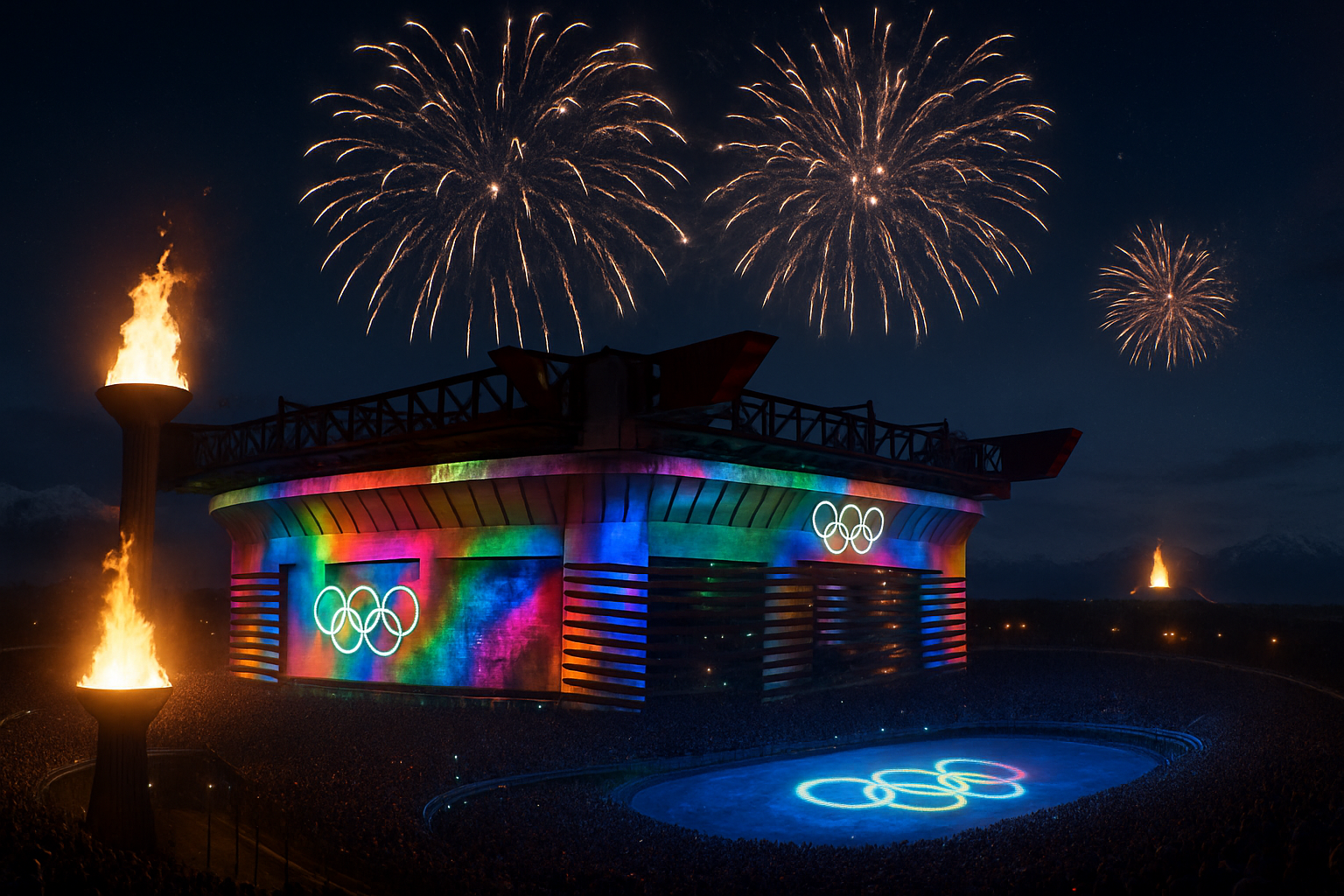
The Milano-Cortina 2026 Winter Olympics officially opened Friday evening with a spectacular and unprecedented ceremony that spanned multiple locations across northern Italy, marking the beginning of the most geographically dispersed Winter Games in Olympic history.
Nearly 3,000 athletes from 92 countries gathered at Milan's legendary San Siro stadium for the centerpiece of a revolutionary three-hour ceremony broadcast at 8:45 p.m. local time. For the first time in Olympic history, the opening ceremony featured dual Olympic cauldrons lit simultaneously - one by ballerina Nicoletta Manni at Milan's Piazza Duomo and another by skiing legend Alberto Tomba in Cortina d'Ampezzo, 400 kilometers away.
A Ceremony Spanning the Alps
The historic ceremony unfolded across four locations simultaneously, with festivities echoing from Milan's iconic San Siro stadium to the snow-capped peaks of Cortina d'Ampezzo, Livigno, and Predazzo. This groundbreaking format reflected the Games' unique dual-city hosting model, which emphasizes sustainability and geographic distribution over traditional centralized venues.
Italian President Sergio Mattarella arrived at the ceremony via a historic Milan tram driven by MotoGP legend Valentino Rossi, creating a memorable fusion of tradition and innovation that captured the spirit of the Games. The Olympic torch had completed a remarkable 12,000-kilometer journey through more than 300 Italian municipalities before reaching its final destinations.
"This represents the most significant reimagining of Olympic ceremonies in modern history. The dual flames symbolize unity across distance and demonstrate how the Olympic spirit can transcend geographic boundaries."
— Kirsty Coventry, IOC President
Star-Studded International Cast
The ceremony featured an extraordinary lineup of international performers under the theme "Harmony," showcasing Italy's cultural heritage alongside global talent. American pop icon Mariah Carey delivered a stunning rendition of "Volare," while Italian tenor Andrea Bocelli moved audiences with his powerful vocals. Chinese pianist Lang Lang, Italian pop star Laura Pausini, and Milan-born rapper Ghali rounded out the headline performances.
The presence of high-profile guests underscored the Games' international significance. Football legend Zlatan Ibrahimović attended alongside U.S. Vice President J.D. Vance and Secretary of State Marco Rubio, though their presence with ICE agents sparked some diplomatic tensions and scattered boos from the crowd.
Historic Participations and Breakthrough Moments
The Milano-Cortina 2026 Games mark several historic firsts in Winter Olympic competition. Saudi Arabia makes its Winter Olympics debut with alpine skier Fayik Abdi and cross-country skier Rakan Aliriza, representing a significant expansion of the Olympic movement into new regions.
For the first time in Olympic history, Caribbean nations Jamaica and Trinidad & Tobago field bobsleigh teams, bringing tropical flair to the winter sports stage. Latvia arrives with its largest-ever Winter Olympics delegation of 68 athletes, demonstrating the growing global reach of winter sports.
Perhaps the most compelling comeback story belongs to American skiing legend Lindsey Vonn, who at 41 years old is attempting to compete despite rupturing her ACL in a crash just days before the Games. Her scheduled downhill race on February 8 represents one of the most dramatic Olympic comeback attempts in recent memory.
Technology and Innovation
The Games showcase remarkable technological advancement with the first-ever Olympic integration of artificial intelligence. Alibaba Cloud's Qwen AI system powers Olympic broadcasting services and spectator experiences, while OMEGA introduces AI-powered analysis for figure skating judging and viewer enhancement.
The ceremony also highlighted the Games' commitment to sustainability through innovative Olympic village designs featuring greenhouse spaces and wood materials, accommodating 3,500 athletes in Milan alone. Cultural innovation includes bilingual place names in Alto Adige/South Tyrol to serve the region's German-speaking population.
Competition Begins Amid Challenges
Competition actually began February 5 with mixed doubles curling, despite power outages that temporarily disrupted matches at the Cortina venue. Italy's curling team of Stefania Constantini and Amos Mosaner defeated South Korea 8-4, while Sweden beat the Czech Republic 7-4 in early results.
The Games face some infrastructure challenges, including an incomplete cable car system in Cortina that has forced school closures for transportation management. However, officials express confidence that all venues will be fully operational for competition, with NHL-quality ice surfaces prepared by experienced Canadian ice masters Don Moffatt and Mark Messer.
Security and Diplomatic Context
Security measures have been extensive following pro-Russian cyberattacks on Olympic venues and Italian diplomatic facilities just hours before the ceremony. Italian Foreign Minister Antonio Tajani confirmed that security services successfully countered the threats targeting hotels in Cortina and Italian embassies in Washington, Sydney, Toronto, and Paris.
The opening ceremony notably highlighted support for Ukraine, with the Ukrainian delegation receiving some of the loudest and warmest cheers of the evening. Russian athletes, competing as neutrals without national symbols, were not included in the opening parade.
A New Olympic Paradigm
The Milano-Cortina 2026 Games span seven venues across more than 400 kilometers, representing a revolutionary approach to Olympic hosting that prioritizes existing infrastructure and environmental responsibility. The model could influence future Olympic planning as the movement adapts to 21st-century concerns about sustainability and climate impact.
Competition occurs against the backdrop of one of Europe's harshest winters in decades, with temperatures reaching -30°C creating ideal natural snow conditions and reducing reliance on artificial snow production. The extreme weather, while challenging for spectators and logistics, provides perfect competition conditions for winter sports.
Looking Ahead
The Games continue through February 22 with 116 medal events across 16 sports, including the Olympic debut of ski mountaineering. Medal expectations center on Norway's cross-country skiing powerhouse led by Johannes Høsflot Klæbo, the Netherlands' anticipated "gold rush" in speed skating, and Italy's own figure skating hope Daniel Grassl, who plans a tango-inspired performance for the home crowd.
As the dual Olympic flames burn across the Italian Alps, the Milano-Cortina 2026 Winter Olympics promise to deliver not just outstanding athletic competition, but a reimagined vision of how the world's greatest sporting celebration can adapt while maintaining its essential spirit of international cooperation and human achievement.