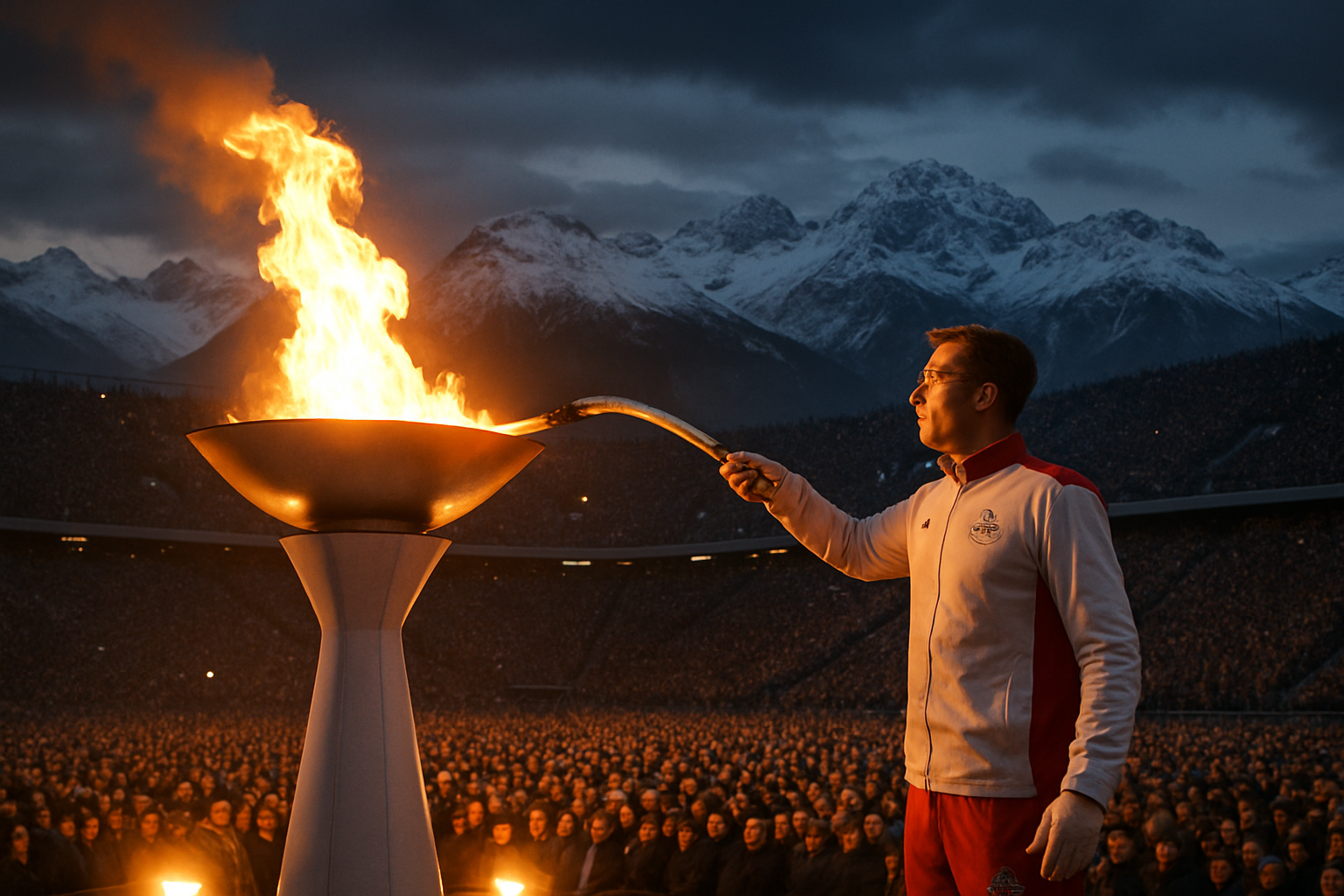
The Milano-Cortina 2026 Winter Olympics opened with a spectacular multi-site ceremony Friday evening, marking the beginning of the most geographically dispersed Winter Games in Olympic history, as Switzerland's Franjo von Allmen claimed the first gold medal with a stunning victory in the men's alpine skiing downhill.
The opening ceremony, broadcast at 8:45 p.m. local time, represented a revolutionary departure from traditional Olympic protocol by taking place simultaneously across four Italian locations: Milan's iconic San Siro stadium, Cortina d'Ampezzo, Predazzo, and Livigno. For the first time in Olympic history, two Olympic cauldrons were lit simultaneously—one in Milan by Italian skiing legends Alberto Tomba and Deborah Compagnoni at the Arco della Pace, and another in Cortina d'Ampezzo by Olympic champion Sofia Goggia.
Historic Opening Ceremony Captivates Global Audience
The three-hour ceremony, themed around "Harmony," featured star-studded performances by American pop icon Mariah Carey performing "Volare," Italian tenor Andrea Bocelli, Chinese pianist Lang Lang, and Italian artists Laura Pausini and Ghali. Italian President Sergio Mattarella made a memorable entrance aboard a historic Milan tram driven by motorcycle legend Valentino Rossi, creating one of the evening's most talked-about moments.
The ceremony welcomed nearly 3,000 athletes from 92 countries who will compete in 116 medal events across 16 sports through February 22. The Games mark several historic firsts, including Saudi Arabia's Winter Olympic debut with alpine skier Fayik Abdi and cross-country skier Rakan Aliriza, as well as the first Caribbean bobsleigh teams from Jamaica and Trinidad & Tobago.
High-profile attendees included football legend Zlatan Ibrahimović, U.S. Vice President J.D. Vance, and Secretary of State Marco Rubio, though their presence with ICE agents sparked diplomatic tensions and crowd disapproval during the ceremony.
von Allmen's Golden Breakthrough
Competition began in earnest on Saturday with the men's alpine skiing downhill at the Stelvio course in Bormio, where 24-year-old Franjo von Allmen delivered a masterful performance to claim Switzerland's first gold medal of the Games. The Bernese Oberland native completed the challenging course in 1 minute 51.61 seconds, producing what commentators described as a "flawless run" down the sunlit track.
"The Swiss skier barely put a ski off line as he blazed down the sunlit track to win with a time of 1:51.61."
— Competition Report
Italy celebrated a double podium finish in the home Games, with Giovanni Franzoni taking silver just 0.20 seconds behind von Allmen, and veteran Dominik Paris claiming bronze at 0.50 seconds back. The result marked a emotional triumph for both Italian athletes—Franzoni in his Olympic debut and Paris finally achieving Olympic medal success in his fifth Games appearance.
Notably absent from the podium was Swiss favorite Marco Odermatt, who finished fourth and missed the medals by just 0.2 seconds, highlighting the razor-thin margins at Olympic level competition.
Unprecedented Geographic Scope
The Milano-Cortina 2026 Games represent the most geographically dispersed Winter Olympics in history, with venues spanning more than 400 kilometers across northern Italy's alpine region. This revolutionary dual-city hosting model emphasizes sustainability through the use of existing venues and represents a potential new paradigm for future Olympic hosting.
The Games have faced significant infrastructure challenges, including incomplete cable car systems in Cortina that forced school closures for transportation management, and last-minute construction work on ice hockey venues. However, competition has proceeded smoothly with NHL-quality ice surfaces prepared by Canadian experts Don Moffatt and Mark Messer.
Technology and Cultural Innovation
The Olympics showcase several technological milestones, including the first Olympic integration of Large Language Model (LLM) technology through Alibaba Cloud's Qwen AI system, which powers Olympic AI Assistants for broadcasting and spectator services. OMEGA has also introduced AI-powered figure skating analysis for judges and viewers.
Cultural innovations include bilingual place names in the German-speaking Alto Adige/South Tyrol region, sustainable Olympic villages featuring greenhouse spaces, and "Gen Z" mascots Milo and Tina. The Games occur during one of Europe's harshest winters in decades, with temperatures reaching -30°C, creating ideal natural snow conditions while presenting logistical challenges.
Notable Athletes and Storylines
Among the most compelling stories is 41-year-old American alpine skiing legend Lindsey Vonn, who is attempting an unprecedented comeback after completely rupturing her ACL in a crash just days before the Games. Vonn's determination to compete in the downhill event represents one of the most dramatic Olympic comeback attempts in recent memory.
The Games also mark significant milestones for several countries, with Latvia sending its largest-ever delegation of 68 athletes and numerous nations making historic debuts or returns to Winter Olympic competition.
Early Competition Results
Competition actually began on February 5 with curling, despite power outages at the Cortina venue that briefly disrupted matches. Italy opened strongly by defeating South Korea 8-4 in mixed doubles, while Sweden beat the Czech Republic 7-4 in other early results.
Cross-country skiing also delivered early excitement, with Sweden's Frida Karlsson winning gold in the skiathlon and Ebba Andersson taking silver, giving Sweden its first medals of the Games. Norway's Heidi Weng claimed bronze in the women's event.
Security and Diplomatic Challenges
The Games faced security concerns in the lead-up to opening, including pro-Russian cyberattacks on Olympic venues and Italian diplomatic facilities. Foreign Minister Antonio Tajani confirmed that Italian security services successfully countered these attacks. The presence of U.S. officials with ICE agents created additional diplomatic tensions, reflecting broader geopolitical challenges facing the Olympic movement.
Looking Ahead
IOC President Kirsty Coventry acknowledged the "bumpy" preparations but promised "unforgettable" Games, marking the return of the Winter Olympics to the Alps after a 20-year absence. The successful opening ceremony and early competitions suggest that despite logistical challenges, the Milano-Cortina 2026 Games are positioned to deliver memorable moments and potentially reshape how future Olympics are organized.
Medal expectations focus heavily on Norway, traditionally the Winter Olympics powerhouse, with cross-country star Johannes Høsflot Klæbo among the favorites. The Netherlands anticipates a "gold rush" in speed skating, while Italy hopes for home success across multiple disciplines, particularly with figure skater Daniel Grassl's anticipated tango performance.
The Games continue through February 22, with the full schedule of 116 medal events across venues from the fashion capital of Milan to the alpine resort of Cortina d'Ampezzo, promising to showcase winter sports against the dramatic backdrop of the Italian Alps while testing new models for sustainable Olympic hosting.