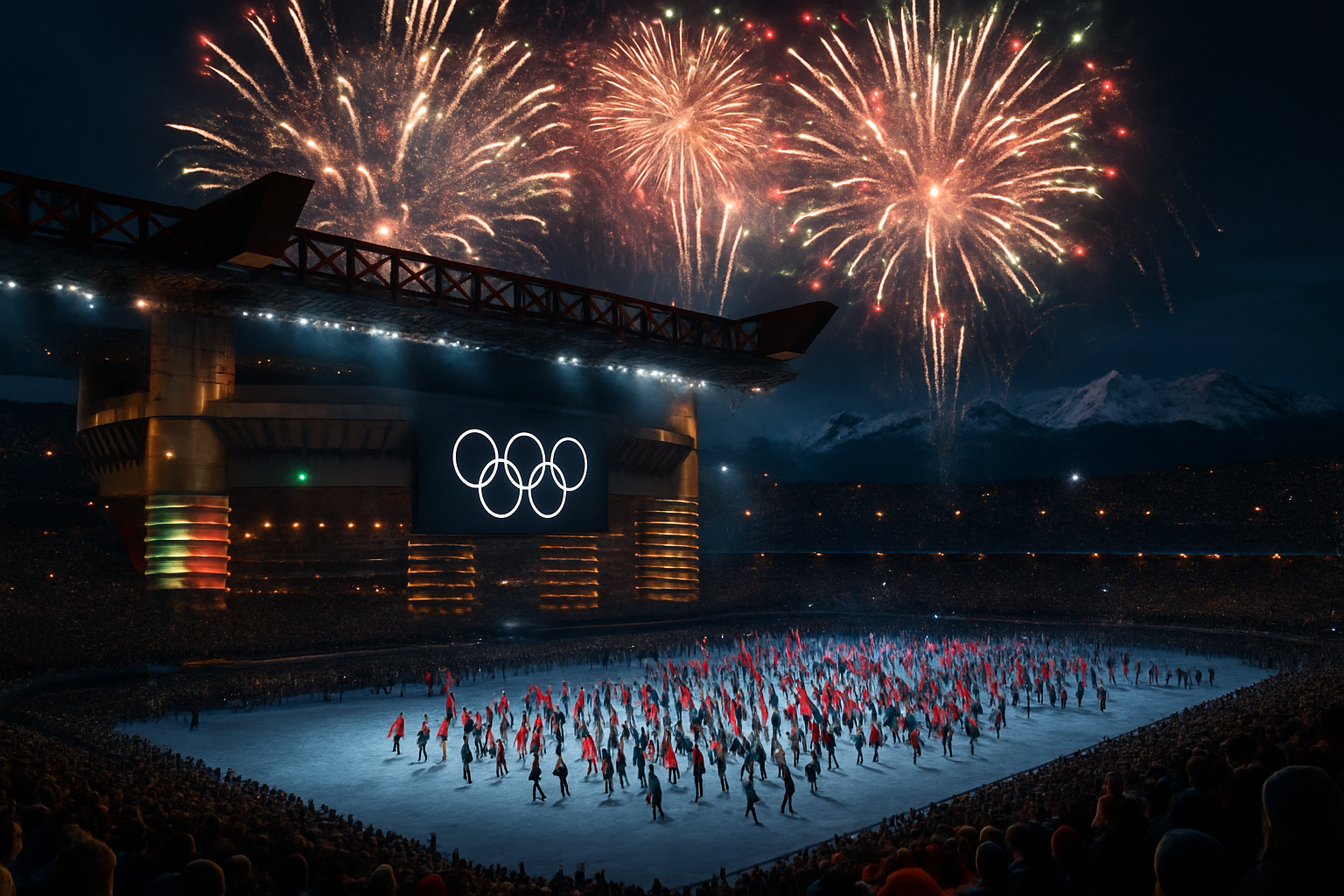
The Milano Cortina 2026 Winter Olympics officially opened Friday evening with a groundbreaking multi-site ceremony that redefined Olympic tradition, featuring star-studded performances by Mariah Carey and Andrea Bocelli while simultaneously lighting two Olympic cauldrons for the first time in Winter Games history.
The spectacular three-hour ceremony, broadcast at 8:45 p.m. local time under the theme "Harmony," took place simultaneously at four locations across northern Italy: Milan's iconic San Siro stadium, Cortina d'Ampezzo, Livigno, and Predazzo. This unprecedented format reflected the most geographically dispersed Winter Olympics ever staged, spanning over 400 kilometers from Milan to the Italian Alps.
Star-Studded Musical Performances
American pop diva Mariah Carey delivered a show-stopping performance of the 1950s Italian classic "Nel blu, dipinto di blu" ("Volare") to thunderous applause at San Siro stadium. The performance was part of a cultural celebration that also featured Italian tenor Andrea Bocelli, Chinese pianist Lang Lang, and Italian artists Laura Pausini and Ghali.
"This is a historic moment that bridges cultures through music and sport,"
— Mariah Carey, following her performance
The ceremony paid tribute to Italian cultural icons, including the late fashion designer Giorgio Armani, who had made Milan his creative base before his death in September 2025. The show featured tributes to Leonardo da Vinci, Dante, Puccini, Fellini, and other luminaries of Italian arts and culture.
Presidential Arrival and International Dignitaries
Italian President Sergio Mattarella made a memorable entrance via one of Milan's historic trams, driven by motorcycle racing legend Valentino Rossi—a moment that captured the fusion of tradition and innovation that defined the evening. The 84-year-old president was introduced to fans through a recorded video clip showcasing his journey through the city.
High-profile attendees included football icon Zlatan Ibrahimović, U.S. Vice President J.D. Vance, and Secretary of State Marco Rubio. However, their presence sparked some diplomatic tensions, with reports of anti-American demonstrations and criticism from Italian politicians over the presence of ICE agents in their delegation.
Historic Dual Cauldron Lighting
The ceremony's climax featured the lighting of two Olympic cauldrons—one in Milan and another in Cortina d'Ampezzo—marking the first time in Winter Olympics history that dual flames have been lit. Ballerina Nicoletta Manni lit the cauldron at Milan's Piazza Duomo, while legendary Italian skier Alberto Tomba performed the honors in Cortina.
The Olympic torch had completed an extraordinary 12,000-kilometer journey through more than 300 Italian municipalities before reaching its final destinations. Olympic shooting champion Abhinav Bindra, who participated in the torch relay, described it as "a symbol of unity, perseverance, and shared human aspiration."
Athletes Parade Across Four Venues
The traditional Parade of Nations took an innovative approach, with athletes marching simultaneously across all four venues rather than gathering in a single location. Austrian snowboard champion Benjamin Karl led Team Austria in Livigno, while other national delegations participated in parades at Predazzo and Cortina d'Ampezzo.
This dispersed format created an unintended consequence: zero competitors from the first five countries alphabetically appeared at Milan's San Siro stadium, as athletes chose to participate at the mountain venues where their competitions would take place.
Revolutionary Games Format
The 2026 Games represent a revolutionary approach to Olympic hosting, with competitions spread across seven venues spanning the breadth of northern Italy. Nearly 3,000 athletes from 92 countries will compete in 116 medal events across 16 sports through February 22, including the Olympic debut of ski mountaineering.
This dual-city hosting model emphasizes sustainability and the use of existing venues, potentially establishing a new paradigm for future Olympic Games focused on geographic distribution rather than centralized hosting.
Historic Participations
The Games feature several historic debuts, most notably Saudi Arabia's first-ever Winter Olympic participation with alpine skier Fayik Abdi and cross-country skier Rakan Aliriza. The Caribbean islands of Jamaica and Trinidad & Tobago will compete in four-man bobsleigh for the first time in Olympic history.
Latvia fielded its largest Winter Olympics delegation ever with 68 athletes, while 41-year-old American alpine skiing legend Lindsey Vonn attempts an unprecedented comeback despite rupturing her ACL just days before the Games in a crash at Crans-Montana, Switzerland.
Technology and Cultural Innovation
The ceremony showcased several technological firsts, including the deployment of Alibaba Cloud's Qwen AI—the first Olympic LLM (Large Language Model) integration for broadcasting and spectator services. This artificial intelligence system will enhance the viewing experience and provide real-time information throughout the Games.
Cultural innovations include bilingual place names in Alto Adige/South Tyrol to accommodate the region's German-speaking population, and the introduction of Milo and Tina, the stoat mascots dubbed the "first openly Gen Z" Olympic mascots.
"We are witnessing not just the opening of Olympic Games, but the birth of a new Olympic model that respects both tradition and innovation,"
— IOC President Kirsty Coventry
Challenges and Resilience
The Games opened amid Europe's harshest winter in decades, with temperatures dropping to -30°C creating ideal natural snow conditions but also significant logistical challenges. Infrastructure concerns persisted until the last moment, including incomplete cable car systems and frantic final construction work on ice hockey venues.
Competition had already begun February 5 with mixed doubles curling, despite power outages at the Cortina venue that disrupted early matches. Italy defeated South Korea 8-4, while Sweden beat the Czech Republic 7-4 in the traditional Games opener.
Security was heightened following pro-Russian cyberattacks on Olympic venues and Italian diplomatic facilities just hours before the ceremony. Italian Foreign Minister Antonio Tajani confirmed that countermeasures had successfully neutralized the threats.
Looking Ahead
The Milano Cortina 2026 Games mark the return of the Winter Olympics to the Alps after a 20-year absence and represent the most geographically dispersed Winter Games in Olympic history. Medal expectations are high for Norway, led by cross-country skiing star Johannes Høsflot Klæbo, while the Netherlands anticipates a "gold rush" in speed skating.
Italy's hopes rest partly on figure skater Daniel Grassl, who is preparing a tango performance that has been described as "entering like a cardinal, emerging as Pope"—capturing the theatrical drama that these Games promise to deliver.
The sustainable Olympic villages feature innovative greenhouse spaces and wood materials, accommodating 3,500 athletes in Milan while emphasizing environmental responsibility—a theme that runs throughout these Games focused on adaptation to 21st-century realities while maintaining the Olympic spirit of international cooperation.
As IOC President Kirsty Coventry acknowledged the "bumpy" preparations while promising "unforgettable" Games, the Milano Cortina 2026 Winter Olympics have already distinguished themselves as a bold experiment in Olympic hosting that could influence the future of international sporting events for decades to come.