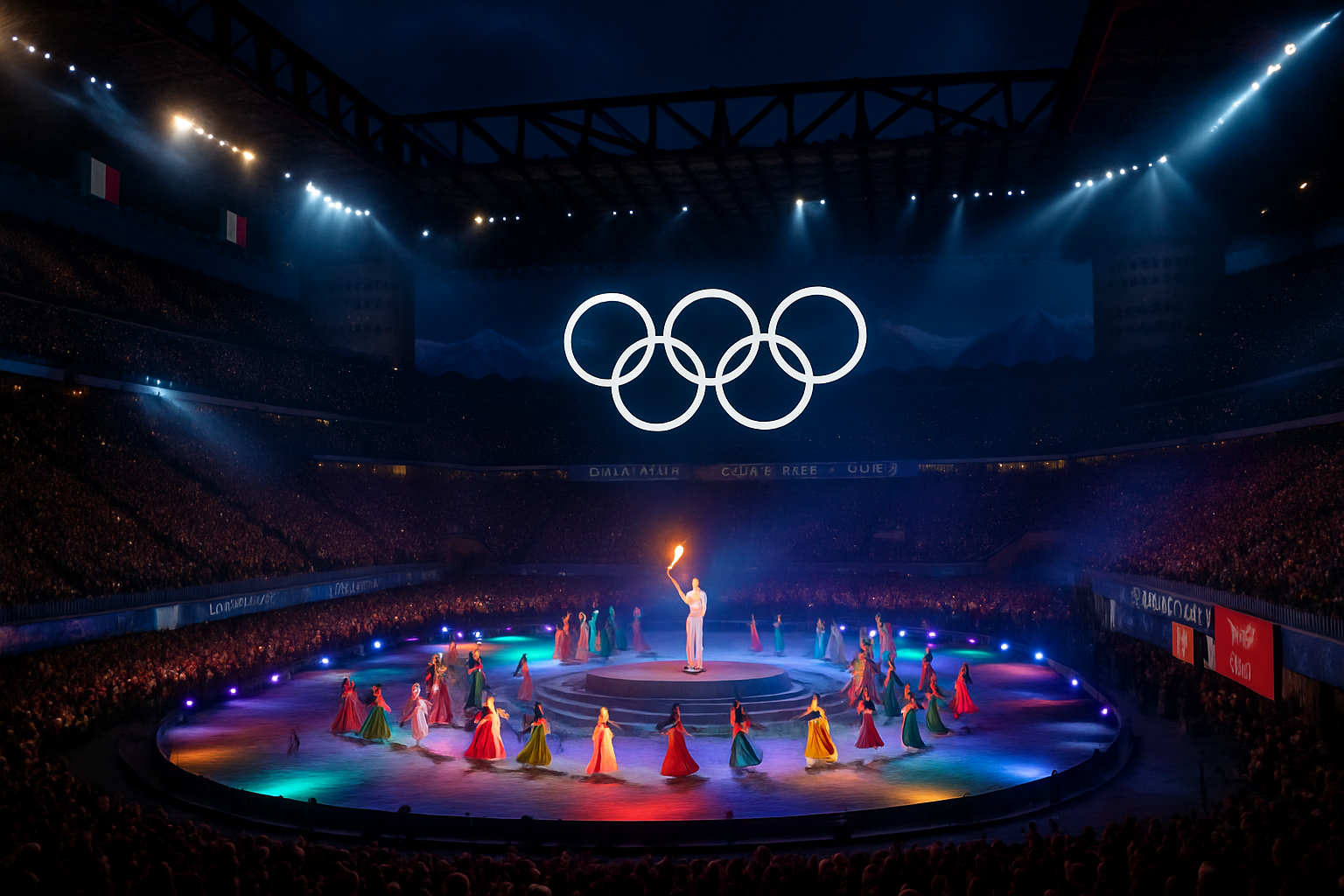
The 2026 Winter Olympics officially opened February 6 with an unprecedented multi-site ceremony spanning four locations across northern Italy, launching the most geographically dispersed Games in Olympic history amid rising political tensions and urgent calls for global peace.
Nearly 3,000 athletes from 92 countries gathered across Milan's iconic San Siro stadium and three other venues in what organizers dubbed a celebration of "Harmony" – a theme that resonated against the backdrop of international conflicts and domestic political friction that marked the opening festivities.
Historic Multi-Site Spectacle
The three-hour ceremony, broadcast live at 8:45 p.m. local time, shattered Olympic tradition by simultaneously hosting events at San Siro in Milan, Cortina d'Ampezzo, Livigno, and Predazzo. For the first time in Olympic history, dual cauldrons were lit – ballerina Nicoletta Manni ignited the flame at Milan's Piazza Duomo while skiing legend Alberto Tomba performed the honors in Cortina.
Pop superstar Mariah Carey opened the festivities with a rendition of "Volare," followed by performances from Andrea Bocelli, Chinese pianist Lang Lang, Laura Pausini, and rapper Ghali. The ceremony celebrated Italian heritage with tributes to Leonardo da Vinci, Dante, Puccini, Giorgio Armani, and Federico Fellini.
"For three hours, the woes of the world seemingly disappeared as spectators across the planet marvelled at Italian ingenuity and high fashion, and revelled in the Olympic spirit."
— Catherine Levesque, National Post
Italian President Sergio Mattarella made a memorable entrance, arriving via Milan's historic tram system driven by motorcycle racing legend Valentino Rossi – a moment that captured the Games' fusion of tradition and innovation.
Political Tensions Mar Opening
Despite the celebratory atmosphere, political undercurrents cast shadows over the proceedings. U.S. Vice President J.D. Vance faced audible boos from sections of the crowd, reflecting tensions over American immigration policies and the presence of ICE agents accompanying the delegation.
Hours before the ceremony, pro-Russian hackers launched coordinated cyberattacks against Olympic venues and Italian diplomatic facilities worldwide, targeting hotel websites in Cortina d'Ampezzo and Italian embassies in Washington, Sydney, Toronto, and Paris. Italian Foreign Minister Antonio Tajani confirmed that security services successfully countered the attacks.
Protesters had marched through Milan's streets just hours before the opening, demonstrating against what they saw as American overreach in Italian affairs. The diplomatic friction underscored broader geopolitical tensions as the Olympic movement sought to promote its traditional message of international unity.
Revolutionary Olympic Model
The Milano Cortina Games represent a revolutionary approach to Olympic hosting, spanning seven venues across more than 400 kilometers from Milan to Cortina d'Ampezzo. This dispersed model, driven by sustainability concerns and climate adaptation strategies, could influence future Olympic hosting decisions.
The Games feature 116 medal events across 16 sports, including the Olympic debut of ski mountaineering. Athletes parade across all four ceremony sites in an unprecedented logistical achievement, though notably, no athletes from the first five countries appeared at the main San Siro venue due to the complex scheduling requirements.
Historic Participations and Comebacks
The Games mark several historic firsts, including Saudi Arabia's Winter Olympic debut with Fayik Abdi competing in alpine skiing and Rakan Aliriza in cross-country. Jamaica and Trinidad & Tobago field their first Olympic bobsleigh teams, while Latvia sends its largest-ever Winter Olympic delegation with 68 athletes.
The most dramatic storyline involves American skiing legend Lindsey Vonn's attempted comeback at age 41. Despite suffering a complete ACL rupture just days before the Games during a crash in Crans-Montana, Vonn declared her intention to compete in the February 8 downhill – an unprecedented display of Olympic determination.
Technology and Cultural Innovation
The Games showcase several technological firsts, including Alibaba Cloud's Qwen AI system – the first large language model integrated into Olympic broadcasting and spectator services. OMEGA has also introduced AI-powered analysis for figure skating competitions.
Cultural innovations include bilingual place names in the Alto Adige/South Tyrol region to accommodate the area's German-speaking population, and the introduction of Milo and Tina, dubbed the "first Gen Z Olympic mascots" for their contemporary appeal.
The Olympic villages feature sustainable design with greenhouse spaces and wood materials, housing 3,500 athletes in Milan alone while emphasizing environmental responsibility throughout the facilities.
Competition Begins Amid Challenges
Competition officially began February 5 with curling, though power outages at the Cortina venue disrupted early matches. Italy defeated South Korea 8-4 in mixed doubles, while Sweden beat the Czech Republic 7-4, despite the technical difficulties that left scoreboards dark during play.
Infrastructure challenges have persisted throughout the final preparations, including incomplete cable car systems forcing school closures in Cortina and last-minute construction work on the main ice hockey venue. However, experienced ice makers Don Moffatt and Mark Messer assured NHL-quality playing surfaces despite the rushed timeline.
Security and Weather Factors
The Games are taking place during one of Europe's harshest winters in decades, with temperatures reaching -30°C across northern Italy. While creating logistical challenges, the extreme cold has produced ideal natural snow conditions, reducing environmental concerns about artificial snow production.
Security measures have been extensive across the dispersed venues, with thousands of officers, robots, drones, and a cyber command center deployed to protect the Games from various threats. The successful defense against the pre-ceremony cyberattacks demonstrated the effectiveness of the comprehensive security preparations.
Medal Expectations and Legacy
Norway enters as the favorites for the overall medal count, led by cross-country skiing star Johannes Høsflot Klæbo. The Netherlands anticipates a "gold rush" in speed skating, while Italy pins hopes on figure skater Daniel Grassl's tango-inspired performance in front of home crowds.
IOC President Kirsty Coventry acknowledged the "bumpy" preparations but promised "unforgettable" Games that would showcase the Alps' return to Olympic hosting after a 20-year absence. The success of the dual-city model could establish new paradigms for sustainable Olympic hosting in an era of climate change and economic constraints.
"This is a symbol of unity, perseverance, and shared human aspiration."
— Abhinav Bindra, Olympic Champion, participating in torch relay
As the Milano Cortina 2026 Games officially begin, they represent both Olympic tradition and innovation – celebrating athletic excellence while navigating the complex realities of 21st-century geopolitics, climate adaptation, and technological advancement. The success of this dispersed model could reshape how future Olympics balance sporting spectacle with environmental responsibility and political stability.
Competition continues through February 22, with the world watching to see whether the Olympic spirit of international cooperation can transcend the political tensions that marked these opening ceremonies. The Games' message of harmony faces its ultimate test not in the Italian Alps, but in a world where the "Olympic bubble" increasingly intersects with global conflicts and domestic political divisions.