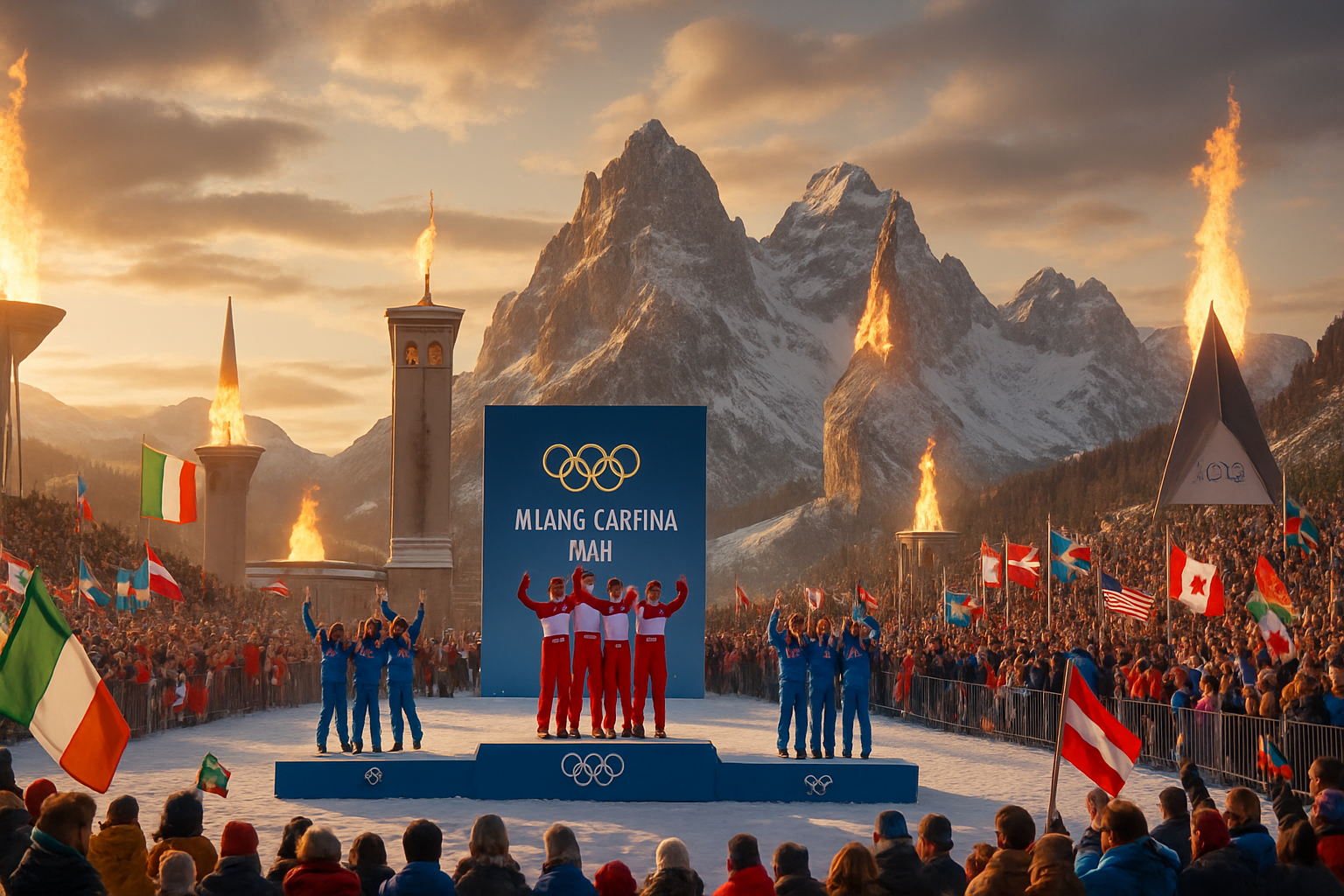
The Milano-Cortina 2026 Winter Olympics reached its spectacular conclusion on February 22, 2026, marking the end of the most geographically dispersed Winter Games in Olympic history with Norway achieving unprecedented medal records and final competitions in women's 50km cross-country skiing and four-man bobsledding across northern Italy's Alpine venues.
Norway's Historic Medal Domination
Norway completed a record-shattering Olympic campaign with an unprecedented 17 gold medals and 33 total medals, both new Winter Olympic records. The Nordic powerhouse's dominance was epitomized by Johannes Høsflot Klæbo, who became the first athlete ever to win six gold medals at a single Winter Olympics, surpassing Eric Heiden's 46-year-old record of five golds from Lake Placid 1980.
Klæbo's achievement in the men's 50km cross-country mass start on the final day was particularly remarkable, as he became the first athlete to win all six cross-country skiing events at one Olympics. His career total now stands at 11 Olympic golds, making him the most decorated Winter Olympian in history.
"This feels incredible, to be the first to win six golds at one Winter Olympics," Klæbo said after his historic victory. "But what makes me most proud is what we achieved as a Norwegian team."
— Johannes Høsflot Klæbo, Norwegian Cross-Country Skier
Final Day Competition Drama
The women's 50km cross-country skiing mass start provided one of the day's most dramatic storylines as Sweden's gold favorite Frida Karlsson, who had already won two golds at these Games, was forced to withdraw due to illness. Her teammate Jonna Sundling also missed the race with cold symptoms, leaving Sweden with only two competitors.
Norway's Astrid Øyre Slind, one of the pre-race favorites, suffered heartbreak when she was forced to withdraw after just 10 kilometers due to ski equipment problems. The unexpected turn of events opened the race for other contenders, with athletes from across the globe competing in this historic endurance event.
In bobsledding, the four-man competition concluded with thrilling final runs at the Cortina sliding center. Latvia's Jēkabs Kalenda piloted his crew through the concluding heats, while teams from Romania, Germany, and other nations battled for the final medals of Milano-Cortina 2026.
Australia's Winter Sports Revolution
One of the Games' most remarkable stories was Australia's emergence as a winter sports power. Sixteen-year-old Indra Brown reached the freeski halfpipe final, capping off what became Australia's most successful Winter Olympics ever. The nation's breakthrough included multiple gold medals in moguls and snowboarding, fundamentally challenging traditional winter sports hierarchies.
Australia's success, achieved with fewer total athletes than many traditional winter nations, demonstrated that geographic location no longer limits Olympic aspirations in the modern era of winter sports development.
Global Winter Sports Democratization
Milano-Cortina 2026 will be remembered as the Olympics that truly democratized winter sports on a global scale. Historic participations included Saudi Arabia's Winter Olympic debut with alpine skier Fayik Abdi and cross-country athlete Rakan Aliriza, the first Caribbean bobsleigh teams from Jamaica and Trinidad & Tobago, and Latvia's record 68-athlete delegation.
Kazakhstan achieved a stunning breakthrough with Mikhail Shaidorov winning men's figure skating gold in one of the biggest upsets in Olympic history. Brazil's Lucas Pinheiro Braathen claimed the nation's first Winter Olympic gold in alpine skiing, while Bulgaria ended a 20-year medal drought.
Revolutionary Hosting Model Success
The Games proved that Olympic excellence could be maintained while embracing environmental sustainability and geographic distribution. Spanning more than 400 kilometers across northern Italy, from Milan to Cortina d'Ampezzo, the dual-city hosting model successfully managed seven venues while maintaining the highest competitive standards.
First-ever Olympic AI integration through Alibaba's Qwen technology and OMEGA's analysis systems enhanced the spectator experience and competitive evaluation. Cultural innovations included bilingual place names in German-speaking Alto Adige/South Tyrol and the popular Gen Z mascots Milo and Tina.
"These Games have demonstrated that we can honor Olympic traditions while adapting to 21st-century realities of sustainability and global participation."
— IOC President Kirsty Coventry
Ice Hockey Gold Medal Final
The men's ice hockey final between the United States and Canada provided a thrilling climax to the tournament, with both nations seeking Olympic gold after a 16-year wait since they last met in an Olympic final. The rivalry, intensified by current geopolitical tensions, captivated audiences across North America and beyond.
Canada's path to the final was marked by drama, including captain Sidney Crosby's injury concerns and emotional overtime victories. The final represented one of the Games' most anticipated matchups, showcasing the return of NHL players to Olympic competition.
Closing Ceremony at Arena di Verona
The Games concluded with a spectacular closing ceremony at the 2,000-year-old Arena di Verona, titled "Beauty in Action." The historic Roman amphitheater provided a stunning backdrop as Italy bid farewell to the Olympic flame with performances by Roberto Bolle, Achille Lauro, Benedetta Porcaroli, and DJ Gabry Ponte.
Italian Prime Minister Giorgia Meloni attended the ceremony, which celebrated both Olympic achievements and Italian cultural heritage. The ceremony marked the extinguishing of the revolutionary dual Olympic flames that had burned simultaneously in Milan and Cortina throughout the Games.
Netherlands Speed Skating Dominance
The Netherlands concluded their expected "gold rush" in speed skating with Marijke Groenewoud and Jorrit Bergsma winning the mass start events. Dutch athletes Xandra Velzeboer and Bergsma were chosen as flag bearers for the closing ceremony, representing their nation's exceptional performance on the Milan ice oval.
The Netherlands' speed skating success contributed to their final medal tally of 20 medals, reinforcing their status as the world's premier speed skating nation.
Legacy and Future Impact
Milano-Cortina 2026 established new paradigms for Olympic hosting that will influence future Games. The successful combination of environmental sustainability, technological innovation, cultural authenticity, and athletic excellence created a template for climate-adapted, geographically distributed Olympic hosting.
The Games proved that winter sports excellence transcends traditional geographic boundaries, with breakthrough performances from six continents challenging established powerhouses. The democratization of winter sports, combined with the revolutionary hosting model, represents a watershed moment for the Olympic movement.
As the Olympic flame was extinguished in Verona's ancient stones, Milano-Cortina 2026 concluded as more than just a sporting spectacle—it became a blueprint for how mega-events can adapt to contemporary global realities while preserving the Olympic spirit of international cooperation and athletic excellence.
The next Winter Olympics will take place in 2030, with the precedent set by Milano-Cortina's innovative approach likely to influence how future hosts approach the challenge of staging sustainable, globally accessible Winter Games.