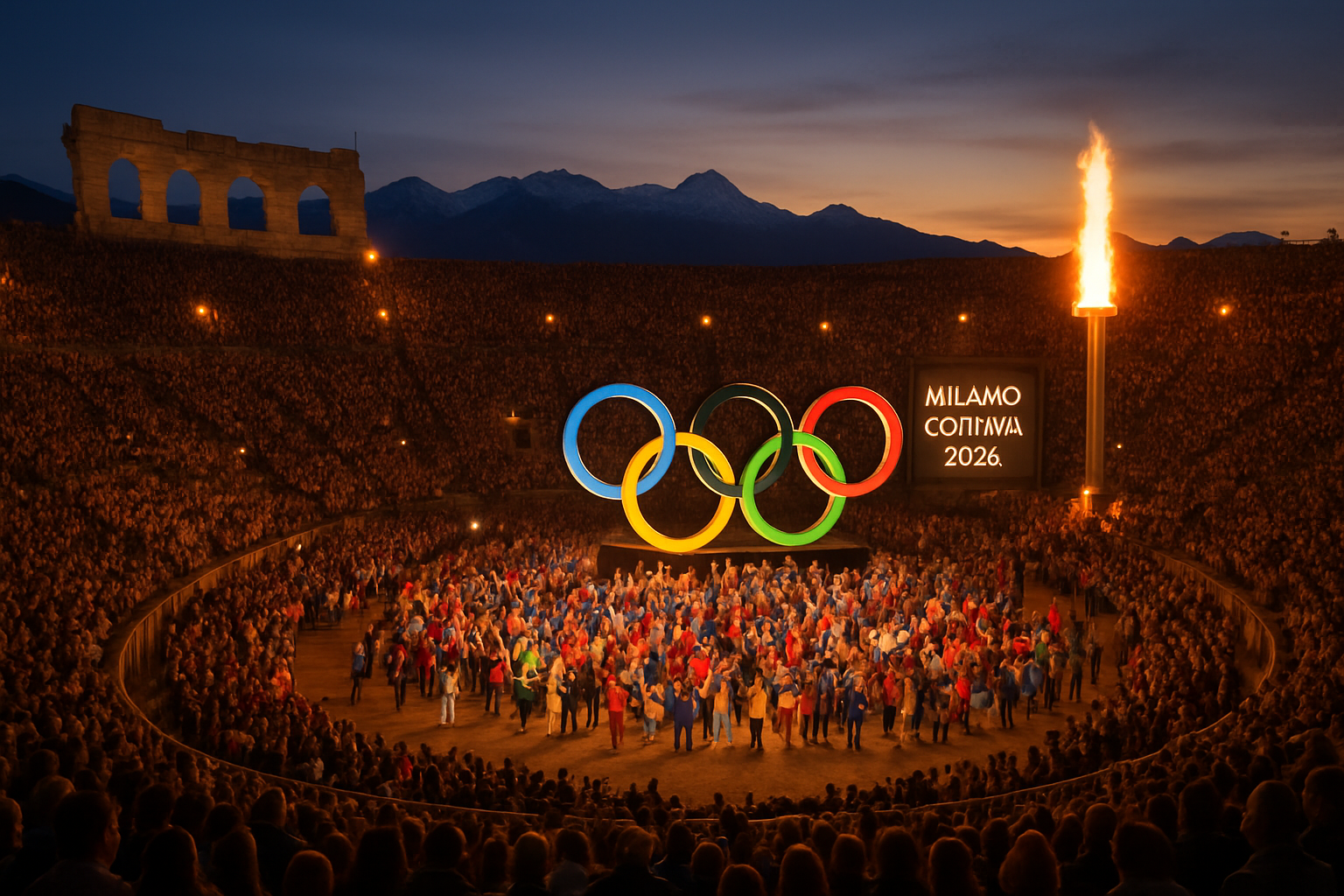
The 2026 Winter Olympics in Milano-Cortina d'Ampezzo concluded Sunday with a spectacular closing ceremony at the ancient Arena di Verona, capping off what many are calling the most revolutionary Winter Olympics in history and setting new benchmarks for global winter sports participation.
The historic ceremony, titled "Beauty in Action," took place at the 2,000-year-old Roman amphitheater, marking the first time a Winter Olympic closing ceremony has been held outside the host cities. Prime Minister Giorgia Meloni attended alongside IOC President Kirsty Coventry, who praised Italy's exceptional hosting of the Games that spanned over 400 kilometers across northern Italy.
Record-Breaking Medal Achievements
Norway dominated the final medal standings with an unprecedented 18 gold medals and 41 total medals, both Winter Olympic records. The Nordic nation's success was epitomized by Johannes Høsflot Klæbo, who won six golds at these Games alone, becoming the most decorated Winter Olympian in history with 11 career gold medals.
Italy delivered their strongest Winter Olympic performance on home soil, securing 9 gold medals and 26 total medals. The host nation's success was highlighted by Lisa Vittozzi's historic individual women's biathlon gold - Italy's first-ever in that discipline - achieved with perfect shooting in the 10km pursuit.
"This has been an unforgettable experience for Italian sport and for all winter sports globally,"
— Prime Minister Giorgia Meloni
France achieved their best Winter Olympic performance in decades with 23 medals, including a record-breaking 19 podium finishes that positioned them fourth in the overall standings. The United States rounded out the top nations with 24 total medals, maintaining their position as a winter sports powerhouse.
Global Winter Sports Democratization
The Milano-Cortina Games will be remembered as a watershed moment for winter sports democratization, with breakthrough performances from six continents challenging traditional powerhouse dominance. Australia achieved their most successful Winter Olympics ever with multiple gold medals in moguls and snowboard cross, while Brazil's Lucas Pinheiro Braathen captured their first-ever Winter Olympic gold in giant slalom.
Kazakhstan's Mikhail Shaidorov delivered one of the Games' biggest upsets by winning men's figure skating gold - the nation's first Olympic figure skating medal. Meanwhile, historic debuts from Saudi Arabia, with Fayik Abdi in alpine skiing and Rakan Aliriza in cross-country skiing, and Caribbean bobsled teams from Jamaica and Trinidad & Tobago demonstrated winter sports' expanding global reach.

Revolutionary Hosting Model Success
The Milano-Cortina 2026 Games proved that the most geographically dispersed Olympics in history - spanning seven venues across 400+ kilometers - could maintain competitive excellence while establishing new standards for environmental sustainability. The revolutionary dual-city hosting model combined existing venue utilization with cutting-edge technology integration.
The Games featured the first Olympic deployment of artificial intelligence technology, with Alibaba's Qwen AI system providing enhanced broadcasting and spectator services, while OMEGA's AI-powered figure skating analysis offered unprecedented insights into athletic performance.
Cultural and Environmental Innovation
Cultural authenticity was maintained through innovative approaches including bilingual place names in Alto Adige/South Tyrol for the German-speaking population, sustainable Olympic villages featuring greenhouse spaces, and the introduction of Milo and Tina, dubbed the first "Gen Z" Olympic mascots.
Europe's harshest winter in decades, with temperatures dropping to -30°C, provided ideal natural snow conditions that reduced reliance on artificial snow production, addressing long-standing environmental concerns about winter sports venues.
Overcoming Unprecedented Challenges
The Games successfully navigated numerous operational challenges that tested the new hosting model. Infrastructure issues including incomplete cable car systems in Cortina that forced school closures, power outages affecting competition venues, and the manufacturing crisis where Olympic medals literally broke apart during celebrations were all managed without compromising competitive integrity.
Security challenges including pro-Russian cyberattacks on Olympic venues and Italian embassies were successfully countered by Italian security services led by Antonio Tajani. Civil unrest in Milan with over 10,000 protesters and coordinated railway sabotage near Bologna during the Games tested Italy's crisis management capabilities.
"Despite bumpy preparations, these have truly been unforgettable Games that will influence Olympic hosting for generations to come,"
— IOC President Kirsty Coventry
Individual Triumph and Tragedy
The Games were marked by both inspiring comebacks and heartbreaking setbacks. American skiing legend Lindsey Vonn's courageous but ultimately tragic comeback attempt ended in a devastating crash just nine days after suffering a complete ACL rupture, symbolizing the fine line between Olympic glory and athletic sacrifice.
In contrast, Switzerland's Franjo von Allmen became the first Swiss athlete to win three gold medals at a single Winter Olympics, capturing victories in downhill, team combination, and Super-G to establish himself as the Games' breakout alpine star.
The figure skating competition provided one of the most shocking upsets when overwhelming favorite Ilia Malinin of the United States, undefeated since 2023, suffered a complete collapse to finish eighth while Kazakhstan's Shaidorov claimed an historic gold.
Technological and Broadcasting Innovation
Milano-Cortina 2026 pioneered new broadcasting approaches with streaming platforms like Claro Sports providing comprehensive Olympic coverage across Latin America via YouTube, potentially influencing future Olympic media rights distribution globally.
The successful integration of AI technology throughout the Games, from real-time translation services to enhanced performance analysis, demonstrated how technological innovation can enhance rather than replace traditional Olympic values.
Looking Toward 2030
During the closing ceremony, the Olympic flag was officially handed over to France for the 2030 French Alps Games. The dual Olympic flames in Milan and Cortina were extinguished simultaneously, symbolically ending the most revolutionary Winter Olympics that successfully combined tradition with 21st-century innovation.
The Milano-Cortina model has established a new template for sustainable Olympic hosting that addresses climate change realities while maintaining competitive excellence. The Games proved that geographic distribution, environmental responsibility, and cultural authenticity can coexist with the highest levels of athletic achievement.
Legacy and Future Impact
The 2026 Winter Olympics Milano-Cortina will be remembered as a paradigm shift in Olympic hosting philosophy. By successfully managing competition across seven venues spanning the distance from Milan to the Dolomites, these Games demonstrated that sustainable, distributed hosting is not only viable but potentially superior to traditional centralized models.
The unprecedented global participation, with breakthrough nations from six continents achieving medals and personal bests, signals a fundamental democratization of winter sports that extends far beyond traditional Northern Hemisphere powerhouses.
Most significantly, the Games proved that international cooperation and Olympic ideals can transcend geopolitical tensions, infrastructure challenges, and environmental concerns when anchored by athletic excellence and cultural celebration.
As the world now looks ahead to the 2030 French Alps Games, Milano-Cortina 2026 has established new benchmarks for what future Olympics can achieve when innovation meets tradition, sustainability meets spectacle, and global participation meets competitive excellence.