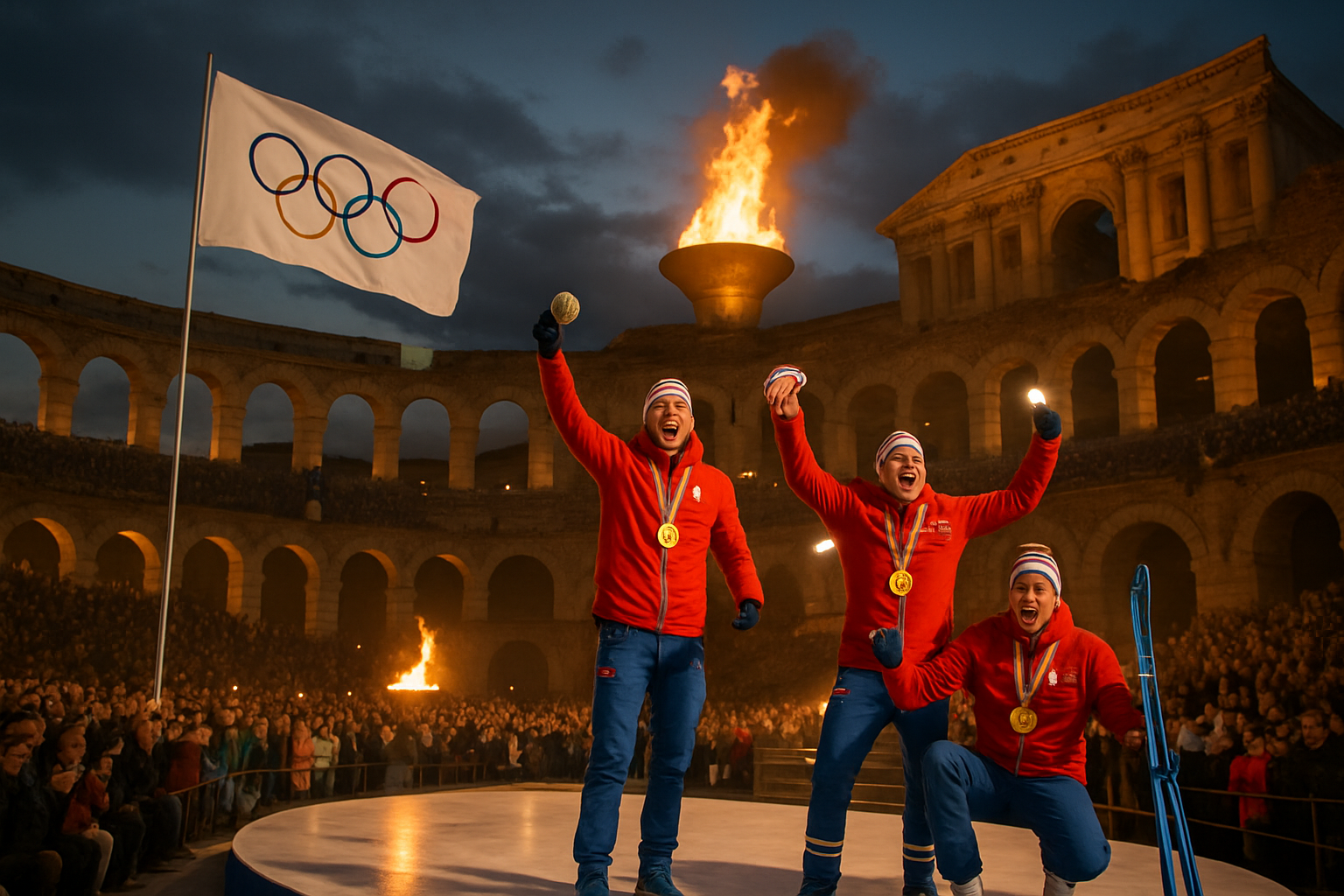
The Milano Cortina 2026 Winter Olympics concluded Sunday evening with a spectacular closing ceremony at the ancient Arena di Verona, as Norway achieved unprecedented records and France officially received the Olympic flag for the 2030 Winter Games in the French Alps.
The historic ceremony, held in the 2,000-year-old Roman amphitheater in the heart of Verona—the city immortalized in Shakespeare's "Romeo and Juliet"—marked the end of the most geographically dispersed Winter Olympics in history, spanning over 400 kilometers across northern Italy.
Norway's Record-Breaking Dominance
Norway rewrote Olympic history at Milano Cortina 2026, achieving an unprecedented 18 gold medals and 41 total medals, both new Winter Olympic records. The Nordic nation's dominance was epitomized by cross-country skiing legend Johannes Høsflot Klæbo, who became the first athlete in Winter Olympic history to win six gold medals at a single Games.
Klæbo's final triumph came in the men's 50km cross-country mass start, where he led an all-Norwegian podium sweep alongside Martin Löwström Nyenget and Emil Iversen. This victory brought his career total to 11 Olympic gold medals, making him the most decorated Winter Olympian of all time, surpassing the previous record of eight golds.
"This is beyond my wildest dreams. To win all six cross-country events at one Olympics and break Eric Heiden's 46-year record—it's something I never thought possible."
— Johannes Høsflot Klæbo, Norway
The 29-year-old's achievement broke Eric Heiden's long-standing record of five gold medals at a single Winter Olympics, set at the 1980 Lake Placid Games. Norway's systematic excellence across Nordic disciplines—cross-country skiing, biathlon, and ski jumping—formed the backbone of their historic medal haul.
Italy's Triumphant Host Performance
Host nation Italy delivered a remarkable performance on home soil, securing nine gold medals and 26 total medals. The Italian team's success included historic breakthroughs such as Lisa Vittozzi's perfect biathlon pursuit gold—Italy's first-ever individual women's biathlon Olympic title.
The emotional highlight came when 35-year-old Federica Brignone became the oldest alpine skiing Olympic champion in history, winning Super-G gold at Cortina just 10 months after a complete leg fracture. The victory, achieved in front of President Sergio Mattarella, symbolized the resilience that defined these Games.
Italy's success extended across multiple disciplines, from alpine skiing to luge, with the dual podium sweep by Giovanni Franzoni and Dominik Paris in the men's downhill setting the tone for the home nation's exceptional campaign.
Global Winter Sports Revolution
The Milano Cortina 2026 Games will be remembered as a watershed moment for the democratization of winter sports. For the first time in Olympic history, nations from all six inhabited continents achieved breakthrough performances, fundamentally challenging traditional winter sports hierarchies.
Australia emerged as a winter sports powerhouse, winning multiple gold medals through Jakara Anthony (dual moguls), Cooper Woods (men's moguls), and Josie Baff (snowboard cross). The nation's systematic approach to freestyle skiing established them as a force to be reckoned with in future Winter Games.
Brazil celebrated its first-ever Winter Olympic gold medal when Lucas Pinheiro Braathen triumphed in the men's giant slalom at Stelvio, while Kazakhstan's Mikhail Shaidorov delivered one of the Games' biggest upsets in men's figure skating. These victories represented more than individual achievements—they signaled the global expansion of winter sports excellence.
Revolutionary Hosting Model
The Milano Cortina 2026 Games established a revolutionary new paradigm for Olympic hosting, proving that geographically distributed events could maintain the highest competitive standards while prioritizing environmental sustainability.
Spanning seven venues across more than 400 kilometers, from Milan to Cortina d'Ampezzo, the dual-city model successfully balanced existing venue utilization with Olympic excellence. The Games incorporated groundbreaking technological innovations, including the first-ever Olympic deployment of Alibaba's Qwen AI language model and OMEGA's AI-powered figure skating analysis.
Cultural authenticity was maintained through bilingual place names recognizing the German-speaking Alto Adige/South Tyrol population, sustainable Olympic villages featuring greenhouse spaces, and the popular Gen Z mascots Milo and Tina.
Spectacular Closing Ceremony
The closing ceremony, titled "Beauty in Action," transformed the UNESCO World Heritage Arena di Verona into a spectacular stage for Olympic farewell. Some 1,500 athletes from 92 nations filled the ancient amphitheater as Italian performers including ballet star Roberto Bolle, opera singer Achille Lauro, and actress Benedetta Porcaroli celebrated Italian artistry.
Prime Minister Giorgia Meloni attended the ceremony, which paid tribute to Italian dance and music while marking the official handover to France. The dual Olympic flames that had burned throughout the Games in Milan and Cortina were extinguished simultaneously, symbolically ending the most revolutionary Winter Olympics in history.
France Prepares for 2030 French Alps Games
In a ceremonial moment watched by millions worldwide, the Olympic flag was officially transferred to France, which will host the 2030 Winter Games in the French Alps. Regional presidents from Auvergne-Rhône-Alpes and Provence-Alpes-Côte d'Azur received the emblem, marking the beginning of the four-year countdown to the next Winter Olympics.
The French delegation's acceptance of the flag came as France concluded their own remarkable Milano Cortina campaign with a record-breaking 19 medals, including an unprecedented 10 biathlon medals that established them as the sport's new dominant force.
Japan's Winter Sports Emergence
Japan's 24-medal haul ranked them fifth in the world rankings, with their eight gold medals matching the country's all-time high set at the 1998 Nagano Games. The Japanese team's success spanned multiple disciplines, from figure skating to snowboarding, signaling their emergence as a comprehensive winter sports nation.
Japanese athletes consistently performed at the highest level, with breakthrough performances in freestyle skiing, speed skating, and the traditional strength in figure skating continuing to evolve under the guidance of world-class coaching programs.
Overcoming Challenges
The Games successfully navigated numerous challenges that tested the Olympic spirit. Infrastructure issues, including the incomplete Apollonio-Socrepes cable car system, were managed without disrupting competition. Europe's harshest winter in decades, with temperatures reaching -30°C, created ideal natural snow conditions while requiring extraordinary logistical coordination.
Security concerns, including pro-Russian cyberattacks on Olympic venues and Italian diplomatic facilities, were effectively countered by Italian authorities led by Foreign Minister Antonio Tajani. The Games proceeded without major security incidents, demonstrating the resilience of Olympic organization in challenging times.
Medal Standings and Legacy
The final medal standings reflected the most competitive Winter Olympics ever staged:
- Norway: 18 gold, 16 silver, 7 bronze (41 total)
- Germany: 12 gold, 8 silver, 10 bronze (30 total)
- United States: 8 gold, 12 silver, 9 bronze (29 total)
- Italy: 9 gold, 7 silver, 10 bronze (26 total)
- France: 6 gold, 8 silver, 5 bronze (19 total)
Beyond the medal count, Milano Cortina 2026 established a template for future Olympic hosting that combines environmental responsibility with athletic excellence. The successful dual-city model, technological innovation, and unprecedented global participation created new possibilities for sustainable mega-event organization.
Looking Toward 2030
As the Olympic flame was extinguished and athletes began their journeys home, the Milano Cortina 2026 Winter Olympics left an indelible mark on Olympic history. The Games proved that winter sports excellence knows no geographic boundaries and that sustainable hosting can enhance rather than diminish the Olympic experience.
The successful handover to France for the 2030 French Alps Games ensures continuity in Olympic innovation, with the French organizers already committed to building upon the sustainable and inclusive model established in Italy.
The legacy of Milano Cortina 2026 extends far beyond the 116 medal events and 16 sports contested across 17 days of competition. These Games fundamentally redefined what it means to host a Winter Olympics in the 21st century, creating a blueprint for climate-adapted, geographically distributed, and culturally authentic Olympic celebration that maintains the highest standards of athletic competition while embracing environmental responsibility and global inclusivity.