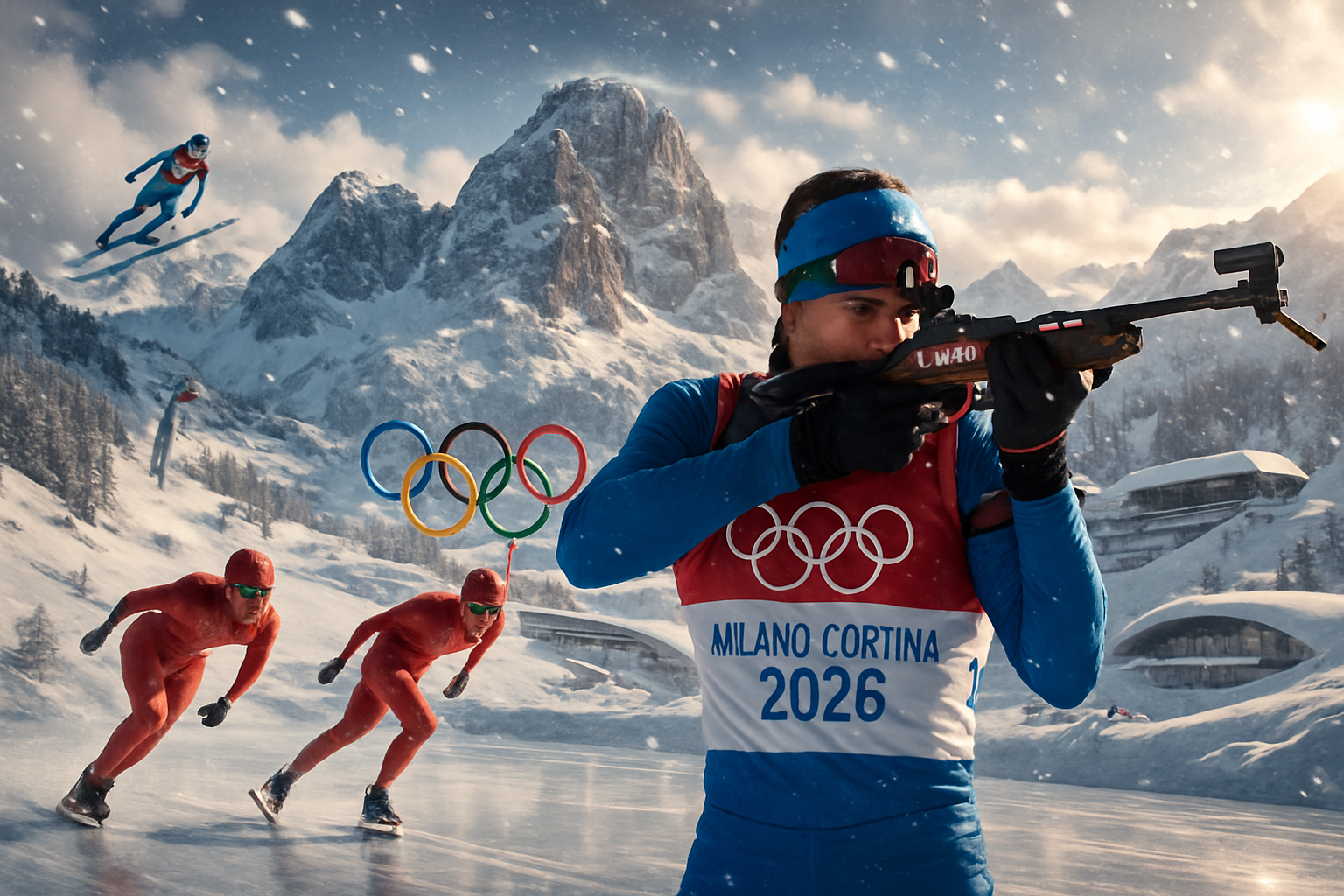
The Milano-Cortina 2026 Winter Olympics reached new heights of drama and achievement on February 15, as Italy's Lisa Vittozzi claimed historic biathlon gold with perfect shooting, while Norway's Johannes Høsflot Klæbo etched his name in Olympic immortality with a record-breaking ninth career gold medal.
In a day that exemplified both national pride and global excellence, the most geographically dispersed Winter Olympics in history continued to deliver extraordinary performances across its revolutionary dual-city hosting model spanning 400+ kilometers of northern Italy.
Vittozzi's Perfect Pursuit
Italy's Lisa Vittozzi produced the performance of her career in the women's 10km biathlon pursuit, hitting all 20 targets with flawless shooting to secure Italy's first-ever individual women's biathlon Olympic gold medal. The 29-year-old finished 28.8 seconds ahead of Norway's Maren Kirkeeide and 34.4 seconds ahead of Finland's Suvi Minkkinen in a commanding display at the Südtirol Arena.
"This is what dreams are made of - competing at home and achieving perfection when it matters most,"
— Lisa Vittozzi, Olympic Champion
The victory marked Italy's 21st medal of the Milano-Cortina Games, further cementing the host nation's remarkable performance on home soil. Vittozzi's triumph came after years of near-misses on the biggest stage, finally delivering when her country needed it most.
Klæbo's Historic Ninth Gold
Norway's cross-country skiing legend Johannes Høsflot Klæbo made Winter Olympic history as part of the men's 4x7.5km relay team, securing his ninth career Olympic gold medal to become the most decorated Winter Olympian of all time. The achievement surpassed the previous record of eight golds held by legends Bjørn Dæhlie, Ole Einar Bjørndalen, and Marit Bjørgen.
The 27-year-old's record-breaking moment came amid emotional scenes as teammate Emil Iversen broke down in tears during the victory ceremony, praising Klæbo's immense contribution to Norwegian cross-country dominance. The relay victory showcased Norway's systematic approach to Nordic sports development, maintaining their traditional powerhouse status even as global competition intensifies.
Global Breakthrough Performances
The day's competition demonstrated the remarkable democratization of winter sports occurring at Milano-Cortina 2026. Slovenia's Nika Prevc claimed her third medal of the Games with bronze in women's large hill ski jumping, completing a remarkable sweep of gold, silver, and bronze across different events in her first Olympic appearance.
The 20-year-old Slovenian's achievement highlighted the depth of talent emerging from non-traditional winter sports powerhouses. Norway's Anna Odine Strøm defended her Olympic title with gold in the large hill competition, while fellow Norwegian Eirin Maria Kvandal claimed silver.
Canadian Breakthrough
Canada finally broke their medal drought at Milano-Cortina 2026 as Mikaël Kingsbury captured gold in men's dual moguls at Livigno Snow Park. The 31-year-old veteran defeated Japan's Ikuma Horishima (silver) and Australia's Matt Graham (bronze) to give Canada their first gold medal of the Games.
Kingsbury's victory came at a crucial moment for Canadian winter sports, ending speculation about the nation's struggles at these Olympics while demonstrating that experience and technical mastery remain decisive factors in moguls competition.
Speed Skating Excellence
The Netherlands continued their speed skating dominance as Femke Kok set an Olympic record in the women's 500m with a time of 36.69 seconds, defeating compatriot Jutta Leerdam for gold. The Dutch performance reinforced their nation's systematic approach to speed skating excellence, maintaining their "gold rush" expectations despite increased global competition.
Sweden's Martin Ponsiluoma won the men's biathlon pursuit, ending his country's medal drought in the discipline and vindicating his career choices after facing criticism earlier in his development.
Revolutionary Hosting Success
The day's events unfolded across the revolutionary dual-city hosting model that has defined Milano-Cortina 2026. From biathlon venues in the Dolomites to speed skating arenas in Milan, the 400+ kilometer span of competition has proven that geographically dispersed Olympics can maintain the highest competitive standards while emphasizing sustainability and existing venue utilization.
Technology integration continued to enhance the Olympic experience, with Alibaba's Qwen AI system and OMEGA's AI-powered analysis providing unprecedented insights for broadcasters and spectators. The cultural innovations, including bilingual place names in Alto Adige/South Tyrol and the popular Gen Z mascots Milo and Tina, have resonated globally.
Medal Race Intensifies
Norway maintains its overall lead in the medal standings, but faces unprecedented challenges from nations across six continents. Italy's strong home performance, Germany's technical excellence, and breakthrough achievements from countries like Australia, Kazakhstan, and Brazil have created the most competitive Winter Olympics in history.
The global expansion of winter sports has become one of the defining narratives of Milano-Cortina 2026, with athletes from the Middle East, Caribbean, and other non-traditional regions making their mark on Olympic competition.
Environmental and Cultural Legacy
The Games continue to demonstrate that Olympic excellence and environmental responsibility can coexist. Europe's harshest winter in decades has provided ideal natural snow conditions across venues, reducing artificial snow concerns while creating spectacular backdrops for competition.
The sustainable hosting model, featuring Olympic villages with greenhouse spaces and emphasis on existing venue utilization, represents a potential template for future Olympic hosting. The successful balance of athletic achievement, cultural authenticity, and environmental consciousness has established new paradigms for the Olympic movement.
"These Games prove that Olympic excellence transcends boundaries - geographic, cultural, and environmental. We're witnessing winter sports truly become global,"
— IOC President Kirsty Coventry
Looking Ahead
As Milano-Cortina 2026 approaches its final stages, the Games have already secured their place as a watershed moment for winter sports and Olympic hosting. The combination of historic individual achievements like Klæbo's record and Vittozzi's perfect performance, alongside the successful implementation of revolutionary hosting concepts, demonstrates the Olympic movement's ability to adapt to 21st-century realities while maintaining its core values.
Competition continues through February 22, with 3,000 athletes from 92 countries still pursuing Olympic dreams across the spectacular Italian Dolomites and beyond. The Milano-Cortina model of geographic distribution, environmental sustainability, and cultural celebration while maintaining competitive excellence has created a new blueprint for future Olympic hosting.
With breakthrough performances continuing to emerge from all corners of the globe, these Games represent not just athletic achievement, but the democratization of winter sports and the evolution of the Olympic ideal for a new generation.